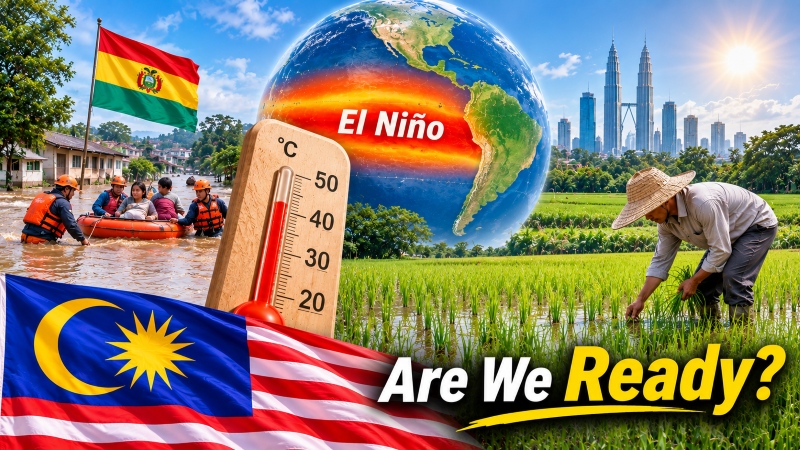
Bolivia declared a nationwide state of emergency on 31 October in response to the hazardous effects of the El Niño weather phenomenon.
President Rodrigo Paz signed a decree stressing the urgency of the measures needed to face the threat.
The decree directs agencies to send additional rescue teams to regions struggling with both floods and drought. With flash floods already happening, the country is also bracing for landslides, mudslides and other environmental damage.
Paz said El Niño would have “very severe impacts in terms of drought and floods”. He said the country needed “the cooperation of all institutions”.
According to a government report, the drought is affecting 78,000 families in six of Bolivia’s nine departments. It has also led to the loss of more than 75,000 cattle.
- Sign up for Aliran's free daily email updates or weekly newsletters or both
- Make a one-off donation to Persatuan Aliran Kesedaran Negara (ALIRAN), Maybank a/c 507246118995 or CIMB a/c 8004240948
- Make a pledge or schedule an auto donation to Aliran every month or every quarter
- Become an Aliran member
Bolivia is prone to flooding. In December 2025, floods in the Santa Cruz region killed 20 people, with at least two dozen others reported missing.
Elsewhere in the region, Santiago, the Chilean capital, recorded its rainiest October, while wildfires in Peru killed at least 12 people last month.
Droughts and floods in Bolivia
Bolivia faces a huge challenge because it is vulnerable to both droughts and floods. This is mainly due to its complex geography.
A landlocked country in central South America, Bolivia borders Brazil, Paraguay, Argentina, Chile and Peru. Much of the country lies at high altitude in the Andes, while the eastern lowlands experience significant climate impacts.
El Niño can bring prolonged droughts to some regions and heavy rain and flooding to others. Its impact is wide-ranging, affecting electricity generation and water supply, and threatening the livelihoods of some communities.
In Bolivia, less rain and lower river flows could reduce hydroelectric power generation, forcing greater reliance on gas-fired power stations and raising generation costs. This might also affect the country’s small data-centre sector through higher electricity costs and possible supply constraints.
Uncertain electricity supply could deter investment, with knock-on effects for the wider economy.
Despite its limited resources, Bolivia is taking the measures it can. It urgently needs funding, and communities badly need water supplies and irrigation.
Hopefully, Bolivia will overcome these challenges with resilience.
What the UN is warning
El Niño is a natural climate pattern. It warms the sea surface in the central and eastern Pacific along the Equator, shifting winds, air pressure and rainfall across the globe. An El Niño usually returns every two to seven years and lasts nine to 12 months. Not every region feels its effects.
The World Meteorological Organization expects both droughts and heavy rain. It says there is a near-100% likelihood that this El Niño will last until February 2027, and warns it could become very strong.
The UN agency is urging countries and humanitarian organisations worldwide to prepare for extreme weather events, including heatwaves, droughts and heavy rain.
The WMO is also stepping up climate information services and early-warning systems to help countries draw up contingency plans for farmers and vulnerable communities.
How Malaysia can prepare
Malaysia should prepare for El Niño before it hits us hard. Several measures could help.
Ensure food security. Malaysia imported about RM94bn of food in 2024, and the bill has risen sharply in recent years. We must aim to be self-sufficient in food.
Our rice, vegetable and other farmers must receive incentives and encouragement to increase efficiency and productivity.
We should also encourage greater livestock production.
Oil palms need extra attention because El Niño can hurt fruit development and yields.
Food prices should not rise because of El Niño. This would hit everyone in Malaysia, particularly the less fortunate.
Energy security must receive due attention. Sufficient power generation must be a top priority, with back-up supplies for critical areas.
Workplaces in the public and private sectors, schools and universities should adopt alternative energy and save energy. The government should keep encouraging solar power as an alternative to fossil fuels.
Water supply to all parts of the country must be assured and constantly monitored. Officials should closely watch dams and water catchment areas to make sure people have enough water.
Public and private health facilities must be ready for a surge in demand caused by El Niño. Demand for health services is bound to rise.
We recently experienced the harmful effects of haze. El Niño can raise the risk of forest and peatland fires, which can harm people’s health. Our authorities must be prepared for this.
The print and electronic media in Malaysia must keep people updated on the challenges posed by El Niño.
The Northeast Monsoon, which began on 27 October, is expected to continue until March 2027.
While its early phase is expected to bring heavy rain and flooding, the final phase from January to March could bring hotter and drier conditions, increasing the risk of heatwaves and drought. MetMalaysia has forecast that temperatures could exceed 41C next year, although this could be revised.
The relevant government agencies should start working together immediately to tackle the challenges El Niño brings.
A special cabinet committee drawn from the relevant ministries and agencies must be formed immediately to deal with the problems El Niño may bring.
AGENDA RAKYAT - Lima perkara utama
- Tegakkan maruah serta kualiti kehidupan rakyat
- Galakkan pembangunan saksama, lestari serta tangani krisis alam sekitar
- Raikan kerencaman dan keterangkuman
- Selamatkan demokrasi dan angkatkan keluhuran undang-undang
- Lawan rasuah dan kronisme