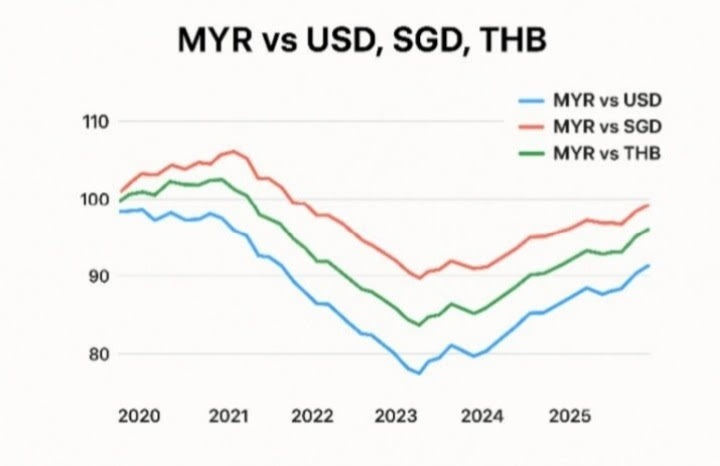
After years of weakness, the ringgit is finally roaring back.
It has climbed to RM4.13 against the US dollar, its strongest level in a year, and RM3.19 against the Singapore dollar.
This marks one of the most impressive currency comebacks in Asean since 2017.
Malaysia’s renewed fiscal discipline and central bank stability are paying off – turning painful subsidy removals into long-term macro strength.
What are the key factors behind this renaissance?
- Bank Negara’s steady 2.75% overnight policy rate has built investor confidence.
- The deficit reduction to 3.8% of gross domestic product (GDP), targeting 3.5% in 2026, has made Malaysia credit-positive.
- Tech export recovery and the US dollar weakness has accelerated ringgit gains.
Yet, sustaining this ‘ringgit renaissance’ demands caution. External fragilities, fiscal rigidities and systemic dependence on global capital could still threaten long-term currency stability.
What could derail the ringgit
- Sign up for Aliran's free daily email updates or weekly newsletters or both
- Make a one-off donation to Persatuan Aliran Kesedaran Negara (ALIRAN), Maybank a/c 507246118995 or CIMB a/c 8004240948
- Make a pledge or schedule an auto donation to Aliran every month or every quarter
- Become an Aliran member
Despite recent optimism, several structural and external risks could impair the MYR’s upward trajectory if left unaddressed.
Global monetary volatility: Should the US Federal Reserve reverse course with renewed tightening due to inflationary shocks, capital outflows from emerging markets could re-emerge, pressuring the ringgit.
Malaysia remains highly exposed to portfolio-sensitive foreign investors, who hold 21% of domestic government securities.
Even modest yield differentials can trigger ringgit volatility, as seen during the 2018 and 2022 cycles.
Export concentration: Malaysia’s export base remains narrowly tied to electrical and electronic goods, palm oil and liquefied natural gas.
While tech exports revived in 2025, global semiconductor cycles remain inherently volatile (OECD, 2024). A downturn in global demand – particularly if China’s recovery stalls – could drag down the ringgit through trade channel effects.
Political constraints: Malaysia’s fiscal reform agenda, though courageous, remains vulnerable to political reversals.
The gradual removal of fuel and food subsidies, while necessary, risks public backlash that could slow consolidation. The persistence of ethno-capitalist patronage networks and rent-seeking in government-linked company-related projects also undermines fiscal efficiency.
Without institutional reform and transparent public procurement, fiscal gains may prove temporary.
Investment gaps: The ringgit’s medium-term performance hinges on productive investment flows, not speculative ones.
However, Malaysia’s manufacturing competitiveness has eroded due to skills mismatches, energy cost pressures, and regulatory ambiguity.
If the country fails to attract quality foreign investment beyond assembly-based industries, structural productivity will stagnate, weakening the currency’s real effective value (World Bank, 2025).
How to sustain the momentum
A roaring currency must rest on enduring fundamentals rather than short-term sentiment.
Malaysia’s next phase of currency stability requires strategic interventions across four key fronts.
Fiscal resilience: Malaysia must institutionalise fiscal reforms through the Fiscal Responsibility Act with binding debt rules, transparent subsidy frameworks and a medium-term revenue plan.
Reintroducing a progressive consumption or carbon tax could widen the revenue base without burdening lower-income households (IMF, 2025). Bank Negara and the Ministry of Finance must also coordinate to manage fiscal-monetary coherence, avoiding any policy divergence that could unsettle markets.
Structural competitiveness: To reinforce the ringgit’s intrinsic value, Malaysia should prioritise industrial upgrading. It needs to move up the value chain in semiconductors, green technologies and digital services.
Incentives should reward research and development localisation, labour upskilling, and technology diffusion rather than rent-seeking. Public-private partnerships must be reframed toward inclusive productivity, aligning with the 13th Malaysia Plan’s sustainability targets.
Trade diversification: Malaysia should deepen South-South trade corridors with Asean, the Gulf states and Latin America to reduce vulnerability to US–China decoupling.
Expanding bilateral currency settlement frameworks, as pioneered with Indonesia and China, could also reduce dollar dependence, cushioning the ringgit against external shocks (Asean Secretariat, 2025).
Institutional credibility: Ultimately, currency strength reflects state credibility.
Independent institutions – particularly Bank Negara, the Malaysian Anti-Corruption Commission (MACC), and Parliament’s Public Accounts Committee – have to operate free from political interference.
Long-term investors respond not only to macro numbers but to the perception of rules-based governance and policy predictability.
Towards a ‘fiscal sovereignty dividend’
The ringgit’s rebound should not be mistaken for a short-lived rally. It symbolises the return of fiscal sovereignty through discipline and reform.
However, the challenge ahead is to translate macro stability into inclusive prosperity. Malaysia needs to reduce reliance on speculative inflows and fortify domestic productive capacity. The true measure of success lies not merely in the exchange rate but in restoring the people’s confidence in the nation’s economic stewardship.
If Malaysia can continue to sustain its current reform path, anchored in credible governance, fiscal realism and productive investment, the ringgit could finally evolve from a reactive currency to a strategic symbol of national resilience.
AGENDA RAKYAT - Lima perkara utama
- Tegakkan maruah serta kualiti kehidupan rakyat
- Galakkan pembangunan saksama, lestari serta tangani krisis alam sekitar
- Raikan kerencaman dan keterangkuman
- Selamatkan demokrasi dan angkatkan keluhuran undang-undang
- Lawan rasuah dan kronisme