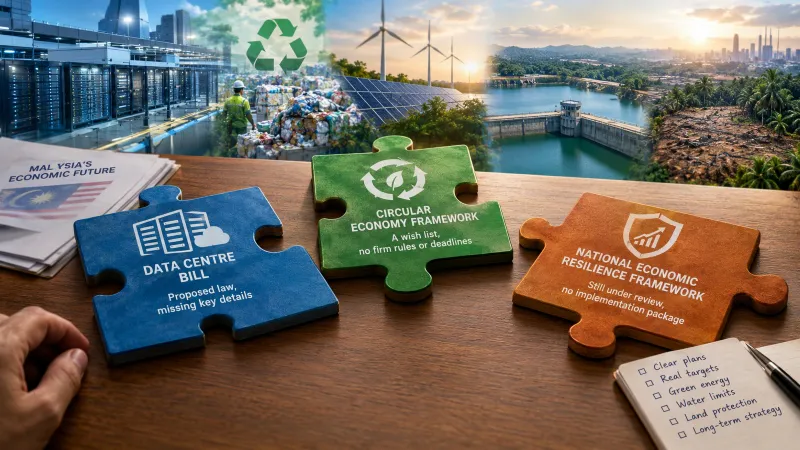
Imagine placing three different puzzle pieces on a table and declaring the puzzle complete.
That is how the government recently presented its new economic plans to the people. They are meant to support a greener, circular economy.
On 19 October the government reviewed three priority initiatives at a single National Economic Action Council meeting chaired by Prime Minister Anwar Ibrahim:
- a proposed law for data centres
- a circular economy framework
- a national economic resilience (back-up) framework
By stitching them together, the government is presenting a grand master plan for Malaysia’s future.
Looking more closely, these three pieces do not fit together.
- Sign up for Aliran's free daily email updates or weekly newsletters or both
- Make a one-off donation to Persatuan Aliran Kesedaran Negara (ALIRAN), Maybank a/c 507246118995 or CIMB a/c 8004240948
- Make a pledge or schedule an auto donation to Aliran every month or every quarter
- Become an Aliran member
One is a proposed law but missing key details. Another is little more than a wish list. And the third is still under review.
Here’s what is really going on.
A bill still on paper
Data centres are huge buildings that store internet information, cloud data and artificial intelligence (AI) systems. They are growing fast in Malaysia. But they are also ‘hungry’ for electricity, water and skilled people.
The government is preparing a new law to manage them.
Data centre companies will have to pay for their own electricity and the grid upgrades they need. They will not get subsidies, which seems fair to consumers like us.
So far, 27 data centre projects worth RM226bn have been approved. The government expects locals to fill 89% of the high-skilled jobs. At least 30% of project content must be sourced locally.
So where will the power come from?
Data centres use about 7% of the country’s electricity today. By 2035, they could use nearly a third of it.
The plan does not yet say how we will generate all this extra power. Will it come from imported coal, with its emissions problem? Or from pricey gas, with domestic reserves under pressure? Or from solar and wind, with their intermittency and land needs?
We don’t know. No details have been given.
A wish list and a delay
Right now, the Malaysian economy follows a ‘take-make-throw’ habit. We take raw resources, make finished products and throw them away after use.
The circular economy framework aims to change this by reusing materials and cutting waste. This would help Malaysia reach net zero carbon emissions by 2050.
To do this, products must last longer and resource depletion must slow. That means repairing, reusing, remanufacturing and recycling. Materials then keep their value, and we need fewer new resources.
Four ministries are to lead the effort: housing and local government; investment, trade and industry; science, technology and innovation; and human resources. The hope is that this will end siloed work across ministries.
While this sounds great, it is so far only a statement of good intentions. The government has not published firm rules, deadlines or penalties. Without clear targets, it is more of a ‘hope’ than a binding rule.
The national economic resilience framework was act as a shield to protect Malaysia’s economy from global shocks, such as pandemics, wars or financial crashes.
The government reviewed this plan, saying it needs ‘further deliberations’.
A real backup plan needs clear warning signs and automatic responses. The absence of an implementation package suggests the government is still weighing whether to set tough rules to protect the economy.
Power, water and land
When we look past the announcements, the physical reality of building so many massive data centres is worrying.
On electricity, globally, data centres use about 1.0-1.5% of a country’s power. Malaysia is already at about 7%, and that could reach nearly a third by 2035!
If we build new power plants just for data centres, we need a clear green energy plan too. Right now, the law is silent on this.
On water, many of these data centres are in Johor, which has already struggled with water shortages. They need large volumes of water to keep their servers cool.
The government acknowledges water constraints. Yet no strict limits on data centre water use have been announced. There is no law to ban these data-centre developers from building data centres in dry regions.
On land, a bigger issue is the leasing of state land to multinational companies.
Nothing announced so far addresses the cumulative conversion of agricultural and agro-forestry land to digital infrastructure. Many conversions have taken place along the Johor corridor, which hosts the bulk of data centre sites.
Land once used for oil palm and smallholder farming is now converted for digital-infrastructure use and exploited, as part of what may be described as modern digital colonisation.
Putting these three plans together makes people believe the nation has a perfect, unified strategy. But a real strategy needs solid details.
If we keep allowing power-hungry data centres without a clear green energy plan, in water-stressed areas without strict water limits, we will face immense problems later.
The question is: once the data centre bill becomes law, can Malaysia sustain the industry’s growth without harming the environment, draining water supplies and overloading the power grid?
My first impression is that these bundled initiatives fall short of a 10-year or 20-year scenario-planning mission. Nor has a future forecast unit been formed that can assess data centre expansion alongside other resource needs.
We need a strategic foresight body with a dedicated system for scanning the horizon for emerging risks. The government would then be able to foresee risks rather than manage one crisis after another.
Other problems demand urgent attention: oil and gas adequacy, rare earth exploitation and depletion, food security and climate change calamities.
For example, the proposed circular economy framework does not say whether Malaysia will move up the rare earth value chain beyond the Lynas plant into making magnets, alloys and components. As it stands, we ship separated oxides to overseas manufacturers.
Until the government provides the missing details, we have a vision but no clear mission.
The proposed data centre bill, the circular economy framework and the delayed resilience framework are being offered together as one integrated development strategy.
Instead, the present impression is that the nation’s circular economy is a continuation of the ‘development of underdevelopment’ (growth that keeps a country dependent on others) (Arrighi, 2010; Wallerstein, 2004).
The people’s aspirations are being turned around, their ambitions tossed around.
AGENDA RAKYAT - Lima perkara utama
- Tegakkan maruah serta kualiti kehidupan rakyat
- Galakkan pembangunan saksama, lestari serta tangani krisis alam sekitar
- Raikan kerencaman dan keterangkuman
- Selamatkan demokrasi dan angkatkan keluhuran undang-undang
- Lawan rasuah dan kronisme