
Ngo Sheau Shi
For decades, Malaysian civil society and ordinary people have campaigned for a genuine federal-level freedom of information law.
Public resources, state policies and the use of administrative power all need public scrutiny. A thriving democracy cannot function in the shadows.
The tabling of the Freedom of Information Bill 2026 was supposed to be a watershed moment for transparency.
Instead, a close reading of the document shows a serious gap between the bill and its stated aims.
- Sign up for Aliran's free daily email updates or weekly newsletters or both
- Make a one-off donation to Persatuan Aliran Kesedaran Negara (ALIRAN), Maybank a/c 507246118995 or CIMB a/c 8004240948
- Make a pledge or schedule an auto donation to Aliran every month or every quarter
- Become an Aliran member
Rather than dismantling the post-colonial legacy of authoritarian secrecy, this proposed law builds a stronger wall around it.
Rather than shielding the public interest, the bill acts as a regressive trap. It risks legally trapping the very people it claims to empower.
1MDB and the illusion of accountability
To grasp the scale of this failure, consider Malaysia’s biggest financial scandal, 1MDB.
As Clare Rewcastle Brown detailed in her book The Sarawak Report: The Inside Story of the 1MDB Exposé, the theft of billions was only uncovered because whistleblowers and journalists worked outside the system. They exposed classified financial statements, manipulated audit reports and secret bank transfers.
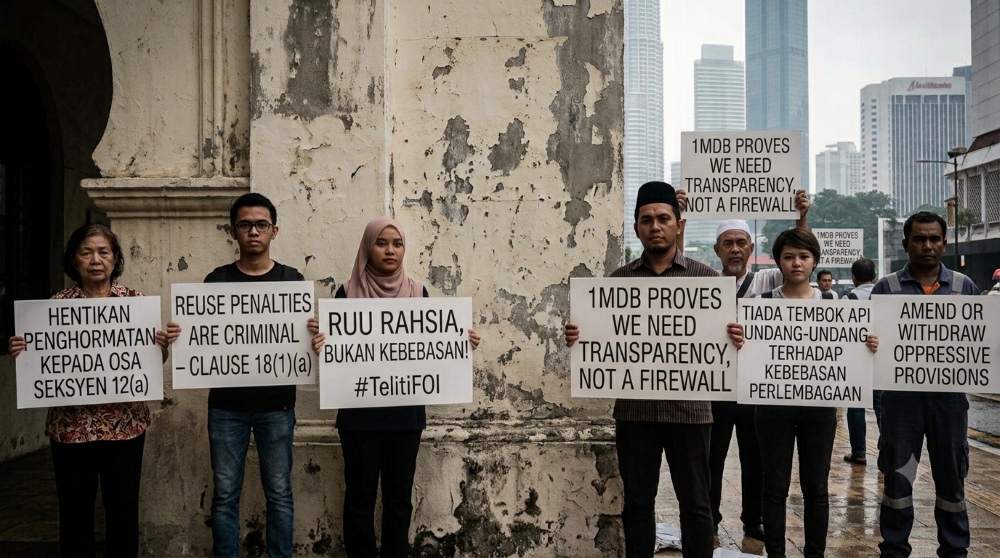
Had the Freedom of Information Bill 2026 been law back then, it would have done nothing to expose the 1MDB scandal or the officials behind it. In fact, it would have legally guaranteed their protection.
Bowing to the OSA
The bill’s biggest flaw is its complete deference to existing secrecy laws.
Clause 12(a) states that information is exempted where it relates to “official documents, official secrets, secrets, confidential information or information protected under other written laws”.
The bill’s explanatory statement removes any doubt: the proposed enactment “is without prejudice to” any law governing confidentiality. Information classified under the Official Secrets Act 1972 is excluded from the enactment altogether.
Recall how the government once used the OSA to withhold the auditor general’s report on 1MDB.
If the same thing happened today, this bill is written to protect that same secrecy – not challenge it.
The ‘tangible interest’ barrier
The bill also restricts who can even ask a question.
Clause 6(1)(d) says a request is only valid if the applicant has a “proper and tangible interest” and has been “prejudiced” by the public authority’s actions.
This undercuts the whole idea of civic duty and public interest journalism. It treats the government as the owner of state documents, rather than a custodian of information that belongs to the public.
A taxpayer asking about a mega-project like 1MDB would likely be turned away, since the state could argue they suffered no personal “prejudice” from a sovereign wealth fund’s offshore dealings.
Criminalising the people
The most troubling part of the bill is how it treats the reuse of information.
In a genuine democracy, once information is released, it belongs in the public domain – open to scrutiny, debate and sharing.
This bill turns that sharing into a crime.
Under Clause 18(1)(a), anyone who uses information “contrary to the purpose” of their original request commits an offence. The penalty is severe: a fine of up to RM100,000, up to five years in prison, or both.
Here’s what that could mean in practice, away from grand corruption cases.
A resident in a hillside community notices land being cleared above their housing estate and fears a landslide. She files a request under the freedom of information law for the project’s environmental impact assessment. To get the request approved, she states the purpose as “educational research”.
The documents she obtains reveal a familiar story: the assessment had warned of a landslide risk and called for strict safeguards. But the authority approved the project anyway and never monitored or enforced those safety measures.
Alarmed, the resident shares the documents with an environmental group, posts them online and starts a petition to halt the bulldozers. Because this now contradicts her stated purpose of “educational research”, the local council can prosecute her under Clause 18(1)(a).
So an ordinary person trying to prevent a disaster could face five years in prison and financial ruin – simply for exposing government negligence.
A firewall, not a gateway
The bill’s drafters appear to know exactly what they are doing.
Clause 22 states that nothing in this enactment shall be treated as a fundamental liberty under Part II of the Federal Constitution.
The explanatory statement is blunt about why: this clause stops the enactment from becoming a guaranteed constitutional right. Instead, it acts as “a legal firewall” that tells the courts that this enactment merely regulates a specific activity, without expanding Malaysians’ constitutional freedoms.
This is not a ‘freedom of information’ act. It looks more like a ‘freedom from accountability’ act.
Rather than building a culture of transparency, the bill as it stands limits accountability. It gives the state new tools to track requests, wide powers to classify ‘sensitive’ documents and harsh legal risks for those who share the public information that they obtain.
Dr Ngo Sheau Shi is a senior lecturer at the School of Communication, Universiti Sains Malaysia. She was appointed as a pro tem committee member for the drafting and preparation of the Freedom of Information Bill in 2025.
AGENDA RAKYAT - Lima perkara utama
- Tegakkan maruah serta kualiti kehidupan rakyat
- Galakkan pembangunan saksama, lestari serta tangani krisis alam sekitar
- Raikan kerencaman dan keterangkuman
- Selamatkan demokrasi dan angkatkan keluhuran undang-undang
- Lawan rasuah dan kronisme
