
Amar-Singh HSS
Pisa recently released its 2025 results for Malaysia.
The Programme for International Student Assessment is run by the OECD, a group of mostly wealthy countries that compares living standards and policy performance worldwide.
The results confirm something uncomfortable: a student’s family background remains one of the strongest predictors of academic performance in Malaysia.
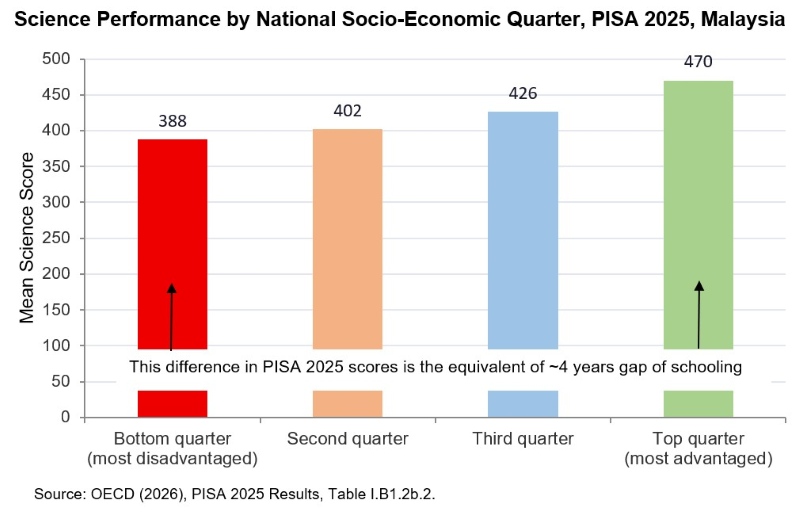
Socioeconomically advantaged 15-year-olds – the top 25% by family wealth, parental education and home resources – outscored their disadvantaged peers, the bottom 25%, by 82 points in science (see graph above from Pisa 2025 results).
- Sign up for Aliran's free daily email updates or weekly newsletters or both
- Make a one-off donation to Persatuan Aliran Kesedaran Negara (ALIRAN), Maybank a/c 507246118995 or CIMB a/c 8004240948
- Make a pledge or schedule an auto donation to Aliran every month or every quarter
- Become an Aliran member
What this means in real-world terms is deeply concerning. Under standard Pisa methodology, 20 score points roughly represent one year of schooling.
An 82-point gap therefore equals about four years of formal education. Malaysia’s poorest 15-year-olds are four years behind their wealthier peers – a gap we cannot afford to ignore.
This is what experts call the ‘inverse care law of education’, or the ‘social determinants of education’. Children who need the most support, resources and high-quality teaching are the least likely to get them.
Nearly two-thirds – 63% – of Malaysia’s most disadvantaged students failed to reach even baseline science proficiency, known as Level 2, in 2025.
There is some hope, though. One in 10 disadvantaged students scored in the top quarter for science – proof that academic resilience is possible despite socioeconomic disadvantage.
Such gaps exist in many OECD countries – the average difference there is 85 points. But that should not be a comfort.
These are the children Malaysia has been leaving behind for years. The gap narrowed modestly between 2018 and 2022, but has since widened again. By 2025, it was back to nearly 2018 levels.
This points to an uneven education system. Students from disadvantaged homes are less likely to have the resources, environments and support that lead to strong academic outcomes.
Recommendations
Move away from aggregate national averages, which conceal the problem. Use disaggregated Pisa scores and educational outcomes data broken down by socioeconomic status.
While all students need support, resources should target those furthest behind and schools serving lower-income communities. Funding should follow need with more funds for schools with high numbers of disadvantaged students.
Set a clear, time-bound target to significantly reduce the gap between disadvantaged and advantaged students. It may be better to measure this using Pisa’s baseline proficiency threshold, Level 2 – the minimum skill level the OECD considers necessary to participate effectively in society and further learning – rather than score points.
If we do not act together, Malaysia risks locking in a two-tier education system.
Generations of children denied the chance to reach even baseline proficiency will grow into adults with fewer opportunities and lower earning potential. They will have less capacity to participate fully in public life.
This will show up in workforce productivity and social mobility – and ultimately, in society as a whole.
Dato’ Dr Amar-Singh HSS is a consultant paediatrician and child-disability activist.
AGENDA RAKYAT - Lima perkara utama
- Tegakkan maruah serta kualiti kehidupan rakyat
- Galakkan pembangunan saksama, lestari serta tangani krisis alam sekitar
- Raikan kerencaman dan keterangkuman
- Selamatkan demokrasi dan angkatkan keluhuran undang-undang
- Lawan rasuah dan kronisme






Will improving the learning conditions in schools suffice? Scholastic excellence is usually the result of a supportive home/community environment. Unless there is community focus on the importance of education, schools will continue to face a daunting task.