By Ahmad Ibrahim
When we talk about the circular economy, images of recycling bins, upcycled furniture and waste-free factories often come to mind.
The conversation, whether in boardrooms, policy documents or sustainability forums, overwhelmingly revolves around the goods economy: how to reduce, reuse, recycle and redesign physical products to minimise waste and resource depletion.
But here’s the curious thing: in most modern economies, it’s not goods that dominate any more – it’s services.
From finance to education, healthcare to tourism, software to entertainment, services account for over 60–70% of gross domestic product (GDP) in many countries, and an even larger share of employment.
- Sign up for Aliran's free daily email updates or weekly newsletters or both
- Make a one-off donation to Persatuan Aliran Kesedaran Negara (ALIRAN), Maybank a/c 507246118995 or CIMB a/c 8004240948
- Make a pledge or schedule an auto donation to Aliran every month or every quarter
- Become an Aliran member
In Malaysia, services contributed 59.2% of GDP in 2023, having long overtaken manufacturing as the largest economic sector.
Yet, circular economy conversations largely pass the service sector by. This is a missed opportunity. If the future is to be sustainable, the service economy must not only join the circular conversation – it must lead it.
Hidden footprints
At first glance, services might seem benign. After all, you can’t ‘throw away’ a bank transaction or ‘recycle’ a legal consultation.
But services still have environmental footprints, often hidden and indirect. Data centres powering cloud services consume vast amounts of electricity and water, with a single data centre capable of consuming up to five million gallons of drinking water per day.
Tourism generates enormous carbon emissions from travel and hospitality.
Financial services influence where investments flow – towards sustainable projects or resource-heavy industries such as steel and cement.
Moreover, services shape consumer behaviour and production patterns. Advertising drives demand for fast fashion and single-use gadgets. Digital platforms orchestrate gig economies with high turnover and a disposable delivery culture.
If services are the connective tissue of the modern economy, they must also be part of the solution.
Rethinking service design
A circular service economy isn’t just about reducing paper usage in offices or switching to LED lighting. It involves fundamentally rethinking how services are designed, delivered and measured.
Take tourism, for example: instead of mass-market, high-volume tourism that strains local ecosystems, imagine services that prioritise low-impact, culturally sensitive and regenerative travel experiences, where visitors contribute to local conservation and heritage efforts.
In finance, banks and insurers can integrate environmental and social risk criteria into investment decisions, steering capital away from resource-intensive industries and towards circular business models.
In education, curriculums can embed circularity principles into business, engineering and social sciences, shaping future professionals’ mindsets.
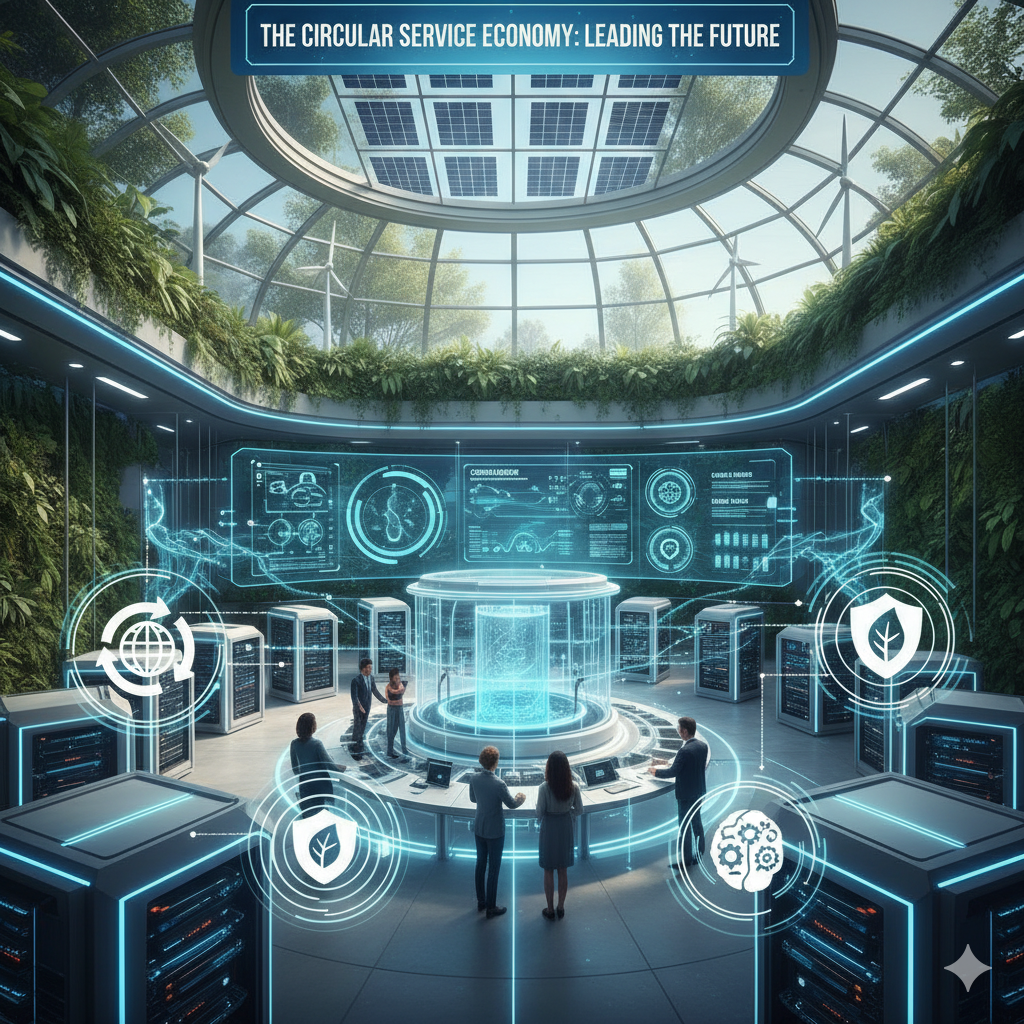
In digital and technology services, data centres can adopt closed-loop cooling systems, use renewable energy, and extend the lifespan of hardware through modular upgrades and refurbishing.
Crucially, services can act as enablers of circularity in the goods economy, through leasing, platform sharing, repair services and product-as-a-service models. The shift from ownership to access is, at its core, a service-driven innovation.
Measurement challenge
One reason the service economy is left out of circular discussions is the difficulty of measurement. It’s easier to quantify tonnes of recycled plastic than the circular performance of a legal firm or a streaming platform.
But this can be addressed. New metrics must capture both the direct environmental impacts of service operations (energy use, travel emissions, waste generation) and the indirect influence they exert through financing, advertising or platform management.
Indicators might include:
- carbon and water footprints per service transaction
- the percentage of revenue derived from circular business models (eg sharing, leasing, repair)
- the impact of services on client or consumer behaviour (eg encouraging sustainable consumption)
- the integration of circularity principles in service design and procurement policies
- resource efficiency of digital services and data management
Statistical agencies should begin incorporating service-sector circularity indicators into national sustainability reporting frameworks, much like they do with energy and material flow accounts for industries.
Central, not peripheral
If we continue to frame circularity solely around goods, we risk leaving the lion’s share of the economy, and its leverage points for change, untouched.
Services may not fill landfills, but they fill our lives, shape our economies and steer our consumption patterns.
It’s time to acknowledge that the service economy isn’t peripheral to circularity; it’s central to it.
Circular principles must be woven into the design, delivery and governance of services just as urgently as in manufacturing and agriculture.
After all, a truly sustainable, future-ready economy isn’t just about what we produce – it’s about how we live, work, travel, heal, learn and connect. And those, increasingly, are services.
Professor Dato Ahmad Ibrahim is affiliated with the Tan Sri Omar Centre for STI Policy Studies at UCSI University. He is also an associate fellow at the Ungku Aziz Centre for Development Studies, University of Malaya.
AGENDA RAKYAT - Lima perkara utama
- Tegakkan maruah serta kualiti kehidupan rakyat
- Galakkan pembangunan saksama, lestari serta tangani krisis alam sekitar
- Raikan kerencaman dan keterangkuman
- Selamatkan demokrasi dan angkatkan keluhuran undang-undang
- Lawan rasuah dan kronisme