Race and religion often get sucked into a black hole of ethnic and religious tension in Malaysia.
It is an unfortunate reality, considering how everyday life in this multi-faith nation isn’t as dramatic or hostile as public discourse on race and religion suggests.
Many of us experience our religious places of worship as holy in-between spaces – liminal, as anthropologists call them – that facilitate an exchange between what’s familiar and human, and what’s otherworldly and Divine.
What of the beauty of a male singer’s sonorous operatic rendition of the Muslim call to prayer, announcing the arrival of dawn?
Or a golden Buddha, towering above a devotee in a Burmese temple, calling her to a purpose bigger than the smallness of her existence?
- Sign up for Aliran's free daily email updates or weekly newsletters or both
- Make a one-off donation to Persatuan Aliran Kesedaran Negara (ALIRAN), Maybank a/c 507246118995 or CIMB a/c 8004240948
- Make a pledge or schedule an auto donation to Aliran every month or every quarter
- Become an Aliran member
Sacred moments of religious liminality move us to forget our titles and statuses, and worship a Higher Being as a collective of equals.
Building on the work of fellow ethnographer Arnold van Gennep, the British social anthropologist Victor Turner uses the term liminality (from the Latin limen, meaning threshold) to describe the transitional state of a rite of passage.
Before entering a new identity, individuals who undergo such rites give up a former status, located “betwixt and between” their present and new roles or identities. One is neither here nor there – one’s present identity fading away, with a new one imminent.
Perhaps liminality is that ambiguous space where rigid boundaries instituted by official classifications on ethnicity and religion seem to melt away.
Consider this scene: an ethnic Indian lorry driver, at a red traffic light, climbs down from his vehicle, walks over to a car, and gives some money to the ethnic Malay baby strapped into the child seat in the front.
Serendipity shows up when a Malay girl offers our crying toddler some keropok to cheer her up. My family and I were at the new Gurney Bridge on New Year’s Eve, watching the fireworks usher in the New Year, when my toddler began to scream, overwhelmed by the noise. The keropok was a successful distraction.
Our muhibbah spirit – that sense of goodwill and fellowship across ethnicities and religions – and local delights like keropok make this a special country. Sometimes, when we walk down the streets of Malaysia, we hear a mixture of temple bells and the azan.
Mosques, Hindu temples, Chinese temples and churches coexist on the same street – as on “harmony street” in Penang, for instance – where religious adherents at the borders between different spiritualities find themselves in an in-between everyday space, united by a common quest for meaning and the Divine, regardless of religious affiliation.
Penang boasts more than 200 years of cultural and religious coexistence, a third space that emerged from sojourners and migrants who came from Indonesia, Thailand, Myanmar, China, India, Sri Lanka, Europe, West Asia and Japan.
Some of us celebrate our various religious festivals in Malaysia with “open houses”, providing opportunities for interactions between ourselves and the Other – the “stranger” who may not subscribe to our personal beliefs.
Sometimes, we throng the roads with floats and religious processions, and transform streets into communal in-between spaces.
Religious parades suspend normal traffic and daily routines, bridging the divide between the secular and the spiritual, and facilitating exchanges between devotees and curious onlookers.
This Wesak Day, Buddhists celebrate the embodiment of liminality by commemorating three significant turning points in the life of Siddhartha Gautama, who became the Buddha: his birth as a prince, his enlightenment and his passing into Nirvana.
We could pause and reflect on liminality in personal and political transition, where growth and change are oftentimes uncomfortable, and possibly slow to come.
Resistance to change manifests in the censorship of “sensitive three R” issues – race, religion and royalty – which continues even in the time of a government that once pledged reform.
People in Malaysia have witnessed governments change, and alliances fracture and reassemble.
We can, however, choose to make a difference by fostering interfaith and intercultural understanding in ordinary in-between spaces that challenge the often-divisive politics of race and religion.
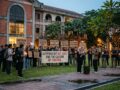
We have done this repeatedly, not just in processions of religious festivals, but also in protests.
Let’s extend compassion to ourselves and others, and practise a loving mindfulness of our intentions and behaviours. Let’s change the world, one kind act at a time.
AGENDA RAKYAT - Lima perkara utama
- Tegakkan maruah serta kualiti kehidupan rakyat
- Galakkan pembangunan saksama, lestari serta tangani krisis alam sekitar
- Raikan kerencaman dan keterangkuman
- Selamatkan demokrasi dan angkatkan keluhuran undang-undang
- Lawan rasuah dan kronisme