
The government’s move to rationalise fuel subsidies in 2026 has reignited a familiar debate.
Oil prices rose sharply because of the war in West Asia.
But who really benefits from the Budi 95 petrol subsidies – and who gets left behind?
For decades, Malaysia’s transport subsidies have leaned heavily towards private vehicle users. Subsidised fuel is often described as helping ordinary people coping with the rising cost of living.
But a closer look reveals big gaps in who actually benefits.
Who really benefits?
- Sign up for Aliran's free daily email updates or weekly newsletters or both
- Make a one-off donation to Persatuan Aliran Kesedaran Negara (ALIRAN), Maybank a/c 507246118995 or CIMB a/c 8004240948
- Make a pledge or schedule an auto donation to Aliran every month or every quarter
- Become an Aliran member
For simplicity, assume the subsidy on Ron 95 petrol works out at roughly RM2 a litre. (In the week of 9-15 April, unsubsidised Ron 95 peaked at RM4.27 a litre, while Budi 95 stayed at RM1.99 – a subsidy of RM2.28 a litre.)
Is this fair? A motorist using 200 litres of petrol a month gets an implicit subsidy of RM400. A low-income motorcyclist using 50 litres gets just RM100. What about an electric vehicle driver, who pays commercial electricity rates and gets nothing at all?
Meanwhile, RapidKL users in the Klang Valley still pay RM50 a month for the My50 pass, or use Touch ‘n Go for distance-based fares. Rapid On-Demand services are also available at a flat rate of RM2 per trip.
Commuters using bus operators such as Causeway Link and Wawasan, or rail services like KTM Komuter, KTM ETS and the ERL, get no direct subsidy at all.
What about people who walk or cycle to get around? Pedestrians and cyclists receive no mobility subsidy whatsoever. They ease congestion, cut carbon emissions and improve public health. Yet they bear the full cost of their own travel. Is that fair?
The picture is even harder for sick people, older people and people with disabilities. Many cannot drive, cycle or walk far. Their mobility often depends on ride-hailing, taxis or specialised mobility vans. These essential journeys receive little or no support at all. Is this fair?
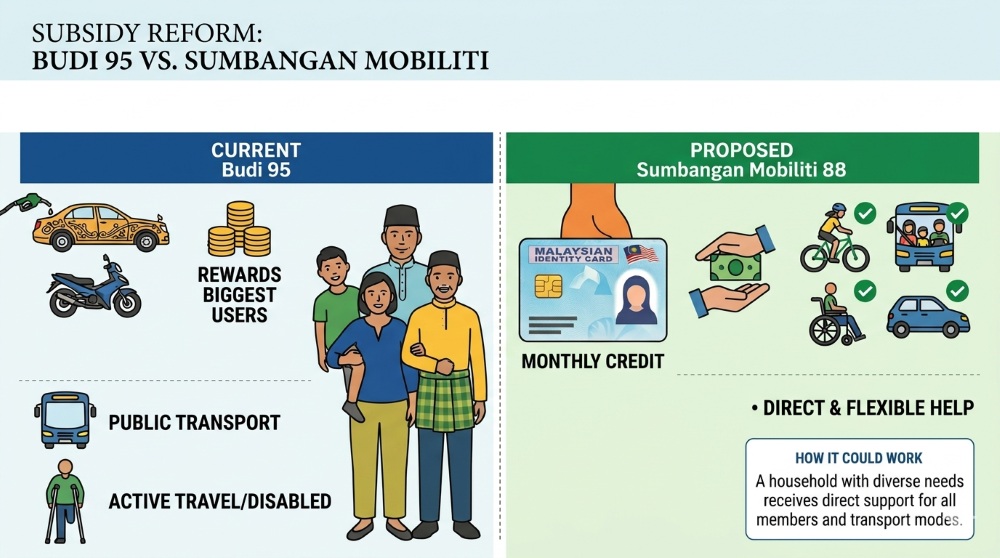
The current system rewards fuel use, not active travel. The more petrol someone burns, the bigger his or her subsidy.
That creates an odd paradox. Those who add most to congestion and emissions often get the most help.
A fairer alternative
A better approach would be to support people, not fuel.
Malaysia already has experience with targeted help through the Sara scheme, where subsidy payments go straight onto recipients’ identity cards.
A similar model – call it Sumbangan Mobiliti 88 (Mobility Aid 88) – could work for transport too. Under this proposal, adults aged 18 and above would get a monthly mobility credit of say, RM88, credited to their identity cards.
Instead of subsidising fuel at the pump, the government would let Ron 95 and diesel move towards market prices over time, while giving people direct support for getting around. (The actual subsidy amount, timeline and pace of any fuel price increase would be for the government of the day to decide.)
This mobility credit could be used flexibly to suit each household’s needs. Motorists could put it towards fuel. Families could pool credits to cover shared transport costs. Public transport users could use it to buy My50 passes or top up Touch ‘n Go cards for KTM Komuter, MyBas and similar services.
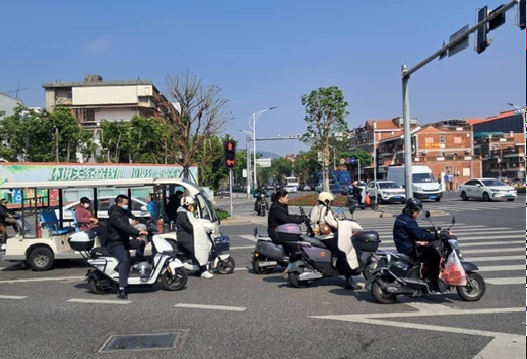
Cyclists and users of e-bikes or e-scooters would finally be recognised too. The credit could help pay instalments or subscriptions on these vehicles, encouraging healthier, more sustainable travel choices.
Older people, people using wheelchairs, and others with specific mobility needs could put the credit towards ride-hailing, taxis or mobility van services – rather than being forced into a one-size-fits-all transport model.
How it could work
Take a household renting a council flat as an example. A woman in her 50s cycles 8km a day to work. Her husband, a stroke survivor, uses ride-hailing to get to the hospital each week. Their son-in-law takes the bus to work in the city. Their daughter rides a motorcycle to work and drops her own daughter at kindergarten. Their grandson, luckily, walks to his primary school nearby.
Under Budi 95, this household gets RM100 (50 litres at a RM2-a-litre subsidy). Her daughter would still have to pay roughly RM100 for her subsidised petrol.
Under Sumbangan Mobiliti, the same household would get RM352 a month (RM88 for each of the four adult household members). This would cover her daughter’s RM200 on 50 litres of unsubsidised petrol, leaving a balance of RM152. Now, add to this the savings in petrol expenditure her daughter would otherwise have incurred under Budi 95 (RM100). This would give the household a total of RM252 to spend on their other mobility needs – enough to cover her husband’s ride-hailing or mobility van trips to hospital, instalments on a bicycle for her grandson, and her son-in-law’s bus fares.
Such a system would be fairer, clearer and more inclusive. It would let people choose the transport mode that suits them, while making sure government help reaches everyone – not just petrol users. It would encourage people to use less of an increasingly costly resource.
Transport is not just about vehicles or fuel. It is about access to work, education, healthcare and social life. If public money is meant to support how people get around, then everyone should benefit – whether they drive, ride a motorcycle, take the bus or train, cycle, walk or rely on assisted transport.
The principle is simple: subsidise people, not petrol.
AGENDA RAKYAT - Lima perkara utama
- Tegakkan maruah serta kualiti kehidupan rakyat
- Galakkan pembangunan saksama, lestari serta tangani krisis alam sekitar
- Raikan kerencaman dan keterangkuman
- Selamatkan demokrasi dan angkatkan keluhuran undang-undang
- Lawan rasuah dan kronisme







I really believe this is the policy that could really be the turning point of our car centric policies. What an interesting perspective.
Is Aliran good articles reaching to the young people network?
i felt the youth , undergrad, fresh grad are the main stakeholders and they should be able to be reached out.
can Aliran take in interns and pay them to do social media? apply to MOE and MOHE for both interns. apply to MOE, then give sijil to secondary school students for their PAJSK (koko) marks. Apply to MOHE and engage with USM like Mass Comm, Social Work, etc. and also engage with International school students to ask them to help aliran
can also apply to Root and Shoots so that Aliran can be part of the voluntary program in the list.
Great article, Simon. Speaks for the voiceless who fall into the cracks on the road. Jalan Raya is not Jalan Rakyat.
Very good and logical proposal. By now, govt has much data on budi95 petrol subsidy to evaluate this proposal consequence if implemented. I believe our nation has lost and continue to lose huge revenue from pilferage and smuggling of subsidised petrol and diesel. Enforcement to counter this loss incur its own expenses. By removing fuel subsidy, pilferage and smuggling of petrol and diesel simply stops as there is no gain in selling market rate fuel in the black market. Enforcement expenses will be reduced significantly. More people will use petrol wisely if they’re paying market rate fuel for their vehicles. This will lead to reduced environment pollution and less traffic congestion.