Charles Santiago
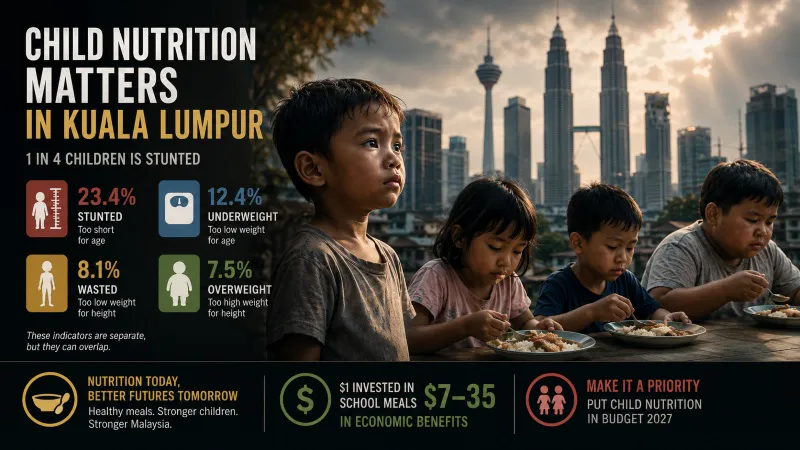
Health Minister Dr Dzulkefly Ahmad says 23.4% of under-fives in Kuala Lumpur are stunted.
Another 12.4% are underweight, 8.1% are wasted and 7.5% are overweight.
These are separate indicators, but they can overlap. A child can be both stunted and underweight, for example. Taken together, they show that several forms of malnutrition coexist at high levels.
This is not a marginal problem. It is a serious nutrition crisis – even in Malaysia’s richest and most developed city.
- Sign up for Aliran's free daily email updates or weekly newsletters or both
- Make a one-off donation to Persatuan Aliran Kesedaran Negara (ALIRAN), Maybank a/c 507246118995 or CIMB a/c 8004240948
- Make a pledge or schedule an auto donation to Aliran every month or every quarter
- Become an Aliran member
Stunting means a child is too short for their age. It usually reflects chronic undernutrition or repeated illness, and can affect brain development, learning, health and future earnings.
Wasting means a child’s weight is too low for their height. This often signals acute undernutrition or recent illness.
Overweight means a child’s weight is too high for their height, but it does not necessarily mean they are well nourished. A child can be overweight and still lack essential nutrients.
Most concerning is the long-term rise in stunting. Malaysia’s under-five stunting rate rose from 11.3% in 2011 to 20.7% in 2016. Unicef’s latest estimate remains high at 22% nationally.
In Kuala Lumpur, Dr Dzulkefly’s latest figure is 23.4% – nearly one in four children.
Stunting needs to be treated as a cost-of-living issue. When households have to stretch every ringgit, nutritious food is often the first thing to go. Protein, fruit, vegetables, milk and other nutrient-dense foods become harder to afford. A child may be full, but still not be well nourished.
Malaysia needs a universal national meals plan that gives children nutritionally balanced meals, as part of the cost-of-living agenda.
The World Food Programme estimates that every $1 invested in school meals can generate $7-35 in economic benefits. These come through better health and learning, higher future productivity and stronger local food economies.
Malaysia should not wait for another minister to tell us what families already know. Child nutrition and the national meals plan need to be in Budget 2027.
No child in Malaysia should be denied healthy growth because a nutritionally balanced meal is unaffordable.
Charles Santiago is a prominent Malaysian politician, economist and human rights advocate who served three terms as the MP for Klang and has twice chaired the National Water Services Commission.
AGENDA RAKYAT - Lima perkara utama
- Tegakkan maruah serta kualiti kehidupan rakyat
- Galakkan pembangunan saksama, lestari serta tangani krisis alam sekitar
- Raikan kerencaman dan keterangkuman
- Selamatkan demokrasi dan angkatkan keluhuran undang-undang
- Lawan rasuah dan kronisme