
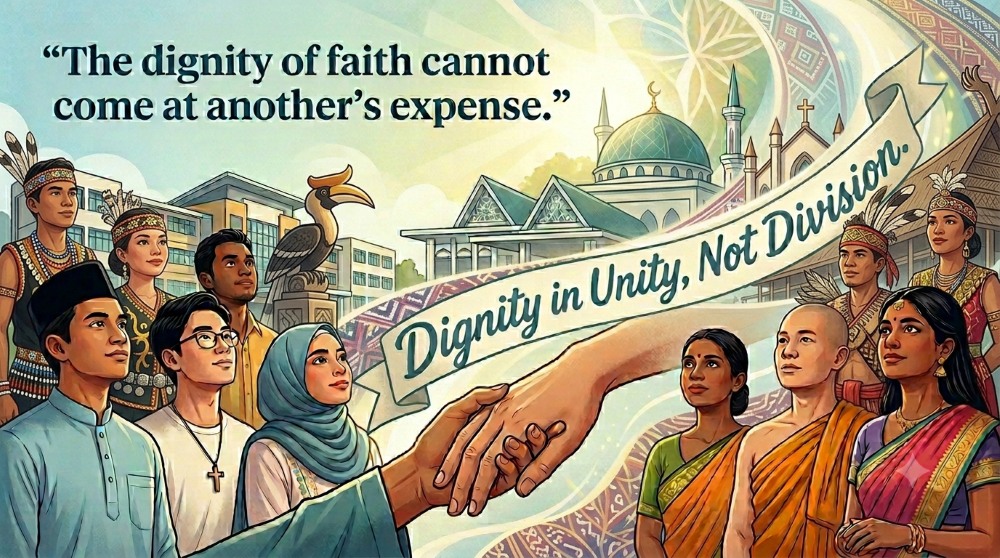
“Put that bl**dy cross away!”
That’s what an 11-year-old Malay classmate shouted when he saw my son’s cross pendant.
This sparked a punch-up on the school field over whose God is the most powerful.
That was almost three decades ago, at a public primary school in an urban area with a multi-ethnic population.
A few years later, my daughter’s cross pendant was confiscated by a school prefect on the orders of the discipline teacher. The cross was seen as an ‘accessory’ and accessories were against school rules. Mind you, this was in a public school, one of the top secondary schools in Petaling district.
- Sign up for Aliran's free daily email updates or weekly newsletters or both
- Make a one-off donation to Persatuan Aliran Kesedaran Negara (ALIRAN), Maybank a/c 507246118995 or CIMB a/c 8004240948
- Make a pledge or schedule an auto donation to Aliran every month or every quarter
- Become an Aliran member
Yes, even as far back as three decades ago such incidents did occur, even in places we would not expect. This was before the era of social media: so these incidents did not go ‘viral’. That allowed both these incidents to be settled privately and effectively.
My son became friends with the classmate he fought, after I spoke to the boy.
As for the confiscated pendant, I lodged a complaint at the district education office after the principal and the discipline teacher stood their ground.
The official in charge clarified that there was no such directive from the ministry and immediately sent a circular to all schools. It reiterated that cross pendants, Buddhist amulets, sacred wrist threads and kara bangles were not accessories and could be worn in school.
So was this just another case of “little Napoleons” distorting government policy in the schools concerned? I wonder what the policy is today.
These incidents raise the question: what are children taught at home and in religious classes about religious freedom and mutual respect in a multiracial and multi-religious society?
I used these two incidents as opportunities to teach my children about religious freedom as a basic right and how to defend it fearlessly – not just for themselves but for others as well, however different those others might be.
These incidents came to mind as I listened to speakers at the recent International Summit of Religious Leaders in Kuala Lumpur, which focused on youth empowerment.
It was encouraging to see hundreds of young people from various faith groups and cultural backgrounds coming together to listen to religious leaders from many countries, including the Vatican.
Muslim World League secretary general Mohammed Al-Issa highlighted an interesting point about “preventive peace”. The challenge, he said, is to stop conflicts before they begin.
“True harmony in our world lies not in extinguishing the flames of conflict, but in preventing them from igniting in the first place,” he said.
One way to do this is by embedding values such as mutual respect, justice, and friendship into child development and school curricula. The goal should be to normalise peaceful coexistence from early childhood.
The sultan of Perak touched on combating digital intolerance. AI-generated disinformation is used to weaponise youth grievances and radicalise young people. On the flip side, this can fuel Islamophobia and hate speech.
The sultan referred to the encyclical by Pope Leo XIV, Magnifica Humanitas (Magnificent Humanity), on safeguarding the human person in the AI age.
Sultan Nazrin Shah urged people never to believe that honouring their own religion requires putting down another’s. That is a powerful and timely reminder.
But what if state-sanctioned authorities use their power to diminish the dignity of your faith or even question your faith?
How can an individual or group challenge or resist the might of the state when it imposes its interpretation of religious dos and don’ts?
The Madani government deserves credit for some initiatives to foster greater inter-religious understanding and harmony.
But recent incidents raise doubts about the authorities’ credibility in safeguarding religious rights. Can they manage religious tensions effectively, including tensions within a single faith – such as the hostility towards the Rohingya community?
Belief in God is the first principle in the Rukun Negara. Freedom of religion is enshrined in Article 11 of the Federal Constitution. That freedom is not absolute, as some restrictions apply.
But can these restrictions be used to deny any person the right to not believe in God or religion or any particular interpretation of a religion?
The position of Islam as the religion of the federation is enshrined in Article 3(1) of the Federal Constitution.
But this should never be used as justification to erode or limit the religious rights of non-Muslims in Malaysia.
Yet, some people suggest doing exactly that. They conveniently ignore that Article 3(1) also states that other religions may be practised in peace and harmony in any part of the federation.
Why we can’t leave it to others
But what happens if the authorities impose restrictions using arbitrary definitions of “public order” and “religious sensitivity”?
Consider the restrictive planning guidelines for houses of worship in Selangor, which raised considerable public disquiet.
It turned out that these controversial ‘guidelines’ were actually approved by the state government six months ago. They had remained unnoticed until the issue was recently highlighted by Petaling Jaya MP Lee Chean Chung, one of a group of disgruntled PKR MPs.
The state government has since revised these guidelines, but only after a public outcry from non-Muslim faith groups and the rebranded Bersama party.
We cannot just leave it to elected representatives or the government to protect our basic rights. After all, the Malaysian Racism Report 2025, published by Pusat Komas, found that of the 107 documented cases of racial and religious rhetoric, 40.2% took place in Parliament!
Even well-meant policies can have unintended consequences and end up infringing on our basic rights. When that happens, the government and the relevant authorities cannot just focus on damage control and manage perceptions. They have to tackle the root causes and ensure swift redress.
We need to be vigilant. We need to know our rights and make use of every available avenue to protect them. Young people have to be empowered to stand up for their rights.
So what does the dignity of our respective faiths depend on? Is it how much power its followers hold over others? Is it how much bigger, taller, louder and grander its places of worship are?
Or is it simply how well we live up to the basic teachings of our own faiths?
AGENDA RAKYAT - Lima perkara utama
- Tegakkan maruah serta kualiti kehidupan rakyat
- Galakkan pembangunan saksama, lestari serta tangani krisis alam sekitar
- Raikan kerencaman dan keterangkuman
- Selamatkan demokrasi dan angkatkan keluhuran undang-undang
- Lawan rasuah dan kronisme

Thank you Madam for the article.
Thank you for your enlightening comments.
Enlightening to you Mary Mag but racism was a painful experience to me, a Malayalee Catholic being discriminated by the Tamil Hindus. Stockholm was supposed to me my second or third posting by these so-called officers sabotaged my chances.
Thankfully, only when a Malay Director General took over justice prevailed for me. She sent me to Stockholm, gave me the Excellent Service Award for the second time and I was bestowed the AMN by the King when she was DG.
They say pain/suffering can be the pathway to enlightenment. 😊
Yes, Ben – I can empathise with your painful experience & it can be even more painful if our ‘own people’ are the perpetrators. But your comments are enlightening because it highlights i) the complex intra-ethnic tensions ii) the inter-religious tensions even within the same broad ethnic group ( I’m only too aware of the Malayalee vs Tamil narrative🤪) iii) it’s not always a Malay vs non-Malay situation at our workplaces or social settings although it may seem like the major recurring theme in Malaysian politics; that in fact a non-Malay’s greatest ally may be a Malay.
So, we must be careful about making generalisations about anything based on our individual experiences.
Importantly, educate people on Respect.
The word tolerance should be taboo whenever it involves race, religion and age.
And Respect should be taught to the younger generation from the day they were borned into this world by parents, siblings and grandparents before this value are further inculcated in them throughout their lives in schools, higher education and work spaces.
There are racists and religious everywhere. If we lived in a homogenous society, we would find a different kind of racism. I was a civil servant for 33.5 years, 23 years in the Ministry of Hunan resources and 10.5 years in MIDA.
The worst racist in MIDA were the Tamil Hindus, not the Chinese or Malays. The Tamil Hindus used to refer to people like me as a Christian not an Indian.
The government of d day may have great plans for inter faith harmony n respect among the races n religions for a more harmonious Malaysia but if this vision is not shared down d line it will be futile. Little Napoleons will practice what they believe it should be and contradict what is being advocated at d top. If d foundation is not strong the whole building will collapse.