Mustapa Mohamed
The Strait of Hormuz narrows to just 21 miles wide at its narrowest point. Through this needle’s eye passes about a fifth of the world’s oil supply.
Recently, as drones flew and ships were seized, the world watched the chokepoint with bated breath. For a moment, the global economy didn’t just worry about a climate crisis, it panicked over an energy crisis.
In that panic, a glaring truth emerged that often gets lost in environmental summits and carbon-neutral pledges. The fight against fossil fuels is not just a fight for the planet; it is a fight for the very architecture of global financial control.
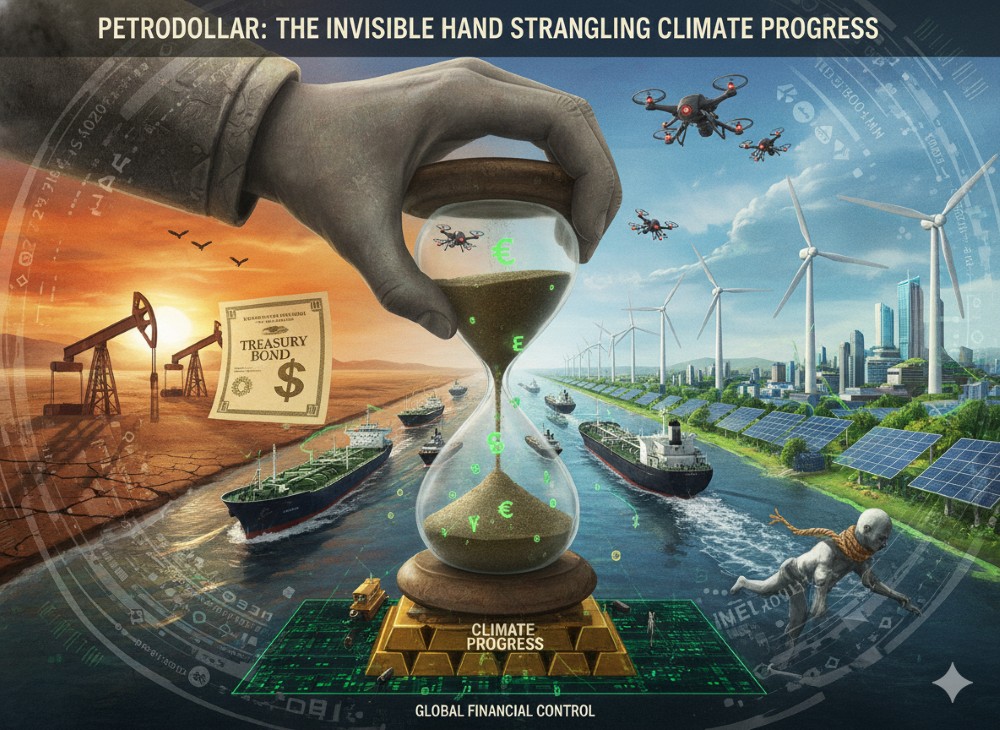
The recent Iran-US tensions have laid bare the uncomfortable reality that the “petrodollar” is the invisible hand strangling our climate progress.
- Sign up for Aliran's free daily email updates or weekly newsletters or both
- Make a one-off donation to Persatuan Aliran Kesedaran Negara (ALIRAN), Maybank a/c 507246118995 or CIMB a/c 8004240948
- Make a pledge or schedule an auto donation to Aliran every month or every quarter
- Become an Aliran member
To understand why the transition to green energy faces such vehement geopolitical opposition, we must look not at the smokestack, but at the Treasury bond. The system, established in the 1970s, is elegantly simple and brutally effective: all major oil transactions are denominated in US dollars.
This creates an insatiable global demand for dollars, allowing the United States to run massive deficits, fund its military and maintain economic supremacy. If you phase out oil, you phase out the dollar’s monopoly.
Existential stakes
The recent conflict with Iran brought this into razor-sharp focus. When the Strait of Hormuz is threatened, it is not merely a supply chain issue. It is an attack on the dollar zone.
The panic in the markets was not just about expensive petrol; it was a primal scream from a system realising its own fragility.
Any disruption to the flow of oil is an existential threat to an American economy that has structured the entire post-war world order around oil.
This is why the “phase out” rhetoric from Western capitals often rings hollow in the ears of many oil-dependent nations. They see the US – a country that has oscillated between being a climate leader and a “drill-baby-drill” advocate –suddenly sanctioning nations that try to sell oil in currencies other than the dollar.
Think of the pressure on nations trading with China in yuan. It appears less like a moral crusade to save the ice caps and more like a strategic defence of the realm.
For nations like Russia, Iran and even some Gulf states, the move towards renewable energy is a double-edged sword. On one hand, they face an existential climate threat. On the other, the very source of their sovereign wealth, their geopolitical leverage and their internal stability is a barrel of oil. To ask them to abandon it is to ask them to dismantle their power structures.
The petroledger
The conflict reveals that the petrodollar is something like a “petroledger” – a historical debt that the US economy owes to oil.
The US has a vested interest in keeping the commodity valuable and in circulation, not because Americans love pollution, but because the seigniorage – the profit from issuing currency – allows the state to function.
If the world shifts to a decentralised, electrified energy grid powered by sun and wind found everywhere, where does the demand for dollars go? It evaporates.
This does not mean we are doomed to burn fossil fuels forever. But it does mean that the energy transition is not just a technological problem to be solved by better batteries. It is a geopolitical land grab.
The resistance to phasing out fossil fuels is not just about oil company lobbyists, though they play a part. It is about the fear of a power vacuum.
If the petrodollar collapses, what replaces the US Navy’s ability to keep the sea lanes open? What replaces the Treasury’s ability to borrow at rates others cannot?
A new financial order
The anxiety many feel over Strait of Hormuz closures is the sound of a system realising its own Achilles’ heel.
And it points to something important: until we decouple global financial stability from the flow of oil, every climate conference will be a negotiation over how to commit suicide slowly.
The countries most vehemently opposing the phase-out are not just climate deniers. They are survivalists trying to protect the currency of their power.
The path forward, therefore, is not just about green technology. It must be about a new financial architecture. We need a “climate dollar” or a basket of currencies for energy trade that severs the link between geopolitical leverage and environmental policy.
Until we solve the petrodollar puzzle, wars will keep being fought over oil, and climate progress will stay held hostage by the very real fears of economic collapse.
The fight for the planet is, and always has been, a fight for a new economic order. The tension in the Persian Gulf is just the opening salvo.
Dato Seri Mustapa Mohamed is an advisor at the Ungku Aziz Centre for Development Studies, University of Malaya.
AGENDA RAKYAT - Lima perkara utama
- Tegakkan maruah serta kualiti kehidupan rakyat
- Galakkan pembangunan saksama, lestari serta tangani krisis alam sekitar
- Raikan kerencaman dan keterangkuman
- Selamatkan demokrasi dan angkatkan keluhuran undang-undang
- Lawan rasuah dan kronisme