The news arrived in two parts, hours apart.
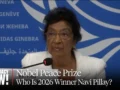
First, from Oslo: the Nobel Committee awarded its 2026 Peace Prize to Navi Pillay, a former judge of the International Criminal Court (ICC). It honoured her work for international law at what the citation called “a time when judges and institutions of international law are under political attack.”
Then came the answer from the US. Sweeping sanctions were imposed on the court itself – its resources to be cut off, its operations crippled. US Secretary of State Marco Rubio dismissed it as a “rogue court”.
The ICC described the measures as “an assault on the rule of law and the foundations of the international legal order.”
I am no political scientist. I am writing this as someone who reads the news late at night and then cannot sleep.
- Sign up for Aliran's free daily email updates or weekly newsletters or both
- Make a one-off donation to Persatuan Aliran Kesedaran Negara (ALIRAN), Maybank a/c 507246118995 or CIMB a/c 8004240948
- Make a pledge or schedule an auto donation to Aliran every month or every quarter
- Become an Aliran member
What I felt reading those two headlines was not outrage. It was a kind of cold confirmation.
A court built to hold the powerful to account was being punished for exactly that. The punishment was timed to mock the very idea that the law might bind the strong.
I was born at the end of World War Two. After the trenches and the camps and Hiroshima and Nagasaki, the world did something unprecedented. It wrote down rules:
The UN Charter.
The Universal Declaration of Human Rights in 1948, which declared that all human beings are born free and equal in dignity and rights.
The Genocide Convention.
Nuremberg, which established that even heads of state could be tried.
The promise was simple and enormous. It declared that from then on, power would be bound by law and sovereignty would be equal. We would be citizens of a world and not merely subjects of whoever held the biggest guns.
For the first time in history, there was a road to a civilised existence.
The road has collapsed
That road has collapsed. In my own lifetime, I have watched the signposts come down.
A sitting head of state abducted from his own capital by a foreign army.
Gaza reduced to rubble while court orders were simply ignored.
Iran bombed in an unprovoked attack.
Venezuela blockaded, its tankers seized by force.
The Americas (what Washington calls the Western Hemisphere) declared, openly, to be America’s sphere of influence.
Institutions of accountability defunded, delegitimised and blacklisted.
Each act justified as necessity. Each violation met with a shrug dressed up as realism.
Cheering crowds
What frightens me most is not the powerful. It is the crowds.
Every time a line is crossed, there are people cheering – not a few cranks, who could be shrugged off, but millions.
They cheer when a court is humiliated, when a city is flattened, when a leader is dragged away in chains. They cheer not because they have weighed the evidence, but because the violator wears their colours.
Reason has become a football tournament. We are no longer a world of citizens. We have become a world of fans.
Underneath the cheering is something worse: helplessness.
I can vote, but it changes little. Sanctions, wars and surveillance run through executive orders, secret agencies and private contractors that no ballot reaches.
I can protest; I am a nuisance. I can organise; I am monitored. I am told information has never been freer; yet the news arrives pre-framed, pre-angered, pre-divided.
I know something terrible is happening, and I cannot touch it. I am a spectator to my own future. And it is a future I would rather not see.
And I do believe this is a countdown. When law is treated as an obstacle, force is the only arbiter left.
There are too many flashpoints now – Venezuela, Iran, Gaza, Ukraine, Taiwan, the South China Sea, Korea – for all of them to stay contained.
Add climate collapse, cyber-attacks, resource wars and machines that can begin a war faster than a human can stop it.
A nuclear exchange would not simply kill millions. It would poison the soil, break the supply chains and end the connected civilisation that ordinary people depend on.
Those who would suffer most are those with the least say: workers, families, migrants, refugees, the poor. As always.
What can one person do?
Consider Navi Pillay. Born in apartheid South Africa, she became the first non-white woman to open her own law firm in the Natal province (now KwaZulu-Natal). She defended activists and prisoners when the law itself was designed to deny them equality.
She became a judge, and then president of the International Criminal Tribunal for Rwanda. There, she helped establish the principle that rape and sexual violence can constitute genocide.
She sat on the International Criminal Court. She served as the UN’s top human rights official. In 2025 she chaired the UN inquiry that concluded Israel had committed genocide in Gaza.
And in October 2026, the Nobel Committee awarded her the Peace Prize for a lifetime spent enlarging the reach of international law.
Her life is proof that one person, working through institutions and refusing to look away, can change what the law is capable of.
She did not stop a war. But she made accountability possible. That is not nothing. It is the difference between a world with rules and a world without them. Not nothing.
I can refuse to cheer. I can refuse to wear the colours of any empire, including the one that claims to speak for me.
I can keep alive the memory of what was promised: the Charter, the Declaration, Nuremberg. The powerful depend on us forgetting those rules ever existed.
I can bear witness, write it down, pass it on.
I can act locally, in solidarity with the vulnerable on my own street. I can reach across borders to others doing the same. The only counterweight to a tyranny of the few is a solidarity of the many.
It is thin. It is not enough to stop a war. But it is the difference between being a spectator and being complicit.
The road that collapsed was built once, by ordinary people who had just lived through hell. It can be built again. That is the only hope I have, and I am holding on to it.
And here at home, Aliran is part of that hope.
AGENDA RAKYAT - Lima perkara utama
- Tegakkan maruah serta kualiti kehidupan rakyat
- Galakkan pembangunan saksama, lestari serta tangani krisis alam sekitar
- Raikan kerencaman dan keterangkuman
- Selamatkan demokrasi dan angkatkan keluhuran undang-undang
- Lawan rasuah dan kronisme