Pravin Periasamy
The language used to describe emerging investment opportunities in the economy comes in all colours and shades.
There is the blue economy, which is primarily maritime-related; the green economy, covering renewable and sustainable energy; and the orange economy, which encompasses creative media.
The appeal of these colourful investment opportunities lies in their potential for strong value creation, acting as a powerful engine for economic growth.
For instance, Malaysia’s efforts to develop its blue economy by enhancing aquaculture protection help secure its long-term maritime interests and the health of its fisheries.
- Sign up for Aliran's free daily email updates or weekly newsletters or both
- Make a one-off donation to Persatuan Aliran Kesedaran Negara (ALIRAN), Maybank a/c 507246118995 or CIMB a/c 8004240948
- Make a pledge or schedule an auto donation to Aliran every month or every quarter
- Become an Aliran member
Similarly, supporting the green economy is crucial for the nation’s energy transition goals, as outlined in the national energy transition roadmap. This initiative aims to secure reliable, sustainable sources of power in an upcoming age of resource scarcity.
Taken together, these investments position Malaysia as an attractive hotspot for foreign investment, offering high returns backed by demonstrated industry growth. These economic activities are just a few of the many gears that turn Malaysia’s economic clockwork.
Governments around the world are incentivised to seek out novel investment areas for this very reason – to propel the economy forward and, more importantly, to keep it future-proofed.
Typically, investable opportunities are viewed as promising based on a few key considerations. Namely, they are supported by global shifts, prove to be profitable, and help address pressing issues closer to home.
Referencing the coloured investment concepts mentioned earlier, investing in nascent green technologies and innovation is one way governments can create new, high-value job prospects. This mitigates the threat of unemployment, especially as traditional jobs phase out of relevance.
That said, recent global trends highlight a pressing and urgent need for governments to invest in and help scale the ‘silver economy’. Unlocking the potential of the silver economy provides a much-needed lifeline for one of Malaysia’s most vulnerable groups – older people.
Here, Malaysia must invest comprehensively.
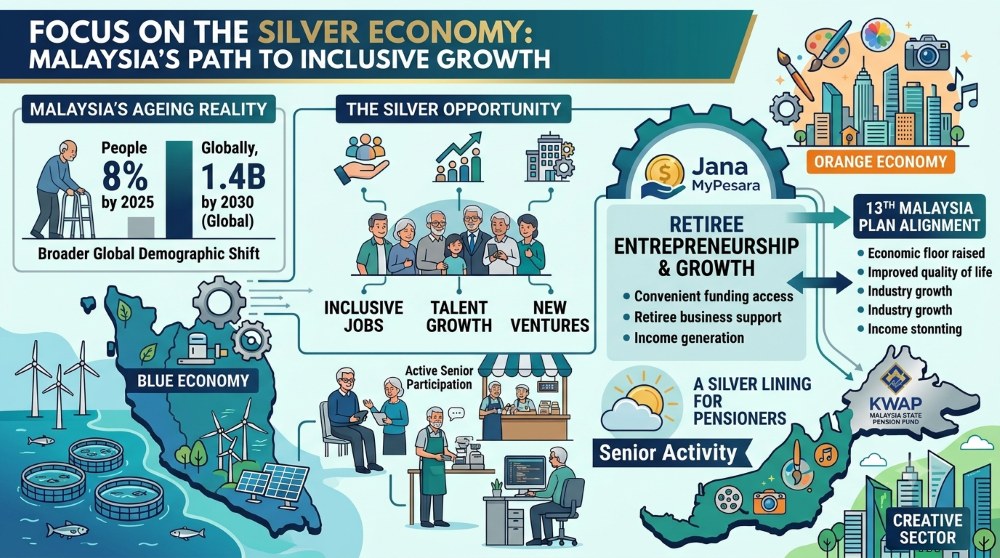
Malaysia’s ageing reality
The silver economy focuses on the economic activities and output of older people, particularly retirees. It has gained prominence over the years largely due to ageing populations worldwide.
Malaysia is no exception; it has been designated an ageing country given the rising proportion of older people.
A resulting challenge is that there are fewer workers to support Malaysia’s long-term growth and stability. This reflects a broader global trend as nations experience dramatic demographic shifts.
The World Health Organization notes that the number of people aged 60 and above is projected to rise to 1.4 billion by 2030, up from 1 billion in 2020.
In Malaysia, the percentage of the population aged 65 and above rose to 8% in 2025, up from 7.6% in 2024.
Beyond the immense costs this presents to healthcare, the implications of neglecting older people are even more alarming. It risks a spillover effect on the government’s ambitions to sustain an inclusive economy.
If a sizeable portion of the population is effectively cut off from Malaysia’s national services, programmes and initiatives, national productivity may slow down.
When consumer markets shrink and businesses see less traffic, the effects eventually spill over into the labour market.
As problematic as this is, it also provides a valuable investment opportunity: it allows Malaysia to structurally support its older people and their needs in a way that also contributes to the economy.
Retirees want to work
This opportunity converges most clearly in retiree-led businesses. For many older people, starting and maintaining a business has proven incredibly challenging.
While a steady cash flow is instrumental to a successful business, it is difficult to achieve. The problem is compounded when retirees are unable to access needed funds due to decreased savings, or when they hit credit limits because banks perceive them as high risk.
In the long term, this can adversely affect the country’s labour force participation rate.
Equally worrying is the reality that many older people would like to pursue entrepreneurship post-retirement but have very little means to do so.
Tapping into this potential could do wonders for Malaysia as it focuses on talent development to drive innovation across all age groups.
It serves as a recipe for inclusive economic participation, boosting Malaysia’s competitiveness by nurturing diverse businesses into powerhouses of future job growth.
Achieving this will almost certainly provide a profitable investment return.
A microfinancing breakthrough
One initiative promoting the silver economy that deserves praise is the early 2026 announcement by KWAP, Malaysia’s state retirement fund.
KWAP’s launch of Jana MyPesara will offer significant relief for retiree-led businesses. Designed as a convenient and accessible microfinancing platform, the scheme makes it much easier for older individuals to secure the funds needed to run their businesses and generate sustainable income.
This policy support aligns with a broader backdrop: Malaysia’s 13th Malaysia Plan, which aims to raise the economic floor by spearheading multiple avenues for older people to increase their quality of life.
KWAP CEO Nik Amlizan Mohamed has called on the public to recognise the aspirations of older people. She noted that many pensioners have contributed years of service to the nation and want to remain active, independent and economically engaged. For some, the barrier is not motivation, but access to the right support and capital.
Giving pensioners a second chance – an opportunity to create something of their own so they can continue to contribute to the nation – is truly a silver lining made possible by Malaysia’s silver economy.
Pravin Periasamy is the executive director of the Malaysian Philosophy Society.
AGENDA RAKYAT - Lima perkara utama
- Tegakkan maruah serta kualiti kehidupan rakyat
- Galakkan pembangunan saksama, lestari serta tangani krisis alam sekitar
- Raikan kerencaman dan keterangkuman
- Selamatkan demokrasi dan angkatkan keluhuran undang-undang
- Lawan rasuah dan kronisme