M Santhananaban
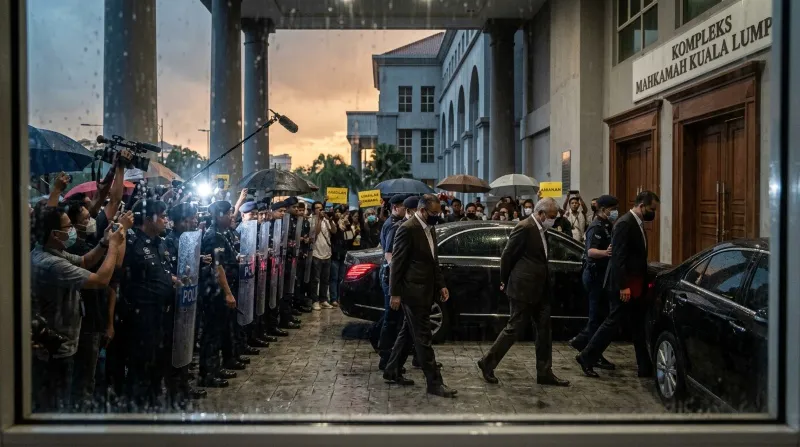
Thursday, 27 August, was one of Malaysia’s most unusual and sobering days.
Three former prime ministers found themselves in a difficult spot. They were defending their positions at the Kuala Lumpur Court Complex.
All three had been summoned to separate proceedings over alleged white-collar wrongdoing.
South of the city, in Putrajaya, a former secretary general of the Ministry of Finance was produced in court to enable the Malaysian Anti-Corruption Commission (MACC) to seek a remand order. That case comes from a separate probe into the Tabung Haji royal commission of inquiry report – not the pension matter described below.
- Sign up for Aliran's free daily email updates or weekly newsletters or both
- Make a one-off donation to Persatuan Aliran Kesedaran Negara (ALIRAN), Maybank a/c 507246118995 or CIMB a/c 8004240948
- Make a pledge or schedule an auto donation to Aliran every month or every quarter
- Become an Aliran member
All four men belong to the baby-boomer generation. All once held high government office, and all draw generous pensions from the public purse. When they stepped down, they would also have received their gratuity as a matter of course.
The pensions saga
Two of the four – the sixth prime minister and the former Treasury secretary-general – have separately been named in other public reports and litigation.
The claim: decisions they took denied fair pensions to civil servants who retired before January 2013.
Amendments made in 2013 to the Pensions Adjustment Act 1980 replaced the old formula with a flat 2% annual increment.
Retirees challenged this in court as being less generous than what came before. They say the change apparently had the backing of the government’s then chief secretary and the then Public Services Department’s director general. The PSD later became a party to the appeals over pension adjustments.
Courts have since ruled the 2013 amendments unconstitutional. They found the changes left pre-2013 retirees worse off. Later appeals, though, have limited how much can be paid out in backdated arrears.
Denying a group of pensioners their fair share was not just unlawful and wrong, campaigners say. It was mean-spirited, too.
‘Three wise men’
The trio – the chief secretary, the PSD director general and the finance ministry’s secretary general – are known in civil service circles as ‘the three wise men’.
Between them, they are said to shape the fate, promotions and progress of civil servants generally, and of the most senior officials in particular. This group has long been seen as the most powerful influence over other civil servants’ appointments, dismissals, rewards and punishments.
All three have gone on to hold some of the most sought-after chairmanships at the country’s government-linked companies and investment funds.
One apparent condition for the role seems to have been more than obedience. It called for a readiness to be obliging towards the prime minister of the day.
In July 2015, the chief secretary to the government at the time personally announced the removal of the attorney general. It was a controversial move that made headlines.
Looking back at the troubles of the now-imprisoned sixth prime minister, it becomes clear that such ‘wise men’ were loyal to him well beyond the bounds of reason or restraint.
Every major scandal to hit the nation – Felda Global Ventures, Tabung Haji, Jana Wibawa and 1MDB – happened partly because such so-called wise men failed in their duty. Instead of checking power, they became compliant yes-men. They appeared to have forgotten their duty to uphold the law and the principles of good governance.
Had the sixth prime minister won the 2018 general election, this same group would likely have gone on to hold the most prestigious chairmanships across the network of government-linked firms and investment companies. Their failure as guardians of good governance would probably have been swept under the carpet.
We are where we are today – with three former prime ministers making their court debut – thanks to conscientious investigators, deputy public prosecutors and a highly competent judiciary.
We owe a debt of gratitude to the MACC, the police, the Attorney General’s Chambers and the judges who led the courts through this period. That includes former chief justices Richard Malanjum and Tengku Maimun Tuan Mat.
This is the only credible way out of the darkest phase in the country’s history, one where the highest elected and appointed officials have been shown to be seriously compromised.
We need principled, courageous civil servants at the top of the service. Not this timid, malleable mould of men chasing fresh contracts after retirement.
Long court process
The court cases involving the three former prime ministers will take a long time to conclude. Let’s hope they proceed smoothly and that justice is done.
For their part, civil servants and technocrats must act professionally and with integrity, in line with the law. They should not be seen to be colluding with politicians in high office.
The country’s interests must come first, well above the narrow interests of political leaders.
Dato’ M Santhananaban is a former Malaysian ambassador with 45 years of public sector experience.
AGENDA RAKYAT - Lima perkara utama
- Tegakkan maruah serta kualiti kehidupan rakyat
- Galakkan pembangunan saksama, lestari serta tangani krisis alam sekitar
- Raikan kerencaman dan keterangkuman
- Selamatkan demokrasi dan angkatkan keluhuran undang-undang
- Lawan rasuah dan kronisme