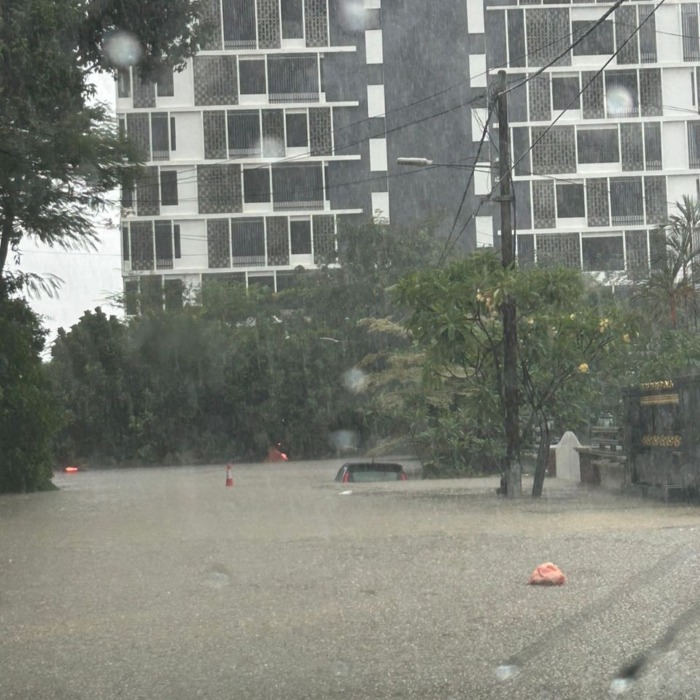
On the evening of 6 May, Kuala Lumpur flooded again – but this time, it felt different.
Many residents across OUG were saying something I personally never thought I would hear so often in one day: “I have never seen this happen before.”
I was there witnessing it myself, not reading headlines later or watching videos after the event. Standing there. Watching the roads disappear under water. Vehicles stranded helplessly. Residents rushing to move cars and household items while rain continued pounding the city.
The frightening part was how quickly everything escalated. Within minutes, residential WhatsApp groups across OUG exploded with photographs, videos, warnings and questions. Floodwaters entered parts of Jalan Hujan Bubuk, including reports of water flowing into living rooms.
Nearby highways and roads began choking under the pressure of rising water: Kuchai Lama, NPE, Kesas near Awan Besar, Jalan 222.
- Sign up for Aliran's free daily email updates or weekly newsletters or both
- Make a one-off donation to Persatuan Aliran Kesedaran Negara (ALIRAN), Maybank a/c 507246118995 or CIMB a/c 8004240948
- Make a pledge or schedule an auto donation to Aliran every month or every quarter
- Become an Aliran member
Several parts of the Klang Valley struggled under flash floods and severe congestion. The city simply could not cope.
After the waters slowly receded, what remained was something bigger than flood damage: questions, many questions.
What the photographs raised
One of the most discussed photographs circulating among residents showed a large drainage channel suddenly narrowing into what appeared to be the opening of a box culvert – an enclosed concrete channel buried beneath the road.
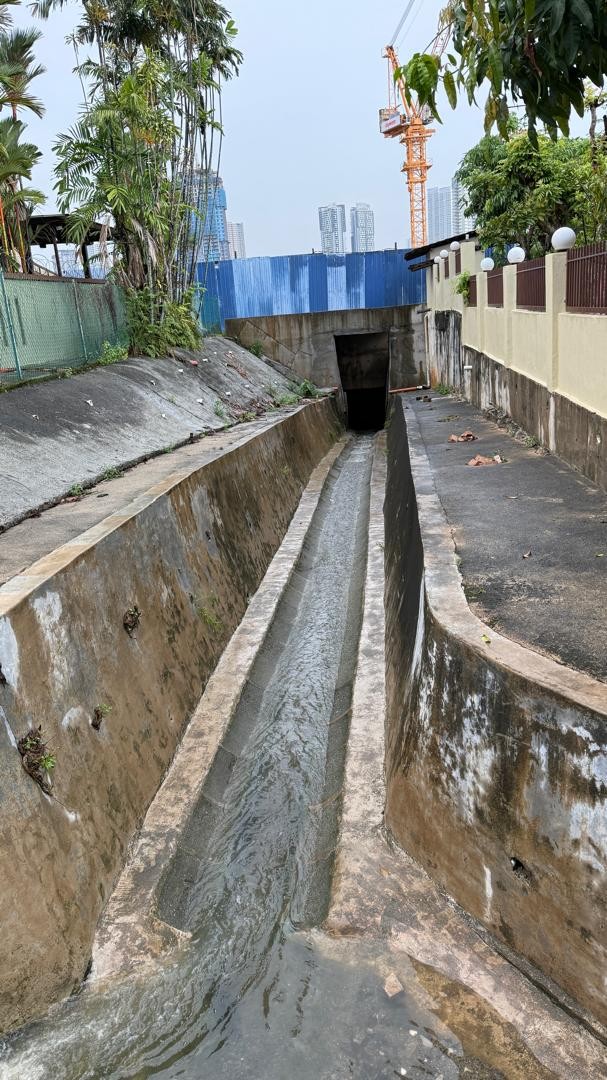
To ordinary residents, even without engineering backgrounds, the image raised immediate concern. How does a relatively wide and fast-moving upstream drainage flow suddenly get compressed into a much narrower outlet during heavy rain?
If massive volumes of stormwater are forced into a restricted discharge point, what happens upstream? Water backs up, roads overflow and homes flood.
Several residents began discussing whether an unidentified bottleneck may exist somewhere near the box culvert system.
Others recalled that years earlier, the residents’ association together with Kuala Lumpur City Hall had carried out a surface water catchment study, after which an earlier pipe culvert was upgraded into a larger box culvert connected to the main drainage outlet.
There were also recollections from previous flooding incidents around three years ago, where blockages caused by construction debris near the sump – the collection pit – before the culvert reportedly contributed to overflow problems.
This is where the public discussion became more complex.
Some residents initially blamed nearby developments, while others pointed out that the area’s terrain, water flow patterns and historical flood vulnerabilities long pre-dated recent projects.
Jalan Hujan Bubuk houses, for example, were completed decades ago around the late 1970s, while Kesas itself has existed since the late 1990s.
The real planning question
The more important issue now may not simply be whether development exists.
The real issue is whether every new project is being designed fully around the constraints and realities of the existing environment surrounding it.
That is the responsibility of modern urban planning. It is not merely about building structures, but also about understanding water behaviour, terrain pressure, discharge limitations and long-term climate risks before approving higher-density expansion.
Rainwater does not care about brochures, launch events or project valuations. It follows the laws of physics. If upstream runoff increases dramatically due to urbanisation while discharge capacity remains constrained, pressure builds somewhere within the system.
That pressure eventually surfaces in the lives of ordinary people: inside their homes, inside parking lots, and across roads and highways.
One observation was especially striking. During a relatively milder rain event after the major flooding, some noticed ponding on one side of the road despite the drains not appearing completely full. Under normal severe downpour conditions, residents explained that drains outside homes along Jalan Hujan Bubuk would usually be visibly overflowing with aggressive water movement.
But this time, the flow behaviour appeared unusual – which raised more technical questions. Is water entering the box culvert efficiently? Is there a hidden obstruction somewhere downstream? Is sediment or construction debris restricting flow?
Has runoff volume increased beyond what the system was originally designed to handle? Or are changing urban conditions exposing weaknesses within an older drainage network now pushed beyond its limits?
These are not emotional questions. They are engineering questions. And they deserve engineering answers.
A city that has outgrown itself
Many residents feel uneasy when official explanations reduce such events simply to “heavy rain”.
Yes, the rainfall was intense. Indeed, climate patterns today are no longer what they were 20 or 30 years ago. Extreme rainfall events are becoming increasingly frequent.
Meanwhile, urban density across the Klang Valley has multiplied. Concrete surfaces have expanded massively while natural absorption areas continue shrinking.
Yet many drainage systems still appear dependent on infrastructure designed for an older Kuala Lumpur. A less dense Kuala Lumpur. A cooler Kuala Lumpur. A cooler Kuala Lumpur.
That city no longer exists. Yet the drainage systems beneath it are still expected to cope as if it does.
Perhaps that is why fear now follows every dark cloud across the Klang Valley – not fear of rain, but fear that the city can no longer protect the people living in it.
AGENDA RAKYAT - Lima perkara utama
- Tegakkan maruah serta kualiti kehidupan rakyat
- Galakkan pembangunan saksama, lestari serta tangani krisis alam sekitar
- Raikan kerencaman dan keterangkuman
- Selamatkan demokrasi dan angkatkan keluhuran undang-undang
- Lawan rasuah dan kronisme