
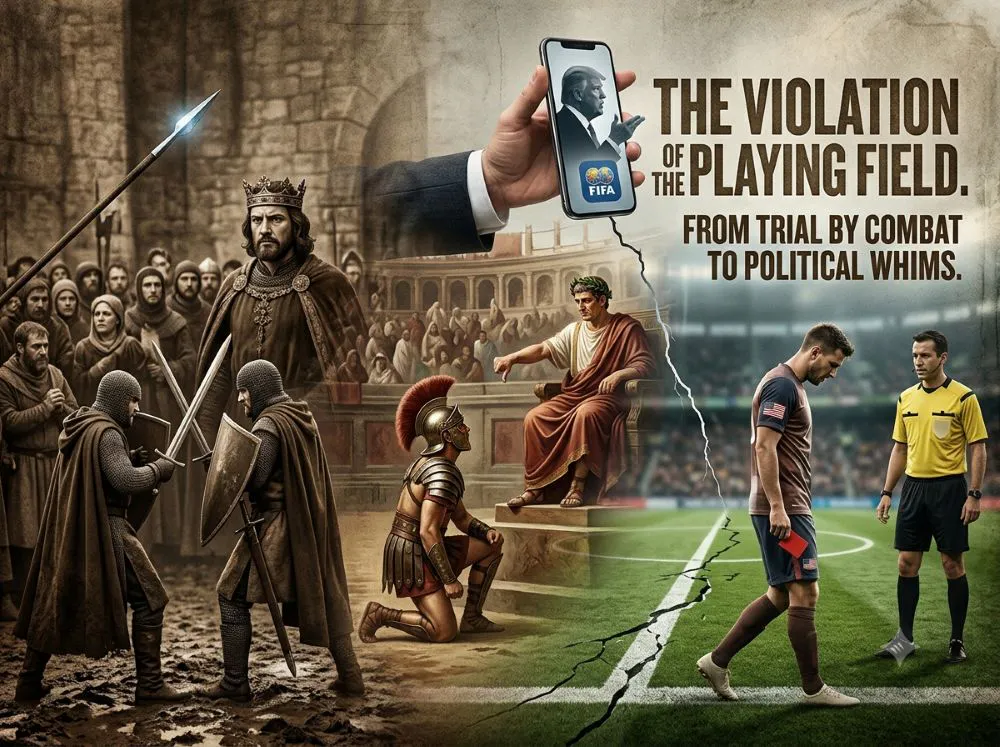
The violation of the playing field is not just a sporting scandal. It is a warning about the fragility of justice itself.
When leaders impose personal whims on the rules, both sport and law begin to slide backwards.
From swords to stadiums
The sports arena – tennis, sepak takraw or football – is one of humanity’s most refined ways of settling conflict without bloodshed.
In early medieval England, from where our common law traces its roots, disputes were settled through trial by combat. Victory in a fight with swords and lances was believed to reveal a divine verdict.
Long before that, in the Roman amphitheatre, the emperor’s thumb decided life or death. A single gesture could spare a gladiator or condemn him. The law was whatever the emperor felt in that moment. And emperors, then as now, could be unstable.
- Sign up for Aliran's free daily email updates or weekly newsletters or both
- Make a one-off donation to Persatuan Aliran Kesedaran Negara (ALIRAN), Maybank a/c 507246118995 or CIMB a/c 8004240948
- Make a pledge or schedule an auto donation to Aliran every month or every quarter
- Become an Aliran member
The irony is that modern common law grew by rejecting this world of sovereign whim. As societies developed, kings gave up their personal power to decide disputes. Rules, evidence, juries and procedure took their place. When monarchs stepped back, the law stepped forward.
The courtroom became the civilised successor to the arena. It was a space where justice no longer depended on strength, luck or the temper of an unstable emperor. Instead, it rested on principles that applied equally to everyone.
Sport mirrors this same shift. Instead of killing or maiming opponents, societies built rules based on fairness. This created a level playing field where conflict could stay fierce yet civil. It forced rivals to accept equality under the law and submit to an impartial arbiter: the referee or umpire.
The playing field became a space where victory was decided not by a ruler’s whim, but by rules that bound everyone equally.
A president’s phone call
This is why the 2026 Fifa World Cup, hosted largely in the United States, has become such a troubling spectacle. The tournament has been overshadowed by political interference and discriminatory enforcement of the rules.
These are not minor regulatory issues. They strike at the heart of what makes sport meaningful: the promise that fairness will prevail within the painted lines.
One of the most widely reported controversies involved American striker Folarin Balogun, who received a straight red card in the round of 32. Under Fifa’s rules, this carries an automatic one-match ban.
Yet after the incident, US President Donald Trump phoned Fifa president Gianni Infantino to ask for a review.
Fifa suspended the ban under Article 27 of its disciplinary code.
The move was so unusual that European football bodies – and Uefa itself – warned it had “crossed a red line”.
Whatever one’s view of the tackle itself, the principle is clear. A head of state should not be able to sway the rules of play on the field, however powerful he is.
When political power intrudes into the referee’s domain, the playing field stops being a sanctuary. It becomes an extension of political authority, much as the arena once was in Rome. This is precisely what sport had grown beyond.
Border checks, not fair play
The erosion of fairness has not stopped at the pitch. Immigration enforcement has repeatedly disrupted the basic promise of neutral ground for a global tournament.
Somali referee Omar Abdulkadir Artan, one of only 52 officials chosen by Fifa for the tournament, was denied entry to the US at Miami airport and sent home, despite holding a valid visa and diplomatic passport.
Iraqi striker Aymen Hussein was held for nearly seven hours at Chicago’s O’Hare airport before he was allowed in. The team’s photographer was denied entry altogether.
The Palestinian Football Association’s president, Jibril Rajoub, said he was not granted a visa at all.
These incidents show how easily the neutrality of sport can be compromised when politics intrudes. When immigration officers, rather than referees, decide who takes part, the playing field is no longer governed by the rules of the game, but by the unfair decisions of the host nation.
The effects have reached beyond the players too. Rights groups have documented heightened risks for immigrant communities in host cities, including visa restrictions and targeted policing.
The World Cup is meant to celebrate humanity’s diversity. Instead, many communities feel watched or excluded.
Fairness is not only about the players. It is about the fans who fill the stadiums and give the game its spirit.
Press freedom, another pillar of fairness, has also come under strain in the host country. Journalists covering the tournament have faced arrests and deportations. When press freedom is restricted, transparency suffers, and the moral authority of the playing field weakens.
Sport is more than entertainment. It is one of humanity’s most successful experiments in managing conflict without violence.
And here lies the deeper warning. If fairness can be violated on a rule-bound football field, it can be violated in the courtroom too. The courtroom is the far more complex arena on which our entire justice system rests.
Kings once gave up their personal power so that rules could govern disputes. We should worry when leaders begin to impose their kingly whims in settling disputes.
The playing field stays sacred only as long as we defend it.
AGENDA RAKYAT - Lima perkara utama
- Tegakkan maruah serta kualiti kehidupan rakyat
- Galakkan pembangunan saksama, lestari serta tangani krisis alam sekitar
- Raikan kerencaman dan keterangkuman
- Selamatkan demokrasi dan angkatkan keluhuran undang-undang
- Lawan rasuah dan kronisme
