When Putrajaya raised the minimum bumiputra ownership stake required to buy property from government-linked firms from 30% to 50%, it concentrated economic power further within the state’s own networks.
Rather than correcting the New Economic Policy’s inherent weakness, the revision perpetuates it.
On 18 November 2025, the Ministry of Economy’s equity development division – formerly the economic planning unit – revised its “Property Acquisitions Guidelines” (PAG) (Ministry of Economy, PAG, 18 November 2025; Conventus Law, March 2026).
Any company buying property worth over RM20m from government-linked firms or investment companies must now have at least 50% bumiputra equity ownership – up from 30%.
The change came by administrative directive, not parliamentary legislation. No published analysis of who would benefit has appeared to date.
- Sign up for Aliran's free daily email updates or weekly newsletters or both
- Make a one-off donation to Persatuan Aliran Kesedaran Negara (ALIRAN), Maybank a/c 507246118995 or CIMB a/c 8004240948
- Make a pledge or schedule an auto donation to Aliran every month or every quarter
- Become an Aliran member
Six months passed before the policy entered mainstream political debate.
The DAP’s Lim Guan Eng, in a press statement on 24 May, called on the prime minister to reverse it. He warned of market disruption and investor disillusionment.
Pas, through a statement by Takiyuddin Hassan, urged “clarity”.
The Ministry of Economy defended it as aligned with national socioeconomic objectives and the bumiputra agenda.
None of the parties asked the most important question: which bumiputras?
Structural failure
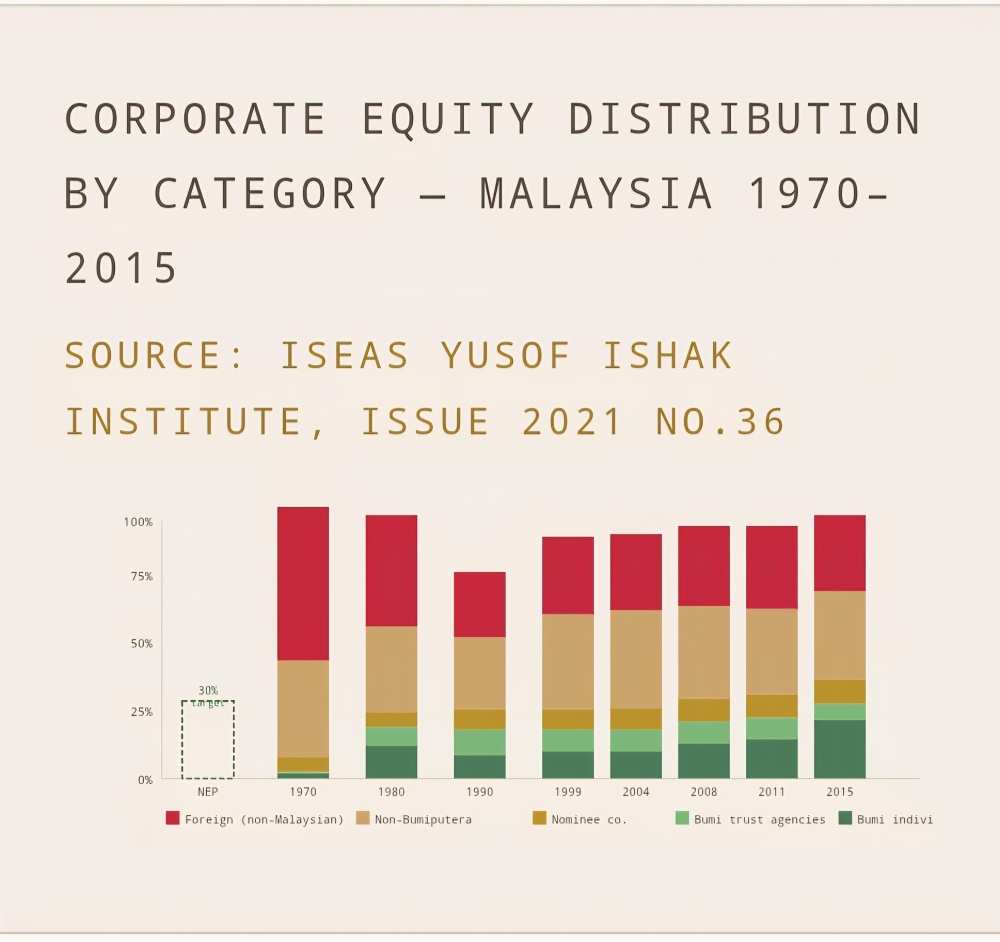
The Iseas corporate equity data establishes a context the Ministry of Economy’s guidelines do not adequately acknowledge (Iseas, Issue 2021/36; Ministry of Economic Affairs, 2019).
Across four-and-a-half decades of NEP implementation, the foreign corporate equity share fell from 63% in 1970 to around 25% by 1990, then stubbornly persisted in the 25–45% band. True, the foreign equity share declined from colonial-era heights but it has never been displaced from structural dominance.
Bumiputra overall equity reached only an estimated 22–25%, once nominee companies were partly reallocated to bumiputra holders. This is well below the original 30% NEP target.
The data tells a clear story. The NEP’s equity redistribution drive was defeated not by insufficient quotas, but by the structural power of foreign and non-bumiputra capital to survive every threshold the state set.
The PAG revision has not changed this. Its reach is confined to the state-controlled asset pool. It cannot affect foreign shareholdings in Bursa-listed companies, foreign direct investment structures or nominee-held equity.
The revision tightens conditions on domestic, state-mediated deals while leaving foreign corporate dominance untouched. In effect, the revised policy accentuates ethnic economic nationalism while reproducing the dependency it claims to correct.
Both thresholds – 30% and 50% – are class policies dressed in ethnic framing. The question is not the number. It is who holds the equity, and what they do with it.
Ethnocapitalism as a class instrument
Companies eligible under the 50% threshold are not small businesses or ordinary bumiputra families. They are corporate entities already embedded in government-linked firms’ networks – what scholars of Malaysian political economy call the state-adjacent rentier bloc.
World Inequality Lab data (Khalid and Rosli, 2025) confirms that the top 1% of Malaysian income earners captured 11.4% of national income in 2022. Meanwhile, the middle-income group’s share fell while intra-bumiputra inequality widened too.
The PAG revision operates in this class context with predictable selectivity. It routes government-linked property towards bumiputra capital already embedded in the state apparatus. This is precisely the group least in need of policy help, and most capable of using political access to benefit from it.
This is what political theorist Nicos Poulantzas called the condensation of class relations within the state: ethnic framing that manufactures consent for an arrangement that mainly serves those already advantaged within the targeted group.
There is a further irony. By narrowing the buyer pool for such asset disposals, the policy suppresses competitive valuations. The Employees Provident Fund, PNB, LTAT and Tabung Haji could then receive lower proceeds. Lower proceeds mean lower dividends (The Edge Malaysia, April 2026).
In the end, the people most affected are not foreign investors or non-bumiputra developers. They are ordinary EPF contributors whose retirement savings depend on institutions this policy structurally weakens.
The suppressed question
The mainstream debate – 30% or 50%? – is a debate within the architecture of Malaysian ethnocapitalism.
Both positions leave foreign corporate dominance unaddressed.
Both accept the complex of government-linked firms and investment companies as the vehicle for bumiputra capital formation.
Both serve the state-adjacent rentier bloc ahead of the bumiputra majority.
The structural question suppressed by this debate is not what percentage to set. It is why, after 55 years, bumiputra equity formation remains largely confined within state-controlled assets rather than grounded in productive ownership, skill formation and competitive enterprise.
The 50% rule is not a new direction. It is the NEP’s typical administrative reflex – the same logic, dressed in the language of economic justice for those it least serves.
What is needed is not a higher or lower threshold but a different understanding of state capital and its dominance.
AGENDA RAKYAT - Lima perkara utama
- Tegakkan maruah serta kualiti kehidupan rakyat
- Galakkan pembangunan saksama, lestari serta tangani krisis alam sekitar
- Raikan kerencaman dan keterangkuman
- Selamatkan demokrasi dan angkatkan keluhuran undang-undang
- Lawan rasuah dan kronisme