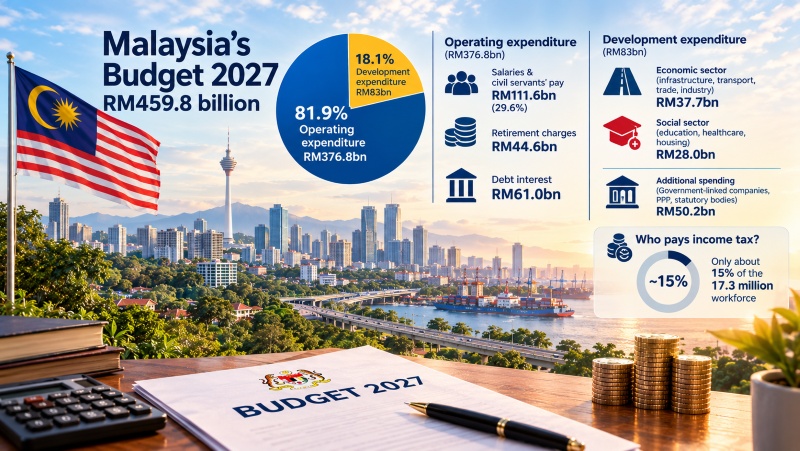
Malaysia’s Budget 2027 is a RM459.8bn spending plan.
Of this, RM376.8bn (81.9%) is for operating expenditure and only RM83bn (18.1%, or less than one-fifth) for development expenditure.
The operating expenditure shows pointedly what it costs to run the country. The government is spending RM4.54 on operating expenditure for every RM1 on development expenditure.
The largest amounts go to salaries and debt. Among others, RM111.6bn (29.6% of operating expenditure) is for civil servants’ pay, including health and education staff.
Retirement charges for the public sector come to RM44.6bn alone, for pensions and gratuities.
- Sign up for Aliran's free daily email updates or weekly newsletters or both
- Make a one-off donation to Persatuan Aliran Kesedaran Negara (ALIRAN), Maybank a/c 507246118995 or CIMB a/c 8004240948
- Make a pledge or schedule an auto donation to Aliran every month or every quarter
- Become an Aliran member
Federal debt interest payments amount to RM61.0bn.
The much smaller share for development – less than a fifth of Budget 2027 – paints a particular picture of how the country is run.
Before the late 1980s, government-financed development and infrastructure spending accounted for a substantially larger share of public expenditure, averaging roughly one-third.
Today, the government is funding about 1,500 new projects. But much of the money goes to capital projects and economic infrastructure rather than expanded social services.
The biggest portion, RM37.7bn, goes to the economic sector, which covers infrastructure such as transport, trade and industry. Just RM28.0bn goes to the social sector, which covers education, healthcare and public housing.
Beyond the federal budget, the government is also mobilising another RM50.2bn through government-linked investment companies, public-private partnerships and statutory bodies. This takes overall spending to RM510bn.
Such projectscollected in 2023. often attract accusations of “crony privatisation”. Critics argue that joint investments may benefit big industrialists and entrenched business interests more than public welfare and social services for the people.
Who pays income tax
How can the government sustain both operating expenditure and development expenditure?
Out of a labour force of 17.3 million people in December 2024, only about 15% currently pay income tax, according to Economy Minister Akmal Nasrullah Mohd Nasir.
Most people, mainly from the bottom 40% and middle 40% income groups, do not pay income tax simply because their incomes fall below the taxable threshold (Department of Statistics, 2023).
Then there is the issue of zakat, the obligatory Islamic almsgiving.
The Inland Revenue Board treats zakat as a tax rebate. Under Section 6A(3) of the Income Tax Act 1967, it is not an exemption or a substitute for income tax (LHDN, 2023).
A rebate comes off the final tax payable, not off chargeable income. Muslim taxpayers must therefore still calculate their income, deduct permitted reliefs and work out their tax. If the tax payable is RM10,000 and RM8,000 is paid as zakat, RM2,000 is due to the Inland Revenue.
But if zakat payments exceed the tax payable, the excess is not refunded. Taxpayers must still file their tax returns.
What zakat means for revenue
The implications are layered.
First, there is the ‘forgone revenue’ effect on the federal budget. Zakat works as a ringgit-for-ringgit rebate against income tax. But not all zakat collected means revenue forgone by the federal government. Only the portion paid by individual taxpayers and offset against their income tax does so.
The roughly RM8.9bn collected by state Islamic religious councils therefore represents, at most, RM8.9bn in potential forgone revenue. The real figure depends on how much was claimed as a rebate.
Although the money stays in the Malaysian economy and may be used to ease poverty among the asnaf (eligible zakat recipients), the rebate portion does not go to the Malaysian Treasury.
As a result, the federal government has less revenue than it otherwise would have to spend on national infrastructure, public healthcare or secular education.
The government may therefore depend more on other sources, including corporate taxes, petroleum revenue, indirect taxes and non-Muslim individual taxpayers, to fund development nationwide.
Second, there is the top 20% group of income earners, which pays most personal income tax. The prime minister told Parliament that people earning above RM100,000 a year paid 86% of the RM37.8bn
Historically, because of Malaysia’s economic structure, the top 20% was often perceived as weighted towards the ethnic minorities in the private sector and urban centres (Lee, 2020).
The zakat rebate then has an uneven effect. A high-income Malay Muslim in the top 20% can legally cut their federal income tax substantially, in some cases to near zero, if their zakat payments are large enough and claimed in good faith.
A non-Muslim in the same income bracket, by contrast, bears the full federal tax burden after ordinary reliefs.
This creates a structural perception that non-Muslim high earners may finance a disproportionate share of the federal government’s operating and development budgets. In the narrow case of individual income tax, it can also be a mathematical reality.
This view may breed fiscal resentment and weaken national unity, because the social contract of ‘who pays for the nation’ can appear ethnically divided (Abdul Rahman, A. (2018). Ethnicity, inequality, and public policy in Malaysia: The political economy of the New Economic Policy. Routledge)
But this conclusion is not based on the whole picture, which should also take into account corporate taxes, petroleum revenue, government-linked investment company dividends and the distribution of public spending.
The hidden corporate bill
A further complication is that a consolidated, economy-wide breakdown of contributions from government-linked firms and investment companies is not readily published.
Listed government-linked firms such as Maybank publish their tax expenses in annual reports. But the combined tax contribution of the whole government-linked network remains opaque (Gomez et al, 2017). This network accounts for a large share of Bursa Malaysia’s market capitalisation.
Corporate giants such as Petronas, Maybank, Sime Darby and Tenaga Nasional play a big part in the economy. Their corporate taxes are bundled into the general corporate income tax lines of the federal budget. Petronas alone contributes a large portion of federal revenue through taxes and dividends .
But the figures are vague. This makes it hard for the public to judge accurately who ‘develops’ the nation.
Non-Muslim top 20% individuals may bear a disproportionate share of personal income tax. But bumiputra-linked institutional wealth, held through government-linked firms and investment companies, are likely to contribute a substantial portion of corporate and petroleum-related revenue.
The lack of transparency prevents a full economic analysis. It lets fragmented, ethnically charged narratives circulate in public debate.
The government relies heavily on state-owned corporate wealth to fund the national budget. In theory, this wealth is held in trust for all the people. In practice, it has historically been aligned with bumiputra economic empowerment, from the New Economic Policy to contemporary bumiputra economic policy initiatives, including PuTERA35.
This creates a paradox.
However, dividends and tax contributions from government-linked firms do not directly ease the personal tax burden of the non-Muslim top 20%.
The system works as a redistribution mechanism. Private individual wealth is taxed federally to fund nationwide development. State-owned institutional wealth is taxed to top up the same federal pool.
The spending of this money comes with selective affirmative action policies attached (Gomez and Saravanamuttu, 2013). This is more so because state-owned government-linked firms are often perceived to be owned and controlled by a dominant ethnic group.
Why transparency matters
These fiscal pieces fit together in ways that carry several implications for Malaysia’s political economy.
First, the tax system raises questions of horizontal equity. Two people with the same income and lifestyle may pay different amounts of federal income tax depending on whether they pay zakat and claim the rebate.
The approach is justified under Islamic jurisprudence, in part to avoid double taxation of a religious obligation. But it can shift part of the federal income tax burden to non-Muslim taxpayers (Kasipillai, 2013).
Second, zakat is collected at state level, but the federal government absorbs the revenue effect of the rebate.
This creates a structural revenue constraint for federal funding. It may push the government to broaden indirect taxes, such as the highly regressive Sales and Service Tax (SST) or to rely on dividends from government-linked firms. The former disproportionately hurts lower-income households of all ethnic groups.
Third, the transparency matters. Without consolidated, published data on contributions from government-linked firms, the claim that “non-bumiputra bear the brunt of national development” remains incomplete.
It is plausible that the corporate tax and dividend contributions of Petronas, Maybank and other government-linked firms are substantial relative to personal income tax collected from the non-Muslim top 20%.
So, it is wrong to say Malay Muslims do not pay income tax. But the zakat rebate can create an apparent ethnic imbalance in personal income tax contributions.
Whatever the argument, the claim that the ethnic minorities alone bear the brunt of national development is incomplete. This is all the more so because there is little transparent data on the substantial corporate tax contributions of government-linked firms and investment companies.
A truly critical analysis requires the Malaysian Treasury to break down and publish the tax data of these firms. That would help shift public debate from resentment towards evidence-based fiscal policy.
AGENDA RAKYAT - Lima perkara utama
- Tegakkan maruah serta kualiti kehidupan rakyat
- Galakkan pembangunan saksama, lestari serta tangani krisis alam sekitar
- Raikan kerencaman dan keterangkuman
- Selamatkan demokrasi dan angkatkan keluhuran undang-undang
- Lawan rasuah dan kronisme