
SP Nathan
Most people in Malaysia would agree that people who give years of their lives to public service deserve some financial security in retirement.
That is not the real question. The real question is whether a politician should get several taxpayer-funded pensions for holding several political offices during one career.
A politician might serve first as a state assembly member. They may then become a state executive councillor, an MP and eventually a minister.
Under the current system, each of these roles can trigger a separate pension entitlement, under different laws and jurisdictions. A single person could end up drawing several pensions, all funded by the public purse.
- Sign up for Aliran's free daily email updates or weekly newsletters or both
- Make a one-off donation to Persatuan Aliran Kesedaran Negara (ALIRAN), Maybank a/c 507246118995 or CIMB a/c 8004240948
- Make a pledge or schedule an auto donation to Aliran every month or every quarter
- Become an Aliran member
Ordinary people in the public sector get only one retirement benefit no matter how many jobs or positions they have had. Many private sector employees go without any retirement benefits or have inadequate Employee Provident Fund savings.
A question of fairness
Teachers, nurses, police officers, civil servants, factory workers and private sector employees contribute to society for decades. Yet they do not get multiple pensions simply because they were promoted or moved between positions.
So why should politicians be treated differently?
Malaysia’s pension system for elected representatives was designed in a different era. Public expectations of accountability, transparency and fiscal responsibility have changed a great deal since then.
Today, people expect government spending to be justified, fair and sustainable. Public trust erodes when leaders seem to enjoy perks that are unavailable to the people they serve.
What other countries do
Other countries have already moved towards fairer systems.
Singapore scrapped pensions for political office holders in 2012, moving them exclusively to the standard Central Provident Fund (CPF) system.
New Zealand closed its special MP pension scheme to new members years ago.
Australia and the UK have also reformed their systems, cutting back excessive benefits and bringing them closer to normal retirement arrangements.
Malaysia should consider similar reform.
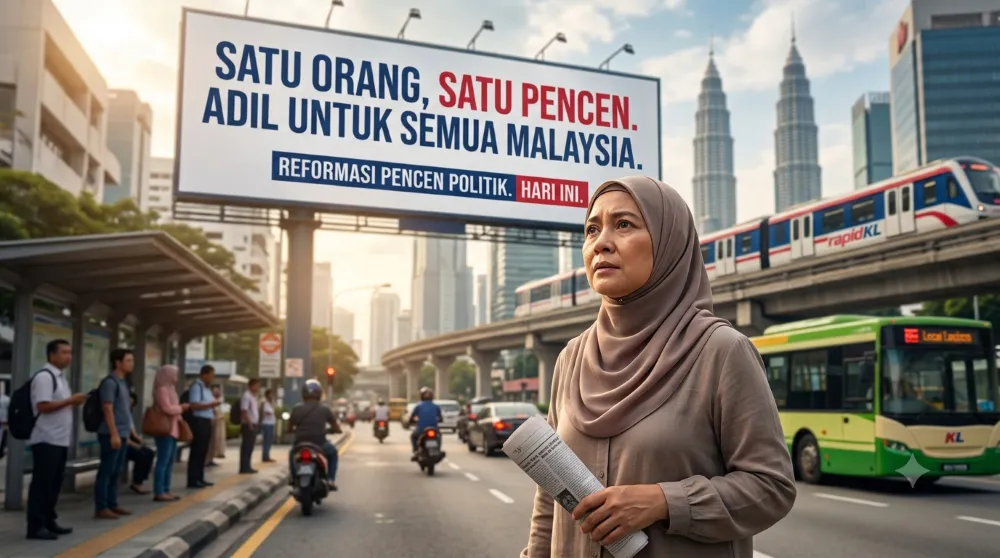
The principle is simple: one person should get one public political pension.
All years of political service should be added into a single pension calculation. This applies whether someone served as state assembly member, state executive councillor, MP, deputy minister, minister, menteri besar or chief minister, or prime minister.
Higher offices could still justify a higher pension rate, given the added responsibility. But the outcome should be one consolidated pension, not several overlapping ones.
Such a reform would not punish politicians. It would simply place them under the same retirement rules that apply to everyone else.
The single pension principle
A single political pension policy would bring several benefits.
- Fairness: everyone would be treated under the same rule – one career, one retirement benefit
- Fiscal responsibility: future pension liabilities would fall, helping to contain long-term public spending
- Public confidence: people would see elected representatives reforming a privilege that benefits themselves
- Good governance: public office would look more like a duty to serve, rather than a path to accumulating lifelong benefits
- International alignment: Malaysia would move closer to global best practice on public sector pay and accountability
Political service is an honour, not an entitlement. A pension should provide retirement security, not create several streams of taxpayer-funded income for any one person.
People in Malaysia are being asked to accept difficult fiscal reforms and tighter government spending. Political leaders should lead by example.
A single consolidated pension would send a clear message. Those who govern are ready to meet the same standards of fairness expected of every ordinary person.
The principle is simple and hard to dispute: one person, one public service career, one public political pension.
SP Nathan has dedicated many years to social work and activism, driven by a belief that Malaysia can be a better nation for all. He is committed to helping build a more just, inclusive and united society.
AGENDA RAKYAT - Lima perkara utama
- Tegakkan maruah serta kualiti kehidupan rakyat
- Galakkan pembangunan saksama, lestari serta tangani krisis alam sekitar
- Raikan kerencaman dan keterangkuman
- Selamatkan demokrasi dan angkatkan keluhuran undang-undang
- Lawan rasuah dan kronisme

all these Fellows have been given to much importance and we tend to Tabit them and some even act as if they are Royalties .
A disgraceful state of affairs and the citizens allowed it .
The biggest bunch of hypocrites in this country is none other than the politicians in this country! Shameless bunch! No more pensions for them. Those who were found guilty of corruption must have all their pensions revoke immediately! Further, it is embarrassing that their honorary titles are not revoked automatically! What a joke!
MKINI did an excellent report on this in 2024 https://newslab.malaysiakini.com/mp-pension/en/
PMX talked about in 2024 https://www.nst.com.my/news/nation/2024/01/1006411/anwar-tells-politicians-uphold-their-moral-responsibility-choosing-only
Nothing came out of it!
Time for Civil Society to mount a concerted campaign to “encourage” political parties to include this in the GE 16 Manifesto.
Learn from SRI LANKA
https://apnews.com/article/sri-lanka-pension-lawmakers-economic-crisis-dissanayake-1371abdfc155452ba0161bac5bf9acb7
I’m a veteran. In TLDM for 12 years. I don’t get pension. Those in the Armed Forces have to serve for 21 years to entitle for pension. But politicians get pension after 5 years. Till date veterans are asking for pension but each time was told there’s no budget. This case was brought to court. Yet pending.
The principle of a single pension is perfectly acceptable and the correct thing to do. However, the statement that “… so many politicians in Malaysia receive multiple pensions…” is not correct. There are some who do receive more than one pension BUT they probably constitute less than ten percent of those currently receiving pensions.
The only elected representatives who are entitled to more than one pension are those who have completed at least one term as a state assemblyman and also one term as a senator, member of parliament or minister at the Federal level. Because these funds come from both Federal and State Consolidated funds, they get both.
Compared to the total number getting single State and Federal pensions, they are few.
“…they are few.” So? How many does that “less than 10%” total up to? And how much is that, in terms of public funds? And being paid for how many more years?
Multiple pensions entitlement and monthly fixed allowances like parking allowance may all be perceived to be approved by politicians in power positions for self greed at the expense of taxpayers may all be suspected to be abuse of power.
Reported RM5K monthly parking as fixed allowance without having to provide documentary supportive evidence may also be suspect as doubtful if any receiving politicians in power position can spend even a fraction of the RM5K monthly.
Legal YES but is it Moral may be DOUBTFUL!!
Bless all