Malaysia’s anti-corruption campaign has faced numerous snags, casting doubt over the country’s ability to eradicate a scourge that has cost the nation billions of ringgit.
Lately, the prime minister’s senior political secretary, Shamsul Iskandar Akin resigned hours after claims surfaced he had allegedly received bribes totalling over RM240,000 linked to a mineral exploration scandal in Sabah.
Corruption in Malaysia has often been portrayed as a series of isolated scandals involving individuals or political parties.
Yet, as Terence Gomez argues in a presentation, corruption is systemic, deeply embedded in state structures and tied to the country’s economic and political evolution.
A systemic problem
The infographics below frame key arguments through the lens of the dependency theory, which examines how power relations – both domestic and international – produce enduring forms of economic dependence.
- Sign up for Aliran's free daily email updates or weekly newsletters or both
- Make a one-off donation to Persatuan Aliran Kesedaran Negara (ALIRAN), Maybank a/c 507246118995 or CIMB a/c 8004240948
- Make a pledge or schedule an auto donation to Aliran every month or every quarter
- Become an Aliran member
It argues that Malaysia’s government-linked companies have become instruments of elite rent‑seeking and political patronage. They reproduce both internal dependency (on state rents) and external dependency (on foreign capital and global value chains), which together constrain Malaysia’s capacity for autonomous development.
Dependency theory traditionally focuses on the core‑periphery relationship between industrialised economies and resource or labour‑exporting nations.
Malaysia exhibits such external dependency: it remains deeply integrated into global commodity networks, providing labour‑intensive assembly, natural resources and mid‑value manufacturing, but capturing only limited value‑added.
Malaysian government-linked companies are frequently tasked with facilitating foreign investment, building infrastructure and providing cheap land or energy – effectively subsidising multinational capital to maintain Malaysia’s position in global supply chains.
A good example is the emergence of data-centre hubs in the country exploiting land and energy resources.
Perpetuating dependency
These institutional weaknesses only perpetuate dependency.
Reform attempts – whether after regime change in 2018 or under the present “unity government” – have failed to break the structural nexus between politics and business.
Without transparent political finance laws, independent regulatory oversight, and merit‑based governance of government-linked companies, the rentier system remains intact.
Indeed, dependency theory predicts such resilience: ruling classes rarely dismantle the very mechanisms that reproduce their dominance.
A double-dependency trap
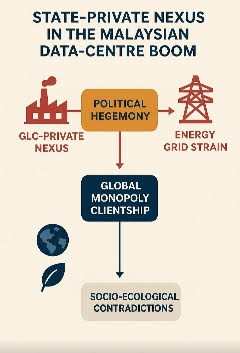
The government-linked companies are not neutral technocratic tools of development but conduits for patronage and elite enrichment.
These firms sit at the heart of Malaysia’s political economy: they control vast resources, dominate key sectors and frequently receive preferential treatment in public procurement and policy decisions.
Board appointments are often political, aligning governance of these firms with ruling party interests rather than commercial performance.
This intertwining of state and business means that these firms can be used to reward loyalists, create business opportunities for politically connected contractors, and channel resources into political financing.
Internal dependency
From a dependency perspective, this nexus represents a form of internal dependency: the political elite rely on rents and concessions generated by government-linked companies to consolidate power, rather than on broad‑based productivity or innovation.
This rent‑seeking equilibrium crowds out competitive private sector development, suppresses entrepreneurial dynamism, and keeps Malaysia reliant on politically mediated accumulation rather than market‑driven investment, as are exemplified in government-driven investment companies.
Stalled investigations
Thus, investigations into major scandals often stall when they implicate senior elites.
Political financing remains opaque, allegedly enabling money from government-linked companies and contractors to be channelled into party coffers without disclosure.
Regulatory capture is common, with civil servants and politicians moving seamlessly between ministerial roles, government-linked company boards, and private companies.
Growth trap, inequality and disaffection
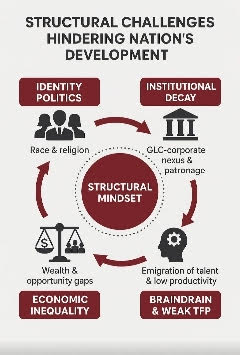
The costs of this dependency‑corruption nexus are significant.
Economic growth continues but is uneven and less transformative. Innovation is weak because resource allocation favours connected firms rather than competitive ones.
Malaysia risks remaining stuck in a middle‑income trap, where productivity gains are insufficient to drive high‑income convergence.
Inequality persists as rents are concentrated among politically connected elites, while ordinary people face rising living costs and limited social mobility.
Political fallout
There are also political consequences: public trust in state institutions erodes, voter cynicism rises and talented professionals migrate abroad.
Foreign investors, while still attracted to certain sectors, may avoid those dominated by opaque government-linked company monopolies, fearing policy risk and governance failures.
Breaking the cycle
Corruption in Malaysia is not an aberration but a structural feature of its political economy.
Viewed through dependency theory, the political‑government-linked companies nexus entrenches both internal and external forms of dependency that limit Malaysia’s economic autonomy and democratic deepening.
To escape the middle‑income trap and restore public trust, Malaysia must undertake bold governance reforms that dismantle rent‑seeking structures, realign government-linked firms toward developmental objectives, and build a more self‑reliant, innovation‑driven economy.
AGENDA RAKYAT - Lima perkara utama
- Tegakkan maruah serta kualiti kehidupan rakyat
- Galakkan pembangunan saksama, lestari serta tangani krisis alam sekitar
- Raikan kerencaman dan keterangkuman
- Selamatkan demokrasi dan angkatkan keluhuran undang-undang
- Lawan rasuah dan kronisme