
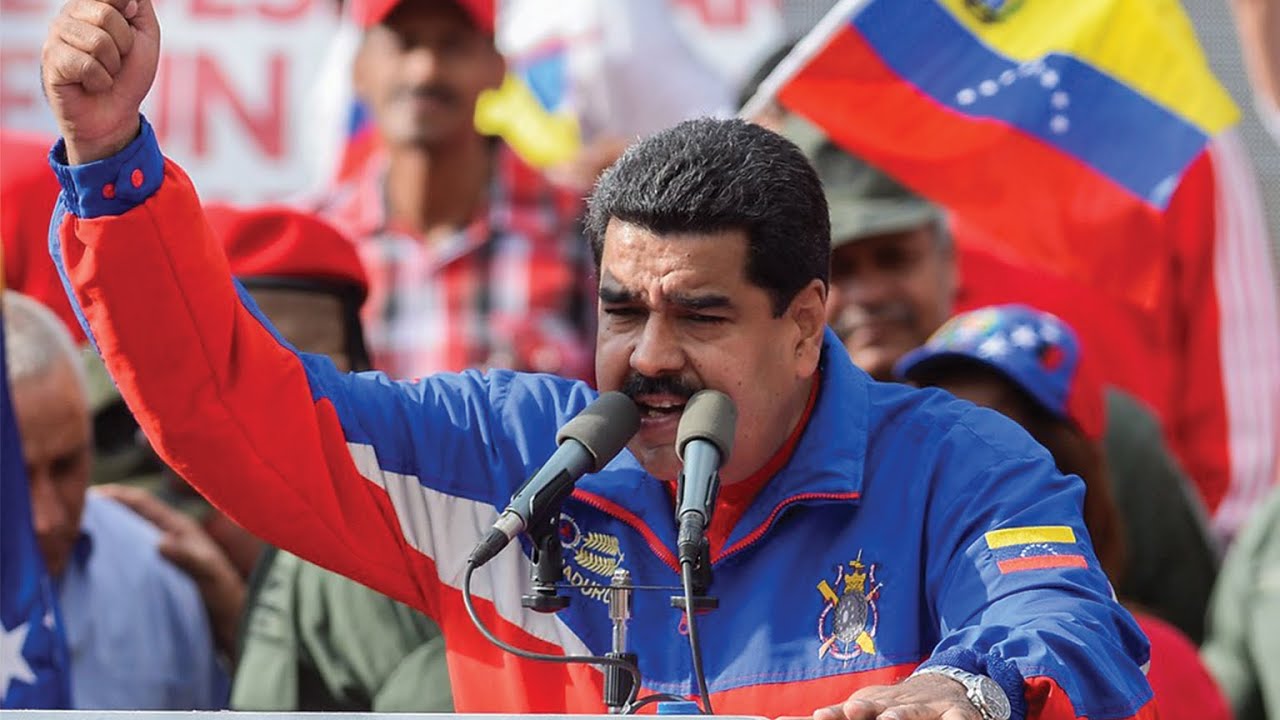
In the early hours of 3 January, Venezuelan President Nicolás Maduro and his wife, Cilia Flores, were kidnapped in a US military operation involving around 150 aircraft.
Over 100 people were killed in the operation, including over 30 personnel of the presidential security detail. The operation appears to have been facilitated by insider information.
Maduro and Flores were subsequently flown to New York, where they were charged with drug trafficking and narco-terrorism.
President Maduro has denounced the charges as nonsensical.
Many governments, including Venezuela’s, have condemned the kidnapping, citing Article 2(4) of the UN Charter, which emphasises respect for other countries’ sovereignty and prohibits the use of military force without UN authorisation against the territorial integrity or political independence of any state.
Why now?
- Sign up for Aliran's free daily email updates or weekly newsletters or both
- Make a one-off donation to Persatuan Aliran Kesedaran Negara (ALIRAN), Maybank a/c 507246118995 or CIMB a/c 8004240948
- Make a pledge or schedule an auto donation to Aliran every month or every quarter
- Become an Aliran member
In the months leading up to the kidnapping, the US administration under President Donald Trump had frequently criticised Maduro’s government for its record on narco-terrorism, authoritarianism, electoral fraud and the mismanagement of Venezuela’s economy.
Following the kidnapping, Trump’s statements at press conferences – insisting that Venezuela must permit US oil companies to extract and export Venezuelan oil — have led many to conclude that the main motivation is control over Venezuela’s vast oil reserves.
Others attribute the kidnapping of Maduro and Flores to Trump’s narcissistic and reckless style on international issues.
One should not forget, though, that US hostility towards Venezuela far predates Trump.
In April 2002, the US under then President George W Bush, a Republican, was believed to have worked with opposition forces in Venezuela to overthrow President Hugo Chávez. They almost succeeded. The coup plotters captured Chávez and spirited him away to an undisclosed site. They then tried to install business leader Pedro Carmona as interim president.
But poorer communities in Caracas streamed into the streets, jamming traffic and making it difficult for the coup organisers to consolidate power. Significant portions of the political elite and the military rallied against the coup. Chávez was released after 47 hours and resumed the presidency.
In 2014, then President Barack Obama, a Democrat, initiated economic sanctions against Venezuela without UN approval, though with support from several European countries. These illegal sanctions were intensified under both Trump and President Joe Biden.
In 2020, Venezuela was even denied access to its own gold reserves deposited in UK banks to purchase Covid vaccines.
Trump’s military operation certainly reflects his narcissistic and aggressive style of governance, but it is fully in line with the US’ long-term hostility to the Bolivarian process in Venezuela.
Chavez’s pro-people reforms
This hostility has deeper roots. The US and its allies in the so-called free world were set against the Bolivarian Revolution from the start, after Chávez won the presidential election in December 1998 with 56.2% of the vote. (His main challenger, Henrique Salas Römer, obtained 40.0%.) [IFES Election Guide, 1998].
Chávez’s reforms included setting up a Constituent Assembly to make the Venezuelan constitution more ‘pro-people’. They involved renegotiating petroleum contracts to increase government revenue, and bartering cheap petroleum for Cuban health personnel to improve healthcare for poorer people in Venezuela. The reforms also included setting up about 45,000 local communal councils so that people could participate in managing local affairs.
These reforms, and Chávez’s habit of regularly broadcasting long explanations of his government’s policies, were well received. He was re-elected in 2000 for a new six-year term under the new constitution.
The opposition triggered a recall referendum in 2004, but Chávez won with 59% of the vote. He won another six-year term in 2006 with 62.8%, and yet another in 2012 with 55.1%.
This was no surprise. Economic and health indicators showed that ordinary people were living better. The poverty rate fell from 49% in 1998 to 29.5% in 2014. Under-five mortality dropped from 23.5 per 1,000 live births in 1998 to 18 per 1,000 in 2014. Under-five stunting rates fell from 19.2% in 1998 to 13.4% in 2009 [Centre for Economic and Policy Research; Wikipedia, Economic policy of the Chávez administration].
What infuriated Washington was Chávez’s support for Cuba, his backing of the Palestinian cause and his opposition to the US-led Free Trade Agreement of the Americas. He was disrupting the imperial order that favoured the largest companies and the billionaires of the West – and, crucially, demonstrating that a pro-people economic programme was achievable and could win and retain popular support from ordinary people.
Together with Fidel Castro, Chávez set up Alba – the Bolivarian Alliance for the Peoples of Our America – in 2004. This was a regional organisation aimed at fostering political, economic and social cooperation, enabling countries of the Global South to rely more on their own resources rather than on the International Monetary Fund and World Bank. By January 2017, Alba had 11 full member states.
These then, are the real reason for the US’s animosity to Venezuela ever since Chavez’s first election victory in 1998.
Venezuela, like Cuba and Gaddafi’s Libya, was setting what Washington considered a bad example for developing nations in Asia, Africa and Latin America. It had to be broken and brought to its knees, to serve as a cautionary tale for other developing countries.
The Global South had to be shown that there is no alternative to the prevailing world order that is premised on the unfettered access for big foreign capital, strong laws protecting intellectual property and the free repatriation of profits.
The sanctions regime
The economic pressure was relentless.
Obama signed the Venezuela Defense of Human Rights and Civil Society Act in 2014, using it to sanction seven Venezuelan government officials. It was extended in 2016. And by 2019, Trump had used it against 75 individuals.
In 2017, the US government prevented Venezuelan government bonds from trading in US financial markets.
In August 2017, Citgo Petroleum – a subsidiary of Venezuela’s state oil and natural gas company, PDVSA – was barred by a US government executive order from delivering dividends to PDVSA, freezing $7bn.
By December 2017, 11 issues of Venezuela debt could not be repaid. (Who would dare lend to Venezuela after that?)
The US also barred American firms from exporting naphtha, a crucial input for extracting heavy crude oil, to Venezuela
In 2018, the Bank of England froze 31 tonnes of Venezuelan gold and refused to release it in 2020 when Venezuela sought to use it to buy Covid vaccines.
The US then put pressure on shipping firms to stop carrying Venezuelan oil.
By 2020, over 100 sanctions had been slapped on Venezuela, hitting the economy hard. Between 2015 and 2023, Venezuela’s foreign currency income dropped by 90%.
The lack of foreign exchange and the unavailability of spare parts for repairs led to the degrading of much of the infrastructure and a deep recession.
Venezuela’s real gross domestic product shrank 74% between January 2014 and December 2019 – meaning that by the end of 2019, economic activity had fallen to roughly one quarter of its 2013 level [United Nations, World Economic Situation and Prospects 2020, Table A3].
Mass unemployment followed and many Venezuelans were forced to emigrate.
Western media reports routinely attributed the economic mayhem caused by the harsh sanction regimes to mismanagement, incompetence, corruption and the intrinsic flaws of an economic system that was trying to redistribute more wealth back to the majority of the people in the country.
Unfortunately, many in the Global South accept and repeat the Western narrative. We need to be more discerning.
But then, Colombia’s GDP grew by 18.3% between 2014 and 2019, while Mexico’s grew by 13.7% over the same period. These are countries whose records on corruption and administrative efficiency are not markedly better than Venezuela’s.
The main cause of Venezuela’s severe economic recession from 2014 onwards is the cruel and crushing sanctions enacted by the US and its European allies. Economists Mark Weisbrot and Jeffrey Sachs calculated that US sanctions contributed to the deaths of around 40,000 Venezuelan civilians between 2017 and 2018 [Economic Sanctions as Collective Punishment: The Case of Venezuela, April 2019].
Our demands
The people of the Global South should push for the following.
National sovereignty must be respected. All countries have the right to choose their own model of development. The principle of non-interference in the internal affairs of sovereign nations must be upheld.
The gunboat diplomacy that the US has exhibited for decades – far more brazenly under Trump – must be roundly condemned. Military action in another country should only be permitted under UN auspices. No country should be able to undertake it unilaterally.
Maduro and Flores must be released immediately and unconditionally.
The economic sanctions on Venezuela, Cuba and Iran must end immediately, and the blockade on Gaza must be lifted. The Fourth Geneva Convention (1949) classifies sanctions as a form of collective punishment, which is prohibited.
Plans to use military force against Iran, Cuba and other countries must be abandoned.
We should also press our own governments to build economic resilience in these uncertain times.
We should aim for self-sufficiency in food, energy, medicines and basic technology. We need to build regional markets so we are less dependent on the US and the EU.
And we should spread awareness that neo-colonialism is not a fancy term used by the left. It is an under-recognised reality of the 21st Century.
With input on the Venezuelan economy by Danesh Prakash Chacko of the Venezuela Solidarity Group, Malaysia
AGENDA RAKYAT - Lima perkara utama
- Tegakkan maruah serta kualiti kehidupan rakyat
- Galakkan pembangunan saksama, lestari serta tangani krisis alam sekitar
- Raikan kerencaman dan keterangkuman
- Selamatkan demokrasi dan angkatkan keluhuran undang-undang
- Lawan rasuah dan kronisme
