
By Harmit Singh
A chorus of boos rang through the stadium as a medic rushed onto the field to tend to a player in red lying on the turf.
It was around the 70th minute, and any football fan would recognise this as time-wasting, one of the oldest tricks in the book and a calculated display of gamesmanship meant to run down the clock.
That night wasn’t just another match, it carried the weight of a nation’s expectations.
Fresh from Malaysia’s Suzuki Cup (now called Asean Championship) win six months earlier, July 2011 had begun with hope. We were in the second round of the 2014 World Cup qualifiers, and only Singapore stood in our way of progressing to the group stage.
- Sign up for Aliran's free daily email updates or weekly newsletters or both
- Make a one-off donation to Persatuan Aliran Kesedaran Negara (ALIRAN), Maybank a/c 507246118995 or CIMB a/c 8004240948
- Make a pledge or schedule an auto donation to Aliran every month or every quarter
- Become an Aliran member
Besides, we were approaching peak Safee Sali craze – he had won the Golden Boot in the Suzuki Cup – and the prospect of him linking up with the younger Norshahrul Idlan (affectionately known as Mat Yo) was tantalising. With people from all walks of life in Malaysia showing up, we still dared to believe – even after losing 5-3 in the first leg across the causeway.
I’d never seen Bukit Jalil so packed. There was barely any space to stand, let alone sit down. We filled every corner of the national stadium, cramming into the 80,000-capacity stadium as crowd control went out the window.
Above all, we had a date with destiny. And for a brief moment after taking the lead in the first half, it felt like we were going to pass into the final stages of the World Cup qualifiers for the first time since 1986.
But alas, the Singaporeans had other ideas, with an equaliser in the 72nd minute all but burying our dreams.
From that point, Singapore’s game management was on full display, as they used every stoppage in play to disrupt Malaysia’s rhythm, including calling for medical intervention over what felt like theatrical injuries.
We lost 6-4 on aggregate over the two legs. Yet, even in defeat, it felt like one of those moments that brought the people of Malaysia together.
One of my favourite memories from that night was a massive banner hanging from the ultras’ section. It mocked Singapore for stacking its team with ‘Mat Sallehs’ – foreign-born players naturalised under Singapore’s Foreign Talent Scheme in the 2000s.
[At the time, Fifa’s eligibility rules allowed players to represent a country after a few years of residency (later extended to five), leading to a wave of naturalisations that divided opinion. Contrary to popular belief, Fifa hadn’t recently relaxed its eligibility requirements – the so-called ‘grandparent rule’ had existed for decades. What changed in the mid-2000s was how countries like Singapore used domestic naturalisation policies to strengthen their squads.]
Among fans in Malaysia, the sentiment was clear: yeah, Singapore may have won, but we lost on our own terms, with a team full of locally bred stars: Khairul ‘Apek’ Fahmi in goal, Safiq Rahim orchestrating the midfield, and my favourite, the mercurial S Kunalan at right wing.
A lot has changed in Malaysian football since then.
Most notably, Johor’s state football team underwent a complete makeover, officially relaunching as Johor Darul Ta’zim in 2013, and essentially winning everything in domestic competition ever since.
This success has been largely driven by the Crown Prince of Johor, Tungku Ismail Idris, better known as TMJ.
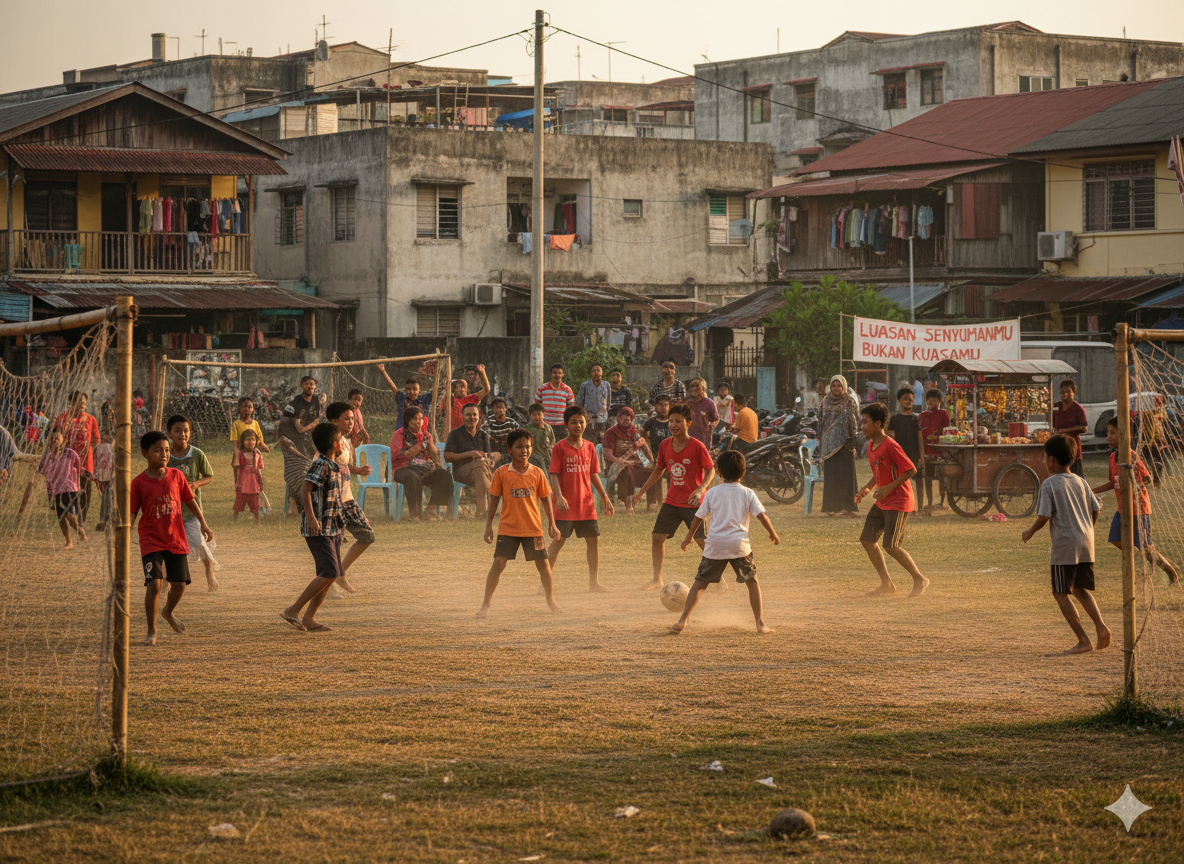
This is the “Luaskan Kuasamu” (Expand your power) turning point, where the regent ushered in a new era of influence in Malaysian football administration.
Building on his success in Johor, TMJ also served as Football Association of Malaysia (FAM) president from 2017 to 2018.
Incidentally, 2018 was also the year we naturalised our first foreign players, Gambian-born Mohamadou Sumareh (who relocated to Malaysia as a teenager) and La’Vere Corbin-Ong, who still plays for the national team at left back (his switch from Canada permitted due to his Chinese Malaysian mother).
In our hyper-globalised world, there is a place for naturalised and heritage players in national teams. To an extent, this represents a progressive acknowledgement of the dynamic nature of identity.
However, in the way it’s practised across the Global South, elite development is effectively imported, with football powerhouses in Western Europe dominating the game.
In this context, one really has to ask, does this serve the ideals of the sport?
These eligibility rules have become a convenient mechanism for countries with extractive systems to evade the more demanding task of institution-building, meaningful reform, and the cultivation of authentic sporting principles.
This outlook echoes Malaysia’s own developmental trajectory, where progress is too often measured by elite accumulation rather than sustainable foundations.
Together, these tendencies erode the intrinsic value of the sport, reducing it to a political spectacle and a vehicle for bureaucratic self-preservation.
To its credit, Malaysia’s Ministry of Youth and Sports has taken steps to strengthen grassroots sports. The ministry’s 2021–25 strategic plan, for instance, articulates a vision of ‘pembudayaan sukan’ – the cultivation of a sporting culture.
Such initiatives, however, remain constrained by the very institutional environment in which they operate.
This malaise extends beyond the ministry, and is best illustrated by the FAM’s recent ‘doctored documents’ controversy, which raises questions about governance and oversight within the association.
What arose from a naturalisation strategy that mutated out of control ultimately exposes the deep structural fragilities at the heart of Malaysian football.
Malaysia must reimagine sports beyond its narrow focus on elite achievement and recognise its potential as an instrument of community development.
Team sports, in particular, possess a unique ability to unite people and bridge differences.
Their value lies not merely in winning, but in serving as a form of civic participation.
In this way, when everyone is given a chance to contribute, a team comes to embody the people it represents. In that shared space, reverence for something of one’s own transforms individuals into a sanctified collective.
Perhaps the best illustration of this, at an organisational level, begins with the story of one of the seven heritage players implicated in FAM’s recent scandal: Jon Irazabal Iraurgui.
Hailing from the Basque Country in Spain, his people have long lived on the periphery of the Spanish federation, enduring both repression and cultural erasure.
In turn, Basque nationalism finds its clearest expression in Athletic Club, a team based in Bilbao, just 13km from Irazabal’s hometown of Galdakao.
Athletic’s defining feature is its famed cantera policy, under which only players from the region may represent the team – a declaration that success must be rooted in community.
Over time, this policy has taken on near-mythic status, with tales of parents rushing home from other parts of Spain to ensure their children are born Basque and thus eligible to play for Athletic.
Sustained by the faith of its people, the club invests heavily in its academy, nurturing a continuous pipeline of homegrown talent.
Irazabal himself joined at 10, and benefited from an ecosystem built on self-belief.
And this philosophy has paid off: Athletic remains one of only three Spanish sides never to have been relegated from La Liga.
Athletic’s story captures what sports can mean when rooted in belonging.
Back in Malaysia, FAM’s documentation debacle exposes how far our institutions have drifted from that ideal. Though not directly involved in the scandal, it highlights the challenges the “Madani” (trustworthy) government continues to face in driving meaningful reform.
I vividly remember Hannah Yeoh’s rise as a DAP darling around 2008. She captured public sentiment by focusing on the local, proving to the gerontocratic establishment that integrity, not patronage, could earn public trust.
Yet, since assuming her role as youth and sports minister three years ago, it remains fair to ask what tangible outcomes have emerged.
I was initially encouraged by Yeoh’s plans to revamp Rakan Muda, the very kind of initiative that could have contributed to a meaningful reorientation towards grassroots engagement.
Unfortunately, any momentum or goodwill seemed to dissipate amid perceptions of insider politics and a public dispute with the Malaysian Youth Council over the age limits for youth membership.
What could have been an opportunity to build capacity among key stakeholders has now largely been squandered.
Hopefully, this moment compels the establishment to confront its shortcomings and lay the foundations for genuine reform.
Our sporting institutions can do better, provided they cultivate a culture that values purpose over performance – where winning is not counted in rankings or medals, but in how many people in Malaysia feel they have a place on the field.
Harmit Singh is the vice-president of the Malaysian Punjabi Youth Movement (GBSM), a minority-based youth organisation promoting a more inclusive Malaysia.
AGENDA RAKYAT - Lima perkara utama
- Tegakkan maruah serta kualiti kehidupan rakyat
- Galakkan pembangunan saksama, lestari serta tangani krisis alam sekitar
- Raikan kerencaman dan keterangkuman
- Selamatkan demokrasi dan angkatkan keluhuran undang-undang
- Lawan rasuah dan kronisme

Why is it that our other sports don’t require naturalisation of 100% foreign players? They feature Malaysian born & bred players of various races of this country and had achieved great success internationally. Even a mix Malaysian parentage person is still very acceptable to represent the country. Something is greatly wrong in Malaysian football & the entire organisation should be revamped with new blood & leadership from top to bottom before the trust, internationally is gone for good.