Eduardo C Tadem
With the Philippine government rolling out the red carpet as host and chair of the 49th summit of Asean, it is important to ponder what the bloc has actually achieved in 59 years of existence.
Asean’s repeated declarations of grand ambitions have been largely rhetorical exercises disconnected from implementation. Its structural features (noninterference, consensus-based decision-making, weak institutions) make genuine integration nearly impossible.
It has largely ignored civil society, it badly handled the Covid pandemic, and it has failed to effectively achieve free labour flows.
A flawed 2045 roadmap
Adopted during the summit in Kuala Lumpur in August 2025, the Asean 2045 Roadmap sets a 20-year vision of “a resilient, innovative, dynamic and people-centered community”.
- Sign up for Aliran's free daily email updates or weekly newsletters or both
- Make a one-off donation to Persatuan Aliran Kesedaran Negara (ALIRAN), Maybank a/c 507246118995 or CIMB a/c 8004240948
- Make a pledge or schedule an auto donation to Aliran every month or every quarter
- Become an Aliran member
The roadmap’s language is too abstract; the same hurdles that have blocked integration since 1992 remain unaddressed. These include:
- the non-interference principle, which prevents collective action on human rights and democratic backsliding
- the absence of enforcement mechanisms
- widening economic disparities
- the abandonment of a single currency
- fragmented regulatory regimes
While the roadmap emphasises digital transformation and AI, the digital push is led only by Singapore, Malaysia, Thailand and Indonesia, and it carries serious environmental costs: data centres are energy-intensive and water-hungry, and AI queries consume far more electricity than traditional searches.
The Asean 2045 Roadmap is largely a rehash of previous declarations:
- the Asean Free Trade Area (1992)
- the Asean Vision 2020 (1997)
- the Declaration of Asean Concord II and the Asean Economic Community (2003)
- the AEC blueprints of 2015 and 2025
Intra-Asean trade averaged just 24.1% of total trade from 2014 to 2023, and the figure is inflated by Singapore’s re-exports.
Intra-Asean foreign direct investments averaged only 14.7% over the same period, hitting a low of 9.6% in 2023.
Trade is also grossly unequal. Singapore alone accounts for 32.9% of intra-Asean exports, with four economies controlling 86% of the total and the bottom four holding just 3.4%.
The intra-Asean trade stagnation is due to a lack of economic complementarity (Asean economies compete rather than complement), non-tariff barriers, regulatory differences, and protectionism.
Democratic deficits abound with the Democracy Index 2024 identifying four Asean states as authoritarian, and six as flawed democracies.
Furthermore, there are debt sustainability concerns in six countries.
Social inequality is stark with 45% of Southeast Asians classified as poor or low-income.
Meanwhile, UN sustainable development goals progress stands at a dismal 17%.
Ignoring civil society
A second major theme concerns Asean’s relationship with civil society organisations.
Despite its recognition of the Asean Civil Society Conference / Asean Peoples’ Forum as “the formal platform for CSOs” in 2005, the Asean Charter (2007) and the 2025 blueprints do not mention civil society groups at all.
The fundamental problem is Asean’s self-serving definition of civil society groups – groups that “promote, strengthen and help realise the aims and objectives of Asean” – which contradicts the internationally accepted understanding of civil society groups as independent and autonomous actors.
Asean prefers a civil society that helps achieve goals already set by governing elites rather than one that participates in setting agendas.
The Asean Civil Society Conference / Asean Peoples’ Forum’s 2016 internal review of its engagement with Asean found that member-states “consistently resisted and vacillated” on civil society participation. Its 2017 statement scored Asean’s “dominant development narrative that has bred extreme inequalities, extensive human rights violations… and wanton exploitation of natural resources.”
The core civil society concerns vis-à-vis Asean include:
- A lack of popular participation
- rising inequalities
- weakening democracies
- human rights deficits
- corporate-centred growth strategies
- lack of regional identity
- gender inequality
- weak social protection
In response, civil society has begun charting an alternative regionalism based on solidarity, complementarity, the commons principle, and people-to-people interactions rather than state-to-state or corporate-led processes.
Delusions of regional integration
As early as 1992, Asean set as its goal “regional integration” with the Asean Free Trade Area, reaffirmed in 2003 with the Asean Economic Community or AEC (target 2020) and accelerated in 2007 (target 2015).
Yet 2015 came and went without integration.
A 2013 study by the Asian Development Bank and Iseas concluded that Asean had “no prospect of coming close to an EU-style single market” by 2015, 2020, or 2025.
There are several impediments to true regional integration:
- member-states’ aversion to surrendering national sovereignty (Malaysia protecting its car industry, Indonesia its agriculture, the Philippines its petrochemicals)
- slow progress on non-tariff barriers
- labour flow disputes (notably over migrant domestic workers between Malaysia/Singapore and Indonesia/Philippines)
- the fact that only 5% of intra-Asean trade uses the ‘common effective preferential tariff’ due to bureaucracy,
- costs and lack of information
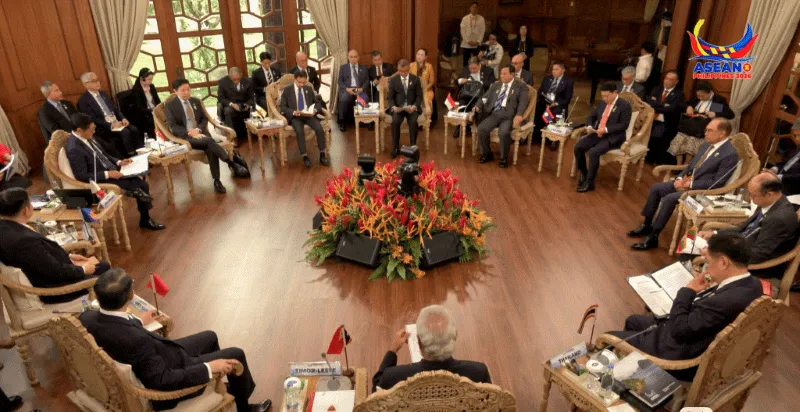
Asean leaders discuss the challenges facing the region – ASEAN 2026 PH / FACEBOOK
Bilateral agreements and external linkages also pre-empt collective efforts.
China’s aggressive infrastructure investment (particularly in the Mekong subregion) risks dividing Southeast Asia.
The Asean Charter’s failure to include enforcement mechanisms, its ‘Asean Minus X’ opt-out provision, and its human rights body’s lack of enforcement power all work against integration.
The South China Sea disputes further expose Asean’s weakness, with a “toothless” 2002 declaration on a code of conduct and no serious talks for a final agreement.
Instead of absolutist sovereignty claims, alternative principles are needed”: the primacy of the commons, joint development, multilateralism, and the ‘common heritage of mankind’ doctrine [from the Third United Nations Conference on the Law of the Sea or Unclos III].
Stumbling on Covid
Asean’s Covid pandemic response was “divisive, unclear, non-consultative, impromptu and driven by divergent policies”, with member states acting individually.
The Covid Asean Response Fund, established in June 2020, drew only four pledges totalling $400,000 (Singapore, Vietnam, Thailand and the Philippines at $100,000 each), while non-Asean dialogue partners contributed $1.2bn in aid much of it bilateral and of unclear form (loans versus grants).
Donor hesitance stemmed from the absence of comprehensive guidelines and doubts about the Asean Secretariat’s capacity. Asean failed to report transparently on the fund, and its June 2022 situational report did not mention it at all.
By late June 2022 Southeast Asia had 32.2 million cumulative cases and 354,584 deaths, and was the only region seeing rising deaths; full vaccination covered less than 50% of the population, far below the World Health Organisation’s 70% standard.
Asean’s failure to coordinate its pandemic response undermines its claim to be a unified, people-oriented organisation.
Negligible labour numbers
Asean’s ‘mutual recognition arrangements’ (MRAs) were supposed to enable skilled labour mobility under the AEC.
The numbers, however, have been negligible. In 2016 there were 1,252 registered Asean chartered professional engineers and 284 architects.
By 2026 there were over 8,500 registered Asean chartered professional accountants for a region of 680 million people – while Indonesia alone aims to send 300,000-500,000 workers abroad in 2026, mostly to Japan, South Korea, Europe and the US.
The MRAs do not eliminate host countries’ rights. Professionals still need work permits, visas and local employers, and can be refused for any reason.
Former Professional Regulation Commission chair Teresita Manzala admitted that the MRAs would not reduce member states’ authority, and Donald Dee of the Employers Confederation of the Philippines observed in 2016 that the MRAs do not open a gateway for free workforce flow.
Actual deployment of overseas Filipino workers within Asean is modest and concentrated in Singapore (140,205 of just over 200,000 in 2014). Even Singaporeans abroad favour China, the US and Malaysia.
The MRAs may exacerbate brain drain, as Indonesia now openly celebrates labour export as a development strategy (remittances of 212 trillion rupiah, or $13.6bn, through the third quarter of 2025).
Bilateral deals work better – Vietnam and Singapore’s June 2025 ‘Innovation Talent Exchange’ will exchange 300 highly skilled workers in year one, rising to 1,000 annually, in data science, cybersecurity, AI and semiconductors.
Asean remains locked in a market-centred, corporate-led, state-dictated process that serves political and economic elites while ignoring peoples’ aspirations.
It’s time to do away with Asean integration policies that emit political hot air and diplomatic platitudes while delivering nothing for Southeast Asia’s marginalised peoples they claim to serve.
Whatever comes out of the 2026 Asean gathering, it would be difficult for the Philippine government to justify its spending ₱23bn for an exercise that is short on substance and long on unattained goals. – CoverStory
Eduardo C Tadem, PhD, is an emeritus professor of Asian studies at the University of the Philippines Diliman. He was co-convenor of the 2017 Asean Civil Society Conference / Asean Peoples’ Forum.
AGENDA RAKYAT - Lima perkara utama
- Tegakkan maruah serta kualiti kehidupan rakyat
- Galakkan pembangunan saksama, lestari serta tangani krisis alam sekitar
- Raikan kerencaman dan keterangkuman
- Selamatkan demokrasi dan angkatkan keluhuran undang-undang
- Lawan rasuah dan kronisme