
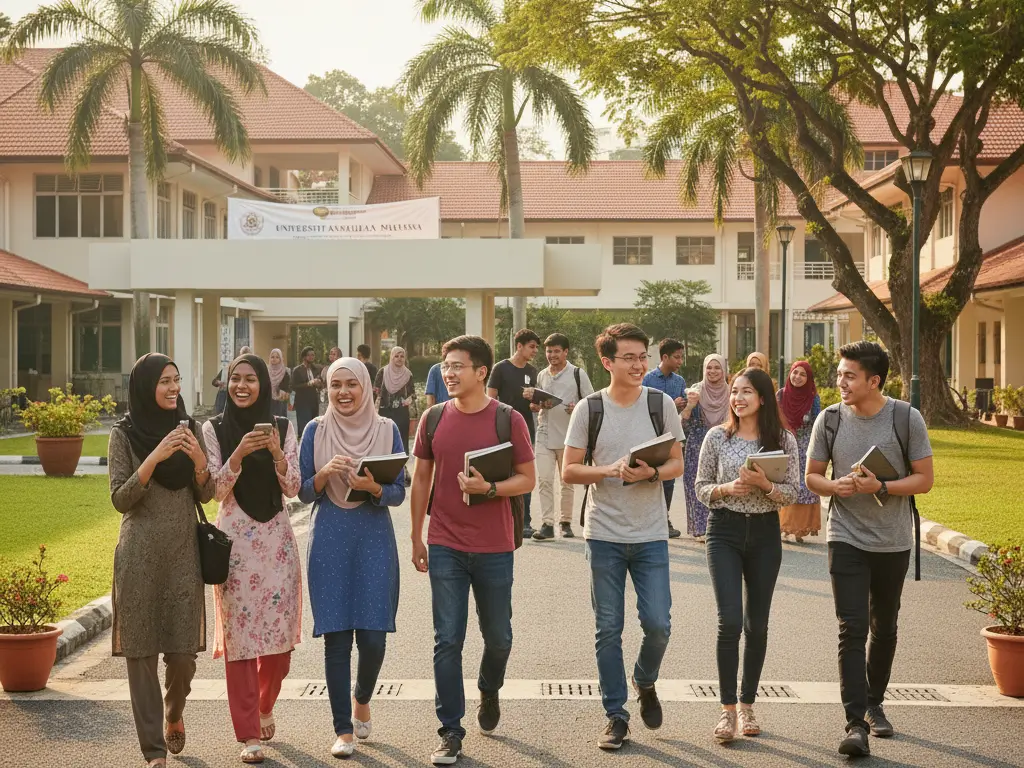
On 13 December 2025 our book Ivory Tower Reform: A Vision for Higher Education in Malaysia was launched.
Subsequently, the issue of global university ranking captured the attention of certain critics, including vice-chancellors and lecturers in public universities.
Rankings are discussed at length in Part III of the book and contrary to one critic, it is far from “simplistic”.
The problem of rankings is presented alongside detailed discussions and analyses of other phenomena such as intellectual imperialism, academic dependency, mediocrity and fraudulent academic behaviour, and academic misconduct.
Further conceptual links are made to prevalent forms of academic dishonesty such as plagiarism, fake credentials, ghostwriting, and the coercive publication culture.
- Sign up for Aliran's free daily email updates or weekly newsletters or both
- Make a one-off donation to Persatuan Aliran Kesedaran Negara (ALIRAN), Maybank a/c 507246118995 or CIMB a/c 8004240948
- Make a pledge or schedule an auto donation to Aliran every month or every quarter
- Become an Aliran member
So read the book in its entirety, slowly and purposefully.
Malaysian universities are increasingly reimagined as corporate entities, with public universities focussing on producing “human capital” instead of cultivating human beings.
But universities are not – and never were intended to be – corporate entities, although such delusions persist among university leaders and politicians.
The public university was originally a public sphere designed for the balanced growth of the “total personality”. The key here is balance.
To reclaim public university excellence, we must look beyond the dictates of the market and return to a model where the pursuit of wisdom is protected and the channelling of this wisdom is for the greater benefit of all communities.
This is not naive; it is an ethical vision that must be dictated by a “reformed reality”.
This is the fundamental meaning of a civilised society or masyarakat madani, is it not? It is a concept that rejects elitism, corruption, the financial excesses of a select few, and the power structure in society enabled by divisive and unjust ethno-religious centrism.
Our book emphasises that only by decoupling the academy from corporate extraction can we restore the university’s true ontological purpose. In this context, “decoupling” does not mean outright rejection, but to maintain a loose link to industry while working independently of corporate culture, ethos and raison d’etre.
Importantly, our book does not focus only on ranking. It comprises 53 chapters and has an extensive bibliography, with detailed footnotes throughout the book for insights into nuanced arguments.
Since the early 2000s, the global higher education landscape has been increasingly defined by a quantitative performance culture, which is mediated through the ranking system.
But everyone is now aware that rankings are marketing tools which have evolved into powerful instruments of global higher education governance, financial profit and neoliberal economic dominance and exploitation.
Less wealthy, newly independent, and post-colonial countries like Malaysia are now caught in a suffocating web. Over two decades, the ranking “gamified” sector has succeeded in conditioning academia into believing university prestige equates with educational excellence, sustainable higher education and lifelong learning.
The ranking industry wants us to believe that all these goodies trickle down to societal benefit, community advancement, social justice and equitable development where everyone prospers.
But we feel it often produces a hollow core.
What this means is, a university’s progress on paper masks practical stagnation in the real world. While a higher ranking can increase a country’s symbolic capital and serve as a marketing tool to attract some forms of investment, the cost to a multi-ethnic society like Malaysia is often the neglect of qualitative excellence and social equity.
And while we interrogate these debates which open a fresh discursive space, the bulk of all these critical issues raised in the book have been ignored by critics.
The matter of draconian legislation, which stifles the intellectual space for critical debate, and academic freedom of expression by both public university students and lecturers, are also discussed extensively.
In fact, all the challenges discussed in the book expose poor governance in Malaysia’s higher education sector over several decades, a stark deviation from our nation’s fundamental educational philosophy, including the Rukun Negara (National Principles).
Furthermore, the book suggests solutions, including alternatives to the current global university rankings, while not totally rejecting all forms of ranking or global competitive strategies.
Today, the ‘Big Three’ – the Academic Ranking of World Universities, Times Higher Education and Quacquarelli Symonds (QS) – provide a standardised mechanism for worldwide comparison. They measure university prestige, but there is so much that is wrong with the methodology, and ‘prestige’ thus becomes questionable.
They have come under intense scrutiny for their methodological biases, the perverse incentives they create, and their failure to capture the nuanced missions of modern universities within their cultural, ethnic, religious and historical contexts.
Furthermore, there is a growing global backlash against rankings, among universities in Europe, Africa, Latin America and the US, to withdraw from the Big Three system. Yet there is hardly any debate in Malaysia.
While a few have framed their criticism of Ivory Tower Reform around the necessity of global rankings, others shy away from analysing the deeper malaise in our universities.
The relentless pressure to meet key performance indicators has led to the normalisation of citation stacking, the use of paper mills and the unethical coercion of junior faculty to include senior names on publications. Yet, it is not publicly discussed.
We attempt to do exactly this
Another malaise and well addressed by the Malaysian Anti-Corruption Commission is the recent probing into Universiti Kebangsaan Malaysia over procurement tenders worth RM58.4m. It is hardly ‘simplistic’ that our book addresses problems of corruption in higher education.
We address very complex realities of poor university governance, a lack of long-term vision, and why ethical foresight is needed to run a prestigious, successful and modern university in the Malaysian context.
The fact that rankings are now the de facto indicators for international funding and collaboration means Malaysia’s ‘brand identification’ is set to attract international students. However, there is no guarantee we will attract talent or graduates who decide to stay in Malaysia.
Furthermore, while higher rankings are used by university leaders to project an image of excellence and attract international students, rankings do not address the underlying reasons why talent leaves. The myth of ‘talent attraction’ versus the reality of brain drain is a debate that remains subdued in this context. Our book is an attempt to prompt more discussion.
A debate is necessary because it allows us to re-evaluate our educational philosophy, what excellence means for the future, and why our socio-ethnic and economic challenges seem to increase despite universities climbing up the rankings.
The need to question the current role of the university in society is very important.
Ivory Tower Reform unpacks critical ideas that suggest a more multidimensional alternative to the current ‘corporatised’ public university.
Furthermore, this is the first book of its kind to be published in Malaysia. It contains discourses about our public higher education challenges, comprehensively, in simple and accessible language, as well as in a scholarly format.
Finally, we all know that universities should not be judged solely based on rankings, numerical indicators or performance metrics. This is too simplistic.
Ironically, it is here that our public universities have failed miserably. Are they succeeding in shaping ethical individuals and in solving real societal problems?
How is Malaysia becoming less polarised, less ethno-religiously intolerant, more politically mature, more gender-sensitive and more open to public inter-faith dialogues?
How are our politicians less corrupt, or more morally upright despite becoming more performatively ritualistic in their respective religions? – Free Malaysia Today
AGENDA RAKYAT - Lima perkara utama
- Tegakkan maruah serta kualiti kehidupan rakyat
- Galakkan pembangunan saksama, lestari serta tangani krisis alam sekitar
- Raikan kerencaman dan keterangkuman
- Selamatkan demokrasi dan angkatkan keluhuran undang-undang
- Lawan rasuah dan kronisme
