

Maisa Bascuas
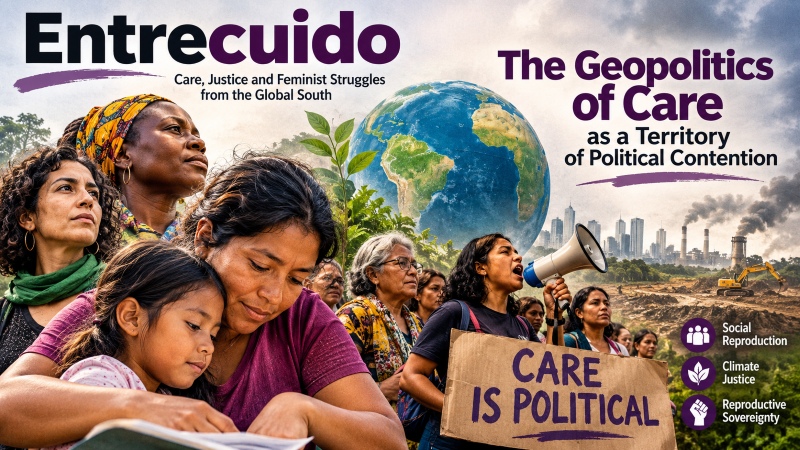
The second issue of the digital journal Entrecuido – the result of a strategic collaboration between the Center for the Study of the Care Economy (Ceecuida) and the Department of Global South Feminisms at the Tricontinental Institute for Social Research – breaks onto the intellectual and activist scene to spark an urgent debate: the geopolitics of care as a territory of political contention in the face of the civilisational crisis of contemporary capitalism.
Compiled through the collective work of researchers, community members, union leaders and academics from Nuestra America and the Global South, the publication seeks to dismantle liberal and technocratic views of care in order to restore its political, economic and territorial depth.
Far from being a private matter or a niche welfare issue, the journal examines social reproduction as the material condition upon which life, production and the possibilities for the emancipation of peoples are sustained.
21st-Century fascism and the Global South
Understanding care in the peripheries requires analysing the transformations of the current phase of capitalism, conceptualised as hyper-imperialism.
In this context of crisis and capitalist restructuring, the offensive against the working classes is not limited to the strictly productive or commercial sphere but directly attacks the sphere of social reproduction.
As Nuria Giniger points out, the rise of 21st-Century fascism and hyperliberalism seeks to impose a new social discipline through the unregulated extension of the workday, the intensification of production tasks, and the intentional dismantling of the state’s redistributive function.
- Sign up for Aliran's free daily email updates or weekly newsletters or both
- Make a one-off donation to Persatuan Aliran Kesedaran Negara (ALIRAN), Maybank a/c 507246118995 or CIMB a/c 8004240948
- Make a regular pledge or periodic auto-donation to Aliran
- Become an Aliran member
In the face of budget cuts, the cancellation of gender programmes and the austerity imposed by foreign debt blackmail in the Global South, the biological and material costs of sustaining life fall entirely on households.
Within this mechanism of structural precariousness, neocolonial states develop strategies to minimise the costs of social reproduction as much as possible.
As Harleen Kaur explains in her analysis of the struggles of more than six million women community workers in health, education and nutrition in India (Anganwadi, ASHA, and school feeding programmes), governments have historically sought to normalise care under the institutional categories of ‘volunteerism’ or ‘sacred service’.
By paying meagre ‘honoraria’ or ‘incentives’ – conceived as gifts or financial aid without labour rights, retirement benefits or a minimum wage – capital institutionalises the precariousness of the female workforce to sustain the public care infrastructure at virtually no cost.
In turn, this scenario is accompanied by a reactionary discursive crusade – the crusade against ‘gender ideology’ or the pedagogy of cruelty – and an increasingly militarised state presence that seeks to fragment the social fabric, promote individualism, and re-naturalise the domestic subordination of women and dissidents.
On the international level, this is complemented by reproductive extractivism: the outflow of care through global chains in which migrant women workers from the Global South are brought to the metropolises of the Global North to fill their social and health care gaps, while suffering from precarious working conditions, structural racism and a lack of legal protection.
Care and the environmental issue
The analysis of care is inseparable from the climate crisis and the debate over the development model.
In contrast to the hegemonic discourse of ‘adaptation,’ ‘resilience’ or ‘green capitalism’ – which reduces the environmental crisis to a technical problem of disaster management – ecofeminist and political ecology perspectives point out that global warming and the devastation of nature are consequences of the metabolic rift inherent in capitalist accumulation.
As Diego Forte, Crismeivis Ezada Martínez and Asdrúbal Alamilla analyse, capital has historically treated the earth, territories, non-human animals, and the bodies of peasant and Indigenous women as ‘cheap nature’, ready to be expropriated.
In rural areas, women in popular and peasant economies have historically upheld food sovereignty and the preservation of the socio-ecological metabolism, simultaneously taking on farming, seed conservation, territorial activism and the reproduction of daily life.
The peasant response to extractivism and agribusiness does not involve integrating into market logic or accepting the privatisation of the commons.
Experiences such as those of the National Movement of Eco-Peasant Women demonstrate how the collective organisation of crops, the community safeguarding of ancestral seeds, and shared child-rearing constitute forms of productive and food sovereignty.
These practices not only de-privatise care but also position the ‘body-territory’ as the first line of resistance against the commodification of life, highlighting the need to transition toward an eco-social paradigm centred on the sustainability of the planet and communities.
Towards reproductive sovereignty
Faced with the double squeeze of hyperimperialist austerity and extractivist dispossession analysed in the previous sections, the responses emerging in the territories of the Global South demonstrate that the working classes do not passively await state aid.
As Analía Noel Gorgoschidse documents in the working-class neighbourhoods of Greater Buenos Aires, where the state withdraws and economies of violence advance, women engage in insurgent care and forms of political mothering.
These are everyday practices of self-organisation that defy the neo-fascist mandate of individual isolation, transgress bureaucratic rules, and transform the responsibility of sustaining life into a platform for collective agency and institutional innovation from the margins.
It is precisely in this unfolding that political mothering and insurgent care enter into a fruitful dialogue with the category of inter-care developed by Asdrúbal Alamilla, Yoselin García Colina and Roxana Zaconeta.
If insurgent care shows how women break free from domestic confinement to sustain the neighbourhood as a community, entre-cuido provides the ethical and epistemological framework for transforming that territorial response into a horizontal web of reciprocity and communalisation.
Starting from our radical interdependence, entre-cuido de-privatises and decolonises social reproduction: it transcends both vertical, welfare-based care and maternalist isolation, understanding that caring, self-care, and being cared for are all part of the same collective fabric.
In this way, neighbourhood networks cease to be mere buffers against poverty and become spaces of community democracy where the very meaning of wellbeing and the sustainability of life are contested.
However, at present, this territorial knowledge is sustained at the cost of a profound physical, mental and financial burden on the caregivers themselves; therefore, the political challenge consists of projecting this potential beyond the emergency so that it does not become trapped in self-exploitation or function as a free subsidy that cheapens fiscal austerity.
For this reason, the programmatic synthesis proposed by this volume is the construction of a public community model of care, as outlined by Marina Sagastizabal, in dialogue with the struggles of caregivers in India, analysed by Harleen Kaur, and the perspective of care as a human right, introduced by Silvina Lo Re.
Far from viewing the community as an excuse for the state’s withdrawal or the public sector as a bureaucratic apparatus that oversees grassroots organisation, this vision seeks to empower insurgent care by anchoring it in the ethics of mutual care: while the community provides territorial roots, democratic management and the emotional bonds that prevent uprooting, the state assumes its non-delegable responsibility by guaranteeing funding, social and health infrastructure, and universal rights.
Only by recognising those who sustain community networks with decent wages and labour rights – integrating social reproduction into sovereign economic planning – will it be possible to transform everyday resistance into reproductive sovereignty for our peoples.
In conclusion, the analyses compiled in this second issue of the digital journal Entrecuido agree that the solution to the systemic crisis will not lie in piecemeal welfare measures or in the commodification of life. – Globetrotter
Maisa Bascuas is an Argentine political scientist and professor at the University of Buenos Aires. She is co-coordinator of the Department of Feminisms of the Global South at the Tricontinental Institute for Social Research. She is a researcher at the Nuestra América regional office.
The views expressed in Aliran's media statements and the NGO statements we have endorsed reflect Aliran's official stand. Views and opinions expressed in other pieces published here do not necessarily reflect Aliran's official position.
- Tegakkan maruah serta kualiti kehidupan rakyat
- Galakkan pembangunan saksama, lestari serta tangani krisis alam sekitar
- Raikan kerencaman dan keterangkuman
- Selamatkan demokrasi dan angkatkan keluhuran undang-undang
- Lawan rasuah dan kronisme
