
By Shiran Illanperuma
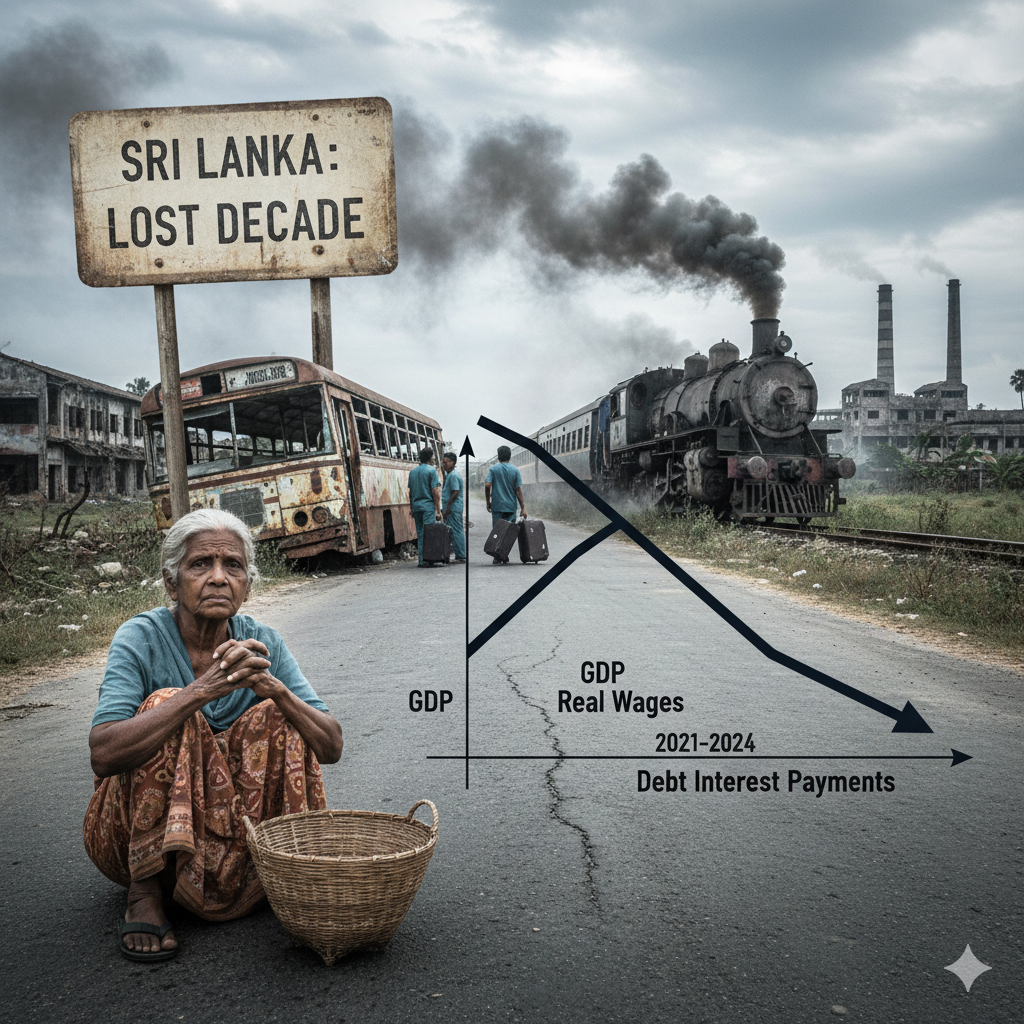
Sri Lanka has undergone one of the sharpest and fastest episodes of austerity in history, driven by massive retrenchment in public investment and the suppression of real wages, according to a World Bank report.
On 9 September, the World Bank published a report called Sri Lanka Public Finance Review: Towards a Balanced Fiscal Adjustment. The 109-page report is anchored in the theoretical certainty that austerity was a painful but necessary adjustment following Sri Lanka’s default on its external debts in 2022.
Yet even within this paradigm, the report provides a treasure trove of data that serves as a damning indictment of how austerity has suppressed investment, undermined growth and deepened social distress.
According to the World Bank, across 330 episodes of austerity in 123 countries between 1980 and 2024, Sri Lanka’s ‘fiscal adjustment’ from 2021 to 2024 stands out as being “sharper and faster”. For Sri Lanka, this record fiscal consolidation is second only to the period from 1980 to 1983 – a turbulent period of neoliberalisation bookended by state-sponsored union-busting and ethnic pogroms.
Growth and investment
- Sign up for Aliran's free daily email updates or weekly newsletters or both
- Make a one-off donation to Persatuan Aliran Kesedaran Negara (ALIRAN), Maybank a/c 507246118995 or CIMB a/c 8004240948
- Make a pledge or schedule an auto donation to Aliran every month or every quarter
- Become an Aliran member
Since Sri Lanka entered into its 17th International Monetary Fund programme in 2021, its primary balance (the difference between government revenue and expenditure, not counting debt repayment) has increased by 8%.
Yet this achievement came at an extraordinary cost. The most severe blow has been dealt to public investment: a retrenchment in this area drove 72% of the spending adjustment between 2019 and 2023. The contribution of public investment to growth turned negative between 2021 and 2023, dragging overall gross domestic product (GDP) downward.
Instead of acting counter-cyclically, public investment was shackled precisely when it was most needed to absorb labour, stimulate demand, and lay the foundations for industrial recovery.
The cuts to public investment are particularly egregious given Sri Lanka’s already poor infrastructure. The World Bank itself acknowledges that Sri Lanka’s public capital stock ranked close to rock bottom – 143rd out of 166 countries in 2019 – with glaring deficiencies in overall infrastructure.
A significant portion of Sri Lanka’s rural road network remains unpaved and in poor condition. In public transport, a third of the public bus fleet is non-operational and over two-thirds of train engines are over 40 years old.
This suppression of investment is directly linked to the economic stagnation that has crippled the country. The World Bank admits that “real GDP is not expected to return to its 2018 level until 2026”. In other words, the country has lost almost a decade of development.
The industrial sector, a key engine for employment and development, has been hit hardest, suffering a cumulative contraction of 25% over 2022 and 2023.
Wages and poverty
The human toll of this austerity policy is hard to digest. The report states that more than a quarter of the population has fallen below the poverty line, with another third of the population categorised as vulnerable and living on the brink of poverty.
The report acknowledges that a 4% increase in poverty was directly attributable to the fiscal adjustment between mid-2022 and mid-2023.
The poor have been disproportionately affected. The removal of electricity subsidies alone led to a 5% decrease in disposable income for the poorest households.
Meanwhile, the promise of stability and recovery has failed to materialise for the average worker. Real wages remain 14% and 24% lower than pre-crisis levels for the private and public sectors, respectively.
The public sector, under a hiring freeze, has borne the brunt of this. The average public sector wage, which was already low, fell from 88% of per capita GDP in 2020 to just 62% in 2023, making government wages the least competitive for highly skilled workers.
These figures contextualise the exodus of skilled workers or brain drain that the country has been grappling with. A recent study found that an estimated 1,489 doctors, including specialists, emigrated in 2022–24, causing a financial burden of nearly $42m to the Sri Lankan government and taxpayers.
This outflow has placed significant pressure on the healthcare system, resulting in shortages of key specialists, disruption in medical training, and widening disparities in access to healthcare.
Conspicuous absences
The report carries a plethora of technocratic recommendations to make the austerity more palatable.
Many of these recommendations – such as improving tax administration, shifting towards direct rather than indirect taxation, and better targeting public spending – are inoffensive in themselves. One could say they are no-brainers.
Where the report has no answer is on two critical structural issues
Debt bomb
The fact is that overall public spending in Sri Lanka is low. The single biggest component of public expenditure is interest payments, which accounted for 9% of GDP in 2023.
To quote the report:
Sri Lanka’s interest payment expenditures are relatively large, whereas the public sector wage bill, capital expenditures and spending on health, social protection and education are relatively low.
No amount of internal fiscal adjustment can provide long-term stability without defusing the debt bomb that crowds out social investment. A thorough restructuring or cancellation is needed.
Structural non-transformation
The words manufacturing or industrialisation hardly appear in the report.
Naturally, the World Bank, with its long history of prescribing a development model based on agricultural exports and services, shows little concern for structural transformation.
The problem of government spending is viewed in near-total isolation from the task of building a modern economy that can generate jobs and growth while sustaining infrastructure and public services.
Balancing the budget will not transform the economy in a way that pre-empts the next crisis; long-term planning and industrial policy are needed.
Sri Lanka’s example is one among many in the Global South. Around 54 underdeveloped countries, home to 3.4 billion people, spend most of their tax revenues to pay creditors rather than invest in the wellbeing of their people. In these nations, the claims of the creditor supersede the dignity of human beings.
When will the hunger of the creditors be satisfied? How can the financing and technology transfers needed for structural transformation be acquired? These are questions the World Bank does not want to ask.
Instead, it insists that what has been done before can be done again – just in a more ‘balanced’ way. – Globetrotter.
Shiran Illanperuma is a Sri Lankan journalist and political economist. He is a researcher at Tricontinental: Institute for Social Research and a co-editor of Wenhua Zongheng: A Journal of Contemporary Chinese Thought.
AGENDA RAKYAT - Lima perkara utama
- Tegakkan maruah serta kualiti kehidupan rakyat
- Galakkan pembangunan saksama, lestari serta tangani krisis alam sekitar
- Raikan kerencaman dan keterangkuman
- Selamatkan demokrasi dan angkatkan keluhuran undang-undang
- Lawan rasuah dan kronisme


