Carmen Navas Reyes
The fear of unilateral coercive measures, or sanctions, is not unfounded.
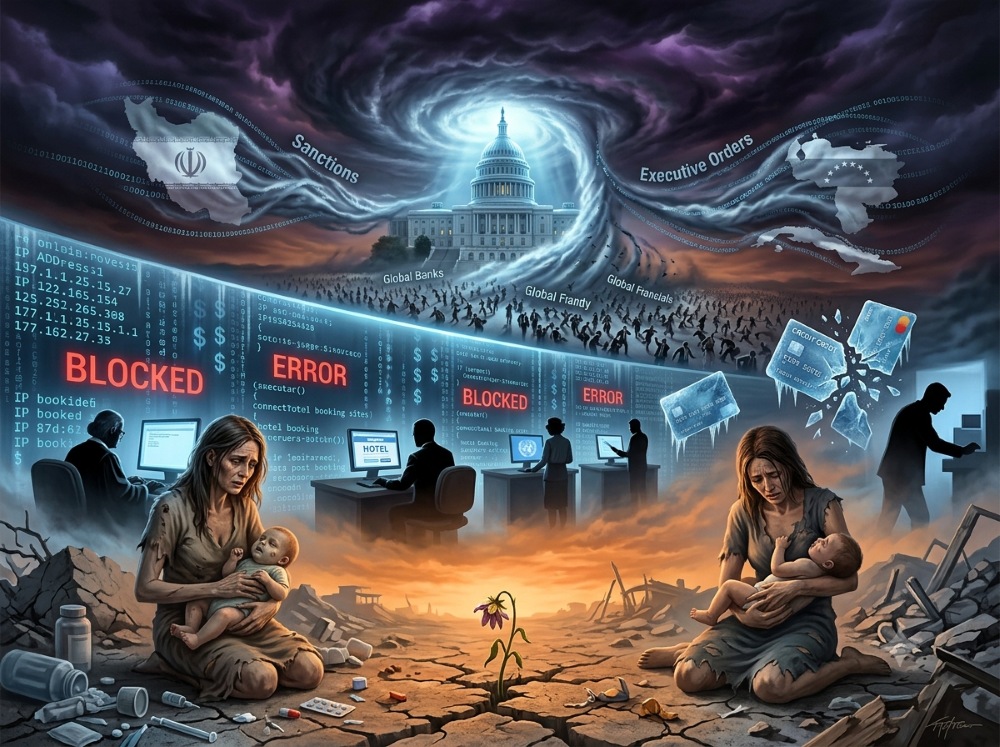
For example, since 2018, the Office of Foreign Assets Control (OFAC) has imposed sanctions against Iran’s use of cryptocurrencies. The decentralised nature of the blockchain no longer offers any immunity.
Any exchange or virtual asset service provider with any connection to the United States – whether by being incorporated there, having US customers, or processing transactions in dollars – is required to block transactions, verify IP addresses, and report frozen assets, under threat of multimillion-dollar fines and exclusion from the dollar-based financial system. The same happened with the Petro in the Venezuelan case.
The result is a self-perpetuating regime: Washington does not need to directly sanction an actor for that actor to become isolated. It is enough for third parties, out of caution, to decide not to take any risks. This is known as overcompliance.
The human cost
- Sign up for Aliran's free daily email updates or weekly newsletters or both
- Make a one-off donation to Persatuan Aliran Kesedaran Negara (ALIRAN), Maybank a/c 507246118995 or CIMB a/c 8004240948
- Make a pledge or schedule an auto donation to Aliran every month or every quarter
- Become an Aliran member
For years, the argument that sanctions are ‘surgical’ or ‘targeted’ – striking governments without harming populations – has been difficult to refute with hard data.
That changed with a study by the Center for Economic Policy Research (CEPR) in Washington: a comparative panel analysis of sanctions and mortality by age group, using data from 170 countries between 1971 and 2021, presents compelling findings.
Sanctions raise mortality rates across all age groups, not just among specific vulnerable populations. Mortality among children under one year of age increases by 21% as a result of the collapse of healthcare, nutrition and access to medicines.
The longer the blockade lasts, the higher the mortality rate, which debunks the idea that the impact is a ‘temporary shock’ that societies eventually absorb. Specific vulnerabilities in maternal health and the burden of care expose them disproportionately to the effects of the blockade.
Finally, the unilateral measures imposed by Washington prove deadlier than those decided by the UN Security Council or other blocs.
Sanctions as a political weapon
The US government has expanded the political use of UN Security Council-based sanctions. It has directed them not only against governments and institutions but, in recent years, against specific individuals whose actions upset Washington or its allies.
In December 2025, the US sanctioned two judges of the International Criminal Court (ICC) – Gocha Lordkipanidze of Georgia and Erdenebalsuren Damdin of Mongolia – for their involvement in investigations and arrest warrants targeting Israeli officials, including Prime Minister Benjamin Netanyahu himself.

Secretary of State Marco Rubio justified the measure by describing the court’s actions as “politicised” and warning that Washington would not tolerate what it considered a violation of US and Israeli sovereignty, noting that neither country is a party to the Rome Statute.
The practical consequences of this type of sanction are severe. The judges affected have their funds frozen in US banks and their credit cards blocked -regardless of the issuing country, given the global reach of the dollar-based financial system – and they lose the ability to make international transfers, book hotels or use everyday services such as online shopping. It is, in effect, a form of financial death.
The case of Francesca Albanese, the UN special rapporteur on the occupied Palestinian territories, further illustrates how erratic and politicised this mechanism can become. She was originally sanctioned in July 2025 following her criticism over Gaza and her recommendations to the ICC.
A federal judge suspended those sanctions in May 2026, ruling that they unduly infringed on freedom of expression.
Days later, an appeals court halted that suspension through injunctive relief, and the Donald Trump administration reinstated the sanctions.
Albanese’s own husband, World Bank economist Massimiliano Cali, faced financial restrictions at his job and pressure to be fired – driven by the NGO UN Watch – as a result of the sanctions against his wife.
These two episodes – the ICC judges and Albanese – show that the sanctions apparatus does not distinguish between states and individuals. It is deployed equally against a government as against an individual judge or a human rights rapporteur. Its collateral effects even reach family members with no direct responsibility for the matter that prompted the sanction.
Blocking humanitarian aid
The Venezuelan case connects both levels – the structural and the human – in a particularly stark way.
Following the earthquakes that struck the country on 24 June, more than one hundred economists and academics signed a letter addressed to the US government and the International Monetary Fund calling for the lifting of economic sanctions against Venezuela and for facilitating the country’s access to international financial mechanisms to address the emergency.
The letter specifically requested the removal of restrictions affecting the Central Bank of Venezuela, state-owned oil and gas company PDVSA, and other institutions, so that the country could access international resources earmarked for the humanitarian response and reconstruction.
Grassroots organisations and sectors of civil society reported at that time enormous difficulties in receiving and distributing aid, noting that the sanctions prevent access to international funds and make it difficult for supplies to reach those affected directly.
This is a clear example of how the ‘overcompliance’ described at the beginning of this article – banks and entities that refrain from doing business with Venezuela out of fear of sanctions, beyond what the law requires – ends up hindering even the response to natural disasters, in which no political considerations should play a role.
A common pattern
The episodes gathered here – the extraterritorial design of the OFAC regime, the statistical evidence on mortality, the selective sanctioning of judges and rapporteurs, and the humanitarian blockade in Venezuela, which have also been applied with the same force against Cuba – are manifestations of a single pattern: a sanctions system that operates less as a targeted legal tool and more as an instrument of power with global reach.
Its cost is measured in child mortality and in humanitarian aid that does not arrive in time during crises that the sanctions themselves provoke – resulting in a perfect storm and serving as a weapon for the regime-change model already tested in more than 20 countries around the world.
The question these cases leave open is not whether sanctions ‘work’ in terms of the policy they seek to change, but rather who ends up paying the price when the system is over-enforced.
It is almost always, not only the governments they target, but to a greater extent the populations – infants, women and individuals caught within their scope – while the US government employs these illegal measures with total impunity. – Globetrotter.
Carmen Navas Reyes is a Venezuelan political scientist with a master’s degree in ecology for human development (UNESR). She is currently pursuing a PhD in Studies of Our America at the Rómulo Gallegos Foundation Center for Latin American Studies (Celarg) in Venezuela. She is a researcher at the Tricontinental Institute for Social Research.
AGENDA RAKYAT - Lima perkara utama
- Tegakkan maruah serta kualiti kehidupan rakyat
- Galakkan pembangunan saksama, lestari serta tangani krisis alam sekitar
- Raikan kerencaman dan keterangkuman
- Selamatkan demokrasi dan angkatkan keluhuran undang-undang
- Lawan rasuah dan kronisme