By Manolo De Los Santos
The mood in the Caribbean grows increasingly tense, as the United States intensifies its military threats.
Beneath the deceptive shroud of the ‘war on drugs’, the US is actively executing a blueprint for military intervention in Venezuela, employing lethal force and projecting power in a manner that legal institutions and regional leaders have condemned as a profound threat to international order.
This aggression is not a law enforcement operation. It is the negation of law, a neocolonial revival of the Monroe Doctrine, designed to shatter the sovereignty of Venezuela, seize control of the world’s largest oil reserves, and install a compliant regime.
License to kill: the precedent of state murder
A chilling adoption of extrajudicial violence has marked the current escalation.
- Sign up for Aliran's free daily email updates or weekly newsletters or both
- Make a one-off donation to Persatuan Aliran Kesedaran Negara (ALIRAN), Maybank a/c 507246118995 or CIMB a/c 8004240948
- Make a pledge or schedule an auto donation to Aliran every month or every quarter
- Become an Aliran member
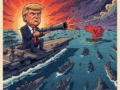
The Trump administration has ordered unilateral military strikes against private vessels near the Venezuelan coast, allegedly to stop drug trafficking. To launch these alarming attacks, the US military has deployed a massive naval force of warships, drones and special operations forces.
These strikes have resulted in the summary execution of at least 27 people as of recent reports. The most recent lethal strike in the Caribbean resulted in the “elimination” of six more people.
This is not law enforcement; it is extrajudicial murder and a campaign that now stands as part of a war plan against Venezuela.
The US administration has characterised the victims, without credible proof, as drug traffickers and “terrorists” – a claim that, even if true, provides no legal authority for the US president to execute whomever it decides.
Legal and human rights organisations have been unequivocal in their condemnation of this profound and dangerous policy, which replaces established law enforcement procedures with premeditated lethal force.
The New York City Bar Association, a key voice on international legal ethics, has strongly denounced these actions. It stated explicitly: “Because the recent attacks on Venezuelan vessels and their crews were unauthorised by US law and in violation of binding international law, they were illegal summary executions – murders.”
The NYCBA further argued that these actions violate the fundamental international principle that “no one shall be arbitrarily deprived of his life” under the International Covenant on Civil and Political Rights.
The US government possesses ample legal authority for the Coast Guard to interdict and search vessels suspected of carrying narcotics, followed by prosecution in US courts according to due process requirements.
However, in the case of the Venezuelan vessels, the Coast Guard’s congressionally authorised police function was bypassed. Instead, the crews were simply targeted and executed by overwhelming military force.
Regional leaders, including Colombian President Gustavo Petro, have condemned the extrajudicial killings, highlighting the profound anxiety across Latin America over a return to unilateral US military action under the cover of anti-narcotics policy.
Escalation: B-52s and the threat of war
Beyond the lethal strikes, the US government has engaged in significant military posturing that amounts to a direct challenge to Venezuelan sovereignty. The sighting of US B-52 bombers in Venezuelan airspace, flying in close range, is a significant escalation.
This warmongering has nothing to do with the ‘war on drugs’ and everything to do with regime change to plunder Venezuela’s oil. This reckless push for war is a criminal act of international aggression.
The Trump administration’s unilateral drone strikes in the Caribbean, combined with the White House’s termination of all negotiations with Venezuela, appear as a precursor for a full-scale regime change operation.
This is a critical moment. We must sound the alarm: there is a risk of a new catastrophic conflict in the region.
The US government’s own officials continue to escalate the crisis with bellicose rhetoric and actions. Secretary of State Marco Rubio, a key architect of the regime-change policy, has consistently refused to rule out a military option, asserting that the Nicolas Maduro regime has become a “threat to the region and even to the United States”.
Venezuela’s response has been one of principled defence of its sovereignty. Ambassador to the UN, Samuel Moncada has repeatedly sounded the alarm on the global stage, arguing that the US military deployment in the Caribbean is a massive propaganda operation that seeks “excuses to fabricate a conflict” to seize the country’s oil wealth.
Moncada affirmed: “The United States believes that the Caribbean belongs to it because it has been using the expansionist Monroe Doctrine for over 100 years, which is nothing more than a remnant of colonialism.”
President Maduro has called on Washington to resume dialogue, stating, “Our diplomacy isn’t the diplomacy of cannons, of threats, because the world cannot be the world of 100 years ago.” He has simultaneously mobilised national defence exercises to ensure the country is prepared for any direct assault.
The NYCBA warned that attacks against Venezuelan vessels and reported threats against the Venezuelan government violate the nation’s obligations under the United Nations Charter, with the risk of escalating to open hostilities.
Oil, ideology and deception
The current situation is chillingly reminiscent of the lead-up to the 2003 invasion of Iraq.
In that case, the George Bush Jr administration justified unilateral action on the basis of “weapons of mass destruction”, but this was a pretext. The true objectives were not limited to oil, but also included achieving profound ideological and political goals – overthrowing a government to reshape West Asian politics and assert dominance.
Washington must learn the lessons of this history. The Bush administration promised a quick victory in Iraq. Instead, the invasion and occupation claimed countless Iraqi lives, resulted in tens of thousands of American soldiers killed or wounded, and destabilised the region.
The notion that the US can carry out military invasions into the heart of Latin America without a massive blowback is outlandish.
In the case of Venezuela, the “war on drugs” and the labelling of the government as a “threat” serve as the new rhetorical pretexts.
The US interest is multifaceted: it involves securing the world’s largest proven oil reserves and achieving the ideological and political goal of overthrowing a socialist government to assert dominance and reshape Latin American politics.
The US seeks to dismantle the Bolivarian Revolution and eliminate a major centre of anti-imperialist politics in the hemisphere.
The current escalation is not about law enforcement or counter-narcotics; it is about regime change and plunder.
While members of Congress from both Democratic and Republican parties, as well as key voices of public opinion, are increasingly speaking up about the illegality of these strikes and the absence of credible information from the administration, this situation requires much more urgency. Once the escalation ladder is climbed, there may be no going back.
The international community must recognise this aggressive campaign for what it is: a criminal act of international aggression. The world must stand against this threat of a new catastrophic conflict. – Globetrotter
Manolo De Los Santos is the executive director of The People’s Forum and a researcher at Tricontinental: Institute for Social Research. His writing appears regularly in Monthly Review, Peoples Dispatch, CounterPunch, La Jornada, and other progressive media. He co-edited, most recently, Viviremos: Venezuela vs. Hybrid War (LeftWord, 2020), Comrade of the Revolution: Selected Speeches of Fidel Castro (LeftWord, 2021), and Our Own Path to Socialism: Selected Speeches of Hugo Chávez (LeftWord, 2023).
AGENDA RAKYAT - Lima perkara utama
- Tegakkan maruah serta kualiti kehidupan rakyat
- Galakkan pembangunan saksama, lestari serta tangani krisis alam sekitar
- Raikan kerencaman dan keterangkuman
- Selamatkan demokrasi dan angkatkan keluhuran undang-undang
- Lawan rasuah dan kronisme