Rosli Khan
Malaysia’s express bus industry is facing a new regulatory burden that raises serious questions about competition, commercial freedom and the government’s understanding of public transport.
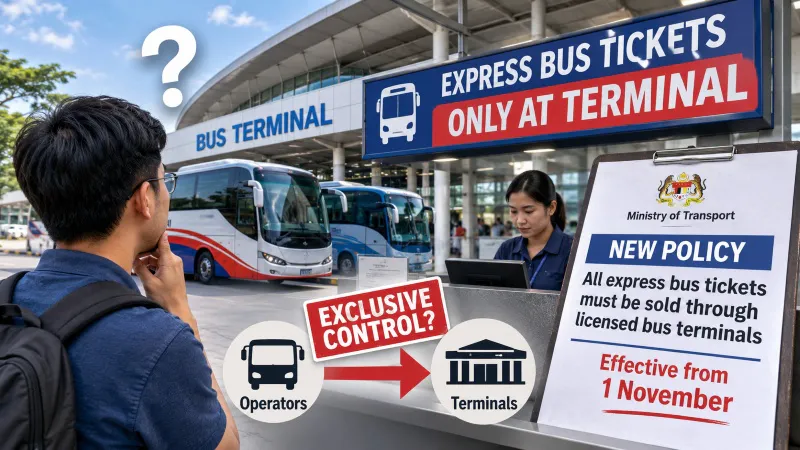
On 16 October the transport minister approved a policy requiring all express bus tickets to be sold exclusively through licensed bus terminals.
The Land Public Transport Agency (Apad) director general subsequently issued a circular directing operators to comply from 1 November, giving the industry just over two weeks to prepare.
The implications are serious.
- Sign up for Aliran's free daily email updates or weekly newsletters or both
- Make a one-off donation to Persatuan Aliran Kesedaran Negara (ALIRAN), Maybank a/c 507246118995 or CIMB a/c 8004240948
- Make a pledge or schedule an auto donation to Aliran every month or every quarter
- Become an Aliran member
This is not merely a change in ticketing arrangements. It shifts control over ticket sales from bus operators to terminal operators, creating a new layer of commercial control over an industry already struggling with rising operating costs.
The first question is obvious: why should a terminal operator have the exclusive right to sell tickets for a bus service that it does not operate?
Would Malaysia Airlines and AirAsia allow KLIA, the airport operator, to become the exclusive seller of their tickets?
It would be interesting to hear the views of the airlines’ owners and CEOs if the Civil Aviation Authority of Malaysia were to issue such a directive and require compliance within two weeks.
There is nothing unusual about terminal operators collecting terminal charges and passenger service fees. But granting them exclusive control over ticket sales is an entirely different matter.
The proposal is difficult to justify and has little precedent elsewhere.
Terminals should serve buses, not control their ticket sales.
Malaysia’s express bus industry has long been constrained by a terminal-centric approach to public transport planning.
Operators are required to serve designated terminals regardless of whether those locations are convenient for passengers or adequately integrated with other transport services.
Many terminals have also evolved into commercial property ventures, backed by substantial investments in buildings and facilities that must generate returns.
Bus operators are expected to pay terminal charges, while passengers bear the inconvenience and additional cost of travelling to terminals that may be poorly connected to their actual destinations.
The situation becomes even more problematic when terminal operators are given exclusive control over ticket sales.
Under Apad’s new directive, terminal operators will have the sole right to sell tickets for express bus services operating from their terminals. They will also assume responsibility for trip management, departures and ticket-sale transactions.
This raises another obvious question. If bus operators are responsible for running services, maintaining fleets, employing drivers and meeting safety requirements, why should they be required to surrender control of their own ticket sales?
A terminal provides infrastructure. A bus operator provides transport services.
These are distinct commercial functions. There is no compelling reason to combine them under a compulsory arrangement that gives one party control over the other’s revenue stream.
The Ministry of Transport should seriously reconsider Apad’s directive before it takes effect. – Free Malaysia Today
Rosli Khan, a traffic planning consultant, has a masters in transport planning and a PhD in transport economics from Cranfield University in England.
AGENDA RAKYAT - Lima perkara utama
- Tegakkan maruah serta kualiti kehidupan rakyat
- Galakkan pembangunan saksama, lestari serta tangani krisis alam sekitar
- Raikan kerencaman dan keterangkuman
- Selamatkan demokrasi dan angkatkan keluhuran undang-undang
- Lawan rasuah dan kronisme