
Without Exaggeration Reflections on the "Illegal Gatherings" in the Kelang Valley on 5 November 2000 by D J Muzaffar Tate
The right to hold public assemblies and the right to express views freely on political matters are contained in Part Two of the Malaysian Constitution. In other words, the 50,000 people or so (a conservative estimate) who gathered on the KESAS Highway and at other points around Kelang were not criminals or mobsters out to disturb the peace, or as Akbar Ali in a contentious article in The Sun (16 November 2000) would have us believe, �a small minority of fanatics� who �cannot seem to accept the will of the people when they lost the majority votes in the last polls�. To the contrary, we were a gathering of thinking Malaysians who are deeply concerned by the way in which our fundamental rights as citizens have been steadily eroded under the Mahathir regime. We did not come to contest the will of the majority of the people as expressed in the last general election, but to demand the restoration of our civic rights - a matter which should be of concern to all Malaysians who believe in democracy. We did not come armed with sticks and parangs (machetes); our only weapon was a small round pink badge with the words Kembalikan Hak Rakyat (Restore the People�s Rights) inscribed upon it, which quite a number of us wore. Our protest was against the latest instance of the arbitrary, undemocratic and unconstitutional measures to which the Mahathir regime has had recourse in its efforts to curtail the expression of political views which differ from its own. The only comment that Mahathir himself had to make about this �illegal� gathering was that: `These are the people who ask us to follow the rule of law. When we follow the rule of law, they condemn us� - a response which indicates that the Prime Minister himself is either not conversant with the concept, or has a very different interpretation of it from that of most of us. Other BN voices have accused the participants of the 5 November gathering as being unpatriotic rabble-rousers out to seek their own particular ends. The Erosion of Malaysian Democracy However, let the facts speak for themselves. Is there any truth in the Barisan Alternatif allegations that civil liberties in this country have been steadily whittled down to such an extent that democracy barely exists here any more? Unfortunately, the answer is �Yes�. The evidence is overwhelming. The best and most comprehensive study to date of how democracy in Malaysia has been reduced to a sham is contained in a book written by Dr. Rais Yatim, now Minister in the Prime Minister�s Department with a purview on law. Entitled Freedom and Executive Power in Malaysia: A Study of Executive Supremacy (Kuala Lumpur, Endowment Publications, 1995), it is a devastating, scholarly analysis of the processes by which the principles of democratic government as laid down in the Malaysian Constitution have been substantially undermined. The process goes back as far as 1957, Merdeka Year, because the new (Reid) Constitution itself contained a number of loopholes, which have enabled the Executive (i.e the Prime Minister and his Cabinet) to get round the supposedly absolute rights of the citizen. We also inherited from the colonial era the Emergency Laws (designed to combat Communist insurgency) granting the Executive extensive powers of arbitrary arrest and detention, converted into the Internal Security Act (ISA) of 1960, which, as we all know, is still in force. Furthermore, since 1960, a number of other repressive Acts of Parliament that infringe upon fundamental liberties of the citizen have been passed and made law. Notably, these include the Police Act (1967), the Sedition Act (revised 1969), the Societies Act (1966), the Universities and University Colleges Act (1971), the Official Secrets Act (OSA. 1972), Essential (Security Cases) Regulations (ESCAR.1975), and the Printing Presses and Publications Act (1984). The net result of all this legislation has been to place in the hands of the Executive (i.e. through the Minister who holds the relevant portfolio) powers to detain, prohibit or revoke without being accountable to anybody, including Parliament. All this has been done in the name of national unity and security, at the expense of the liberty of the subject and the rights to freedom of expression, assembly and association contained in the Constitution. In consequence, democracy in this country has been largely stifled. Since 1981 the process of stifling democracy has been intensified. Full use has been made of the draconian powers which the Executive holds over individual rights and freedom of expression. This becomes very apparent at election time when the government(i.e. Executive)-dominated media - radio and TV and the mainline newspapers - provide only news and views favourable to the ruling party. Moreover, since the last general election we have witnessed the harassment and demise of a number of leading Opposition publications. However, the most lethal blow to democratic institutions has been the castration of the Judiciary, the independence of which was designed to protect the rights of the citizen against Executive encroachment. The first major blow in this direction was the deposition of Lord President Salleh Abas in 1988 in a manner which created a major scandal in legal circles all round the world. The culimination has been seen in the sad saga of former Deputy Prime Minister Anwar Ibrahim. His trial and conviction on charges of abuse of power and sodomy have been regarded by detached legal observers as a gross travesty of justice, and have also been the source of national outrage, particularly amongst the Malay community. Rais Yatim, in his study written in 1995, summed it all up by stating as his conclusion that �while the power of the Executive is on the rise by virtue of majority rule and parliamentary supremacy, the rule of law and human rights deteriorates...; and that with regard to the latter their future in Malaysia �is dismal�. Of the 'Rule of Law' , Human Rights' and 'Natural Justice' The terms �Rule of Law�, �Human Rights� and �Natural Justice� become buzz words in any discussion about democracy and democratic principles. All three are frequently used by Mahathir either to defend his policies or to deride his critics. As for �the rule of law�, his comments on the 5 November gatherings (quoted above) are sufficient to betray either a basic misunderstanding or a deliberate miscontruing of the concept or, at the very least, a gross oversimplification. Taken at face value, �the rule of law� simply means that in the running of national affairs the duly established law is the supreme arbiter, and not the arbitrary whims and fancies of one man or of one particular group of people. In fact no society can function without law; the alternative is chaos. However, there is a silent, deeper implication for those of us who believe in democracy. In a democracy - remember Abraham Lincoln�s classic definition?: �government of the people, by the people and for the people� - the �rule of law� does not imply accepting �the law� for its own sake, but accepting law which is just, fair and equitable, and before which all citizens are equal. In a democracy, the law must be just, or else there can be no democracy but only tyranny. Unfortunately, standing alone, the term �rule of law� does not explicitly indicate what kind of law we are dealing with. This is why the constitutions (i.e. fundamental laws) of most democratic states contain special articles or provisions which define the principles upon which law that is just must be based. As already mentioned, in the Malaysian Constitution they are provided for in Part II, and cover no less than twelve basic freedoms guaranteeing the rights of the individual citizen. If this be the case, laws in a democracy which are unjust must contravene the spirit if not the letter of the Constitution and thereby themselves are inherently �illegal�. It will be noted that in Malaysia Anwar Ibrahim - and many others - have been convicted on the basis of legal technicalities springing from arbitrary powers, which are essentially undemocratic and granted to the Minister of Home Affairs by a supine majority of members of Parliament. Such powers should not exist. The concept of the rule of law in a democratic society does not encompass legislation which in itself contradicts natural justice. Within this context, �Human Rights� and �Natural Justice� are two concepts which Mahathir has ridiculed on many an occasion and which, he suggests, are creations of the West. In other words, although both terms, which are quite self-explanatory, would appear to apply to all human society and are so perceived by the United Nations itself, for him they are not universal since each society has its own set of values. On one occasion in Parliament (as quoted by Rais) when presenting the Constitution Amendment Act of 1988 (which made significant changes affecting the liberty of the subject and the independence of the Judiciary), Mahathir declared - �Is their [i.e. that of Western judges] natural justice more in priority than our own laws? What is this natural justice? What is so �natural� about the justice that is administered by the courts in the West?� Thus, for Mahathir, the rule of law appears merely to mean the application of the existing law, regardless as to whether it is just law or not, and human rights and natural justice, far from being universal, are values which relate to specific cultures only. This is rather surprising for a politician who has identified himself so closely with opposing colonialism in whatever form it may take, in the name of human rights and natural justice. It is also rather strange for the leader of a country which has struggled to free itself from the shackles of colonialism based on the same rationale of human rights and natural justice. So What? In this connection, Rais, looking at the other side of the coin, comments in his book on the �seemingly calm and patronising attitude of the Malaysian people in facing and accepting these excesses vis-a-vis their rights...in a country that prides itself in being democratic and leading the voice of liberation in third world countries.� He ascribes this to the culture of fear that �has set in�. He also speaks of the �bland �antidote� given by the government ... that so long as progress and development are brought to the rakyat, other matters are to be regarded as secondary�. He adds: �Malaysians are expected to look, listen and follow. If one wants to lead, one has to join the ruling elite. The good life, the benefits of the present economic boom (i.e. in the early 1990s) which are generously represented by business opportunities, state aids, welfare allocations and even work opportunities are sadly missing in the lives of those who choose to be democratic and oppose the ruling elite.� Looking at the odds, Rais, as we have seen, was pessimistic about the prospects for Malaysian democracy, and so, apparently has since decided to adopt the philosophy that �if you can�t beat them, join them�. But the fact that at least 50,000 people (who must represent many hundred thousands more who could not come) gathered on that Sunday afternoon in early November because they were concerned enough and brave enough to protest against the loss of their civic rights, may be taken as a sign that we, as a nation, are becoming alive to our rights and responsibilities as citizens after all. | |||||||||||||||

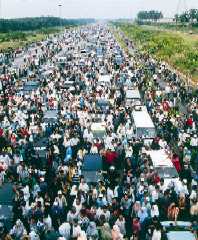 Let us not make any bones about it. The �illegal� gatherings on the KESAS Highway and at other points around Kelang on 5 November were politically motivated and were designed as a protest against the police refusal to grant a permit for the holding of a public rally convened by the Barisan Alternatif. In turn, the purpose of the rally was to criticize some of the policies of the Mahathir regime with which they were not in agreement.