
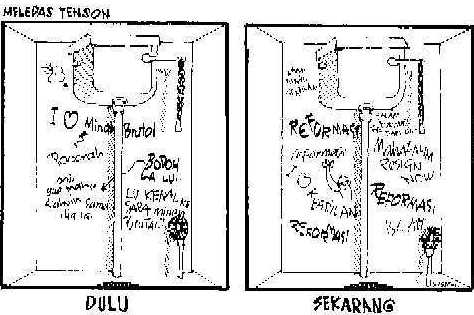
Thinking Allowed Reformasi flourishes in public toilets Haven�t you noticed? It�s true: Malaysian toilets have never been quite the same since the Reformasi movement was unleashed. In pre-reformasi days, the graffiti in our stinking public toilets tended to showcase the predictable if unmentionable �creativity� of Malaysian �artists�. Replete with colourful, vulgar language, these �works of art� invariably focused on various romantic interests accompanied by graphic illustrations, dengan unsur-unsur seks, tidak sesuai untuk tontonan orang ramai. But since reformasi was unleashed, we have been subjected to an overdose of unsur-unsur (elements, most of them unsavoury) of all kinds in the mainstream media and in sodomy court trials; indeed, the public toilet graffiti of old seems almost boring and Victorian by comparison. We have also had the unique if somewhat stomach-churning experience of digesting the novel �Sh**� and expelling what we didn�t understand. How could any public toilet artist top that? Perhaps this is why many modern day graffiti artists have graduated to reflect on the more serious political issues of the day, while doing their daily `business' - no doubt inspired by the stink around them, near and far.
In a prominent local university, for instance, students have scrawled bitingly sharp, illuminating exchanges on the reformasi movement on toilet doors and walls. Mahathir, Anwar, UMNO and PAS are popular subjects (use your imagination, please). No libel laws to worry about here! Students (I wonder if lecturers join in as well) accuse each other of being �prostitute� writers (penulis pelacur) for their political masters, of wasting their time on politics instead of studying, of being ignorant to the outside world. This has really helped to create political awareness in everyday language in the least likely of places - the tandas awam (public toilets). And best of all no publishing permit is required for the graffiti (maybe one day we might need a permit to produce toilet paper?). So, do you want to know how the ordinary Malaysian thinks on weighty political issues? Just head for your local public toilet, pinch your nose and open your eyes� When Papa Votes UMNO and Children Shout "Reformasi" Another noticeable phenomenon is that some Malaysian families have been torn along political lines ever since reformasi broke out. It was probably the younger generation who were most strongly pulled into the reformasi movement on the streets. In the process, many have exposed their parents to the changes that are taking place in Malaysian society. The youth with their idealistic vision of a more just, united society seem more naturally drawn to the reformasi movement while their parents have difficulty overcoming years of allegiance to UMNO � though more and more of them are opening their eyes to what is happening around them as life becomes more difficult for the lower income group.
Sometimes, this can lead to political tension within a family but if there is acceptance of each other�s beliefs then family harmony can still prevail. Otherwise, this is what we will get (see right, from Wasilah - Dec 1999). No doubt, entire families have been split across the nation. Perhaps it is time for UMNO to organise �Family Unity Talks� for families broken along political lines so that everybody can return to UMNO and live happily ever after. Unity in Jeopardy Recently, members of the Malay community in Malaysia were cautioned by UMNO leaders and others that their unity is in jeopardy. And this, so goes the argument, could eventually pose a danger to the survival of the Malays. In a move that was portrayed by the mainstream media as magnanimous, Mahathir reached out to the Malay-based opposition parties, namely PAS and keADILan, and proposed that they set aside their differences and talk to one another. Unity talks, they called it. Critics and cynics alike wondered: was this a way for UMNO to impress upon the Malay public that it always has the interests of the Malay community at heart? Was UMNO trying to give the impression that it still has political clout among Malays and could still call the shots? Or was UMNO simply trying to emphasise its relevance in these changing times when everybody else is resorting to multiethnic approaches to almost every aspect of Malaysian life? But really, is there �disunity� among Malays? Many observers believe that if there is really such �disunity�, it is because many UMNO members have left the party for the opposition PAS or keADILan. Surely, this is political realignment, not a problem of �disunity�. Unless, of course, one�s premise is that Malays must always side with UMNO, come what may. What then actually happened in the recent past? Well, it is understood that the shocking manner in which Anwar Ibrahim was sacked by Mahathir left many Malays - indeed many Malaysians - agape and aghast. Equally revolting was the way in which Anwar was tried in our local courts. Indeed, that episode reminded us of the expression, trial and error. Malays are also �disunited� because of the way the BN Federal government has been mistreating the states of Kelantan and Terengganu. Development funds for these two PAS-led states have been channelled away from the state government to the Pejabat Pembangunan Persekutuan, the Federal Development Office. And in the case of Terengganu, oil royalty, which had been enjoyed by the previous BN state government was abolished by the Federal government. Now, that�s not a good basis to promote unity. Neither is hindering political gatherings or disallowing goodwill parties organised by the opposition the correct way to win friends and influence people, let alone promote unity. Equally revolting is the way this call for �Malay unity� is being orchestrated particularly by the mainstream media. Many a time they gave you the feeling that the �Malay unity� was urgent and necessary because of the �Chinese threat�, viz Suqiu�s so-called extremist demands. To create this climate of fear, you have a bunch of political have-beens and wannabes fanning ethnic sentiments and bigotry. So at the end of the day, what is aimed at is really an ethnic unity targeted against an imagined, external ethnic threat. Sounds heroic? In fact, it�s demagoguery. The danger with such unity claptrap is that the top leaders are the ones who would gain most, all in the name of �the community�. The rest will still lead their ordinary and often dreadful lives. And of course, politics becomes even more polarised, and the nation endangered. Home-grown Malays are Better As though things were not sickening enough, Singapore�s Prime Minister had to open his big mouth and claim that Singapore Malays were better than those in Malaysia. That was all that was required and almost overnight, �champions� of Malaysia�s Malays launched a salvo of verbal attacks on Goh, with a little bit of help from the mainstream media. For example, photographs of successful Malays were front-paged in the Utusan Malaysia to remind all and sundry that Melayu Boleh! And for the race heroes, it was not only Suqiu which now posed a threat. There loomed an even larger �external threat�. And guess who would be in a position to provide this much needed protection for the Malays? Tak kan UMNO hilang di dunia. I Will Follow You Predictably, the MIC has taken the cue from UMNO and is now reaching out to the fledgling IPF, in particular its leader Pandithan. Come join us, and unite the Indian community so that its political, economic and cultural future will be protected. But Pandithan is no fool. Remember, he now rides in a Mercedes donated to him by the IPF members. He also reads the mind of Samy very well. �We used to be like brothers,� both have said of the other. Hence Pandithan has asked to see the new MIC constitution first before committing himself and his IPF members to rejoining MIC. Apparently he wants to be assured that IPF leaders and members who had been expelled from MIC are still eligible to run for office and to hold positions in MIC upon rejoining it. Is this any way to treat one�s brother? | |||||||||||||||

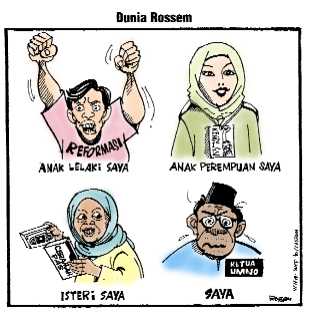 The more orthodox UMNO loyalists must be tearing their hair out wondering what has happened to the Malaysia of old, where everything was staid and predictable�. and utterly boring. They see their children supporting their opposition and shake their heads. What happens if their spouses desert them for an opposing political camp?