
Dams and Development - Time for a Re-think? by Wall Crack
In November 16th last year, a major study on large dam projects was published. The 398-page report entitled �Dams and Development - A New Framework for Decision-making�� was the culmination of two years� work by the World Commission on Dams (WCD) and sets out the values, criteria and guidelines that could, and should, govern future decisions on dam building.
In a statement published from this meeting, they called for a �society where human beings and nature are no longer reduced to the logic of the market where the only value is that of commodities and the only goal profits. We must advance to a society which respects diversity, and which is based on equitable and just relations between people, regions and nations.�
They demanded that �an international independent commission [be] established to conduct a comprehensive review of all large dams financed or otherwise supported by international aid and credit agencies, and its policy conclusions implemented�.
This request became reality at the World Bank Meeting in Switzerland, where an internal evaluation of World Bank Dams was slammed as being biased and methodologically flawed. Somewhat surprisingly, the World Bank, together with the World Conservation Union (IUCN), acceded to requests for an independent study and agreed to put up seed funding (about 10 per cent of the overall budget) for the World Commission on Dams.
Aims and Evidence
This new, independent organisation was set two major aims: first, to review the development effectiveness of dams and assess alternatives for water resources and energy development and, second, to develop internationally accepted standards, guidelines and criteria for decision-making in the planning, design, construction, monitoring, operation and decommissioning of dams.
The make-up of the Commission included major names from both those who had favoured and/or had been involved in the building of large dams as well as those who had been critical. Amongst them were engineers, company representatives, members of governments, academics, economists and indigenous and NGO representatives.
The Commission took its task extremely seriously, and the Report represents a wide range of evidence. The WCD held four regional consultations in which 1,400 individuals from 59 countries made representations, took part in two hearings on large dams organised by NGOs in Southern Africa and Europe, and received 947 submissions from over 80 countries.
In addition, it commissioned eight independent case studies on large dams and two country studies (India and China). It also sought 17 thematic reviews under the following categories: social, environmental, economic and financial, options assessment and institutional.
And finally, it conducted a comprehensive global survey of 125 dams for a �Cross-Check Survey�. Altogether, 1,000 of the 45,000 large dams in the world have been examined in some detail.
Importantly, despite the diversity of views represented by the commissioners, all signed the main conclusions of the report. This in itself should encourage all of us, not least our Government, to take its evidence and conclusions extremely seriously.
The Report's Conclusions
The conclusions are not positive. The Report is very clear about the shortcomings of large-dam projects. Whilst recognising the fact that such dams have provided benefits in the form of irrigation and drinking water, flood control and hydroelectric power (globally, dams account for 19 percent of electricity generated and 12 to 16 per cent of global food production), the Report states that these have invariably been at the expense of people and environment.
It records the under-performance of large dams in providing irrigation facilities and generating hydro power. It documents the adverse environmental impacts of large dams including on river ecosystems, and the negative impact on people dependent on these ecosystems, particularly tribal and indigenous communities.
The many testimonies reported by the WCD also show that negative impacts of large dam projects are usually heavily under-estimated by dam proponents. The study found that dam building involves huge cost overruns and delays, and environmental and social impact assessments have all too often failed to identify accurately the effect of the dam(s) on environment and people. The report goes so far as to allege that �few dams have ever been looked at to see if the benefits outweigh the costs�. This might ring some bells in Malaysia.
A quarter of dams built to supply water deliver less than half the intended amount, says the Report. In a tenth of old reservoirs, the build-up of silt has more than halved the storage capacity. What is more, by stopping the flow of silt downstream, dams reduce the fertility of flood plains and invariably cause erosion of coastal deltas. Large dams have caused extinction of many fish and other aquatic species, as well as huge losses of forest, wetland and farmland.
Dams Are Not 'Green'
The Report also demolishes the idea that dams represent something of a �green� ideal. In looking at the evidence from around the world, the Report states that rotting vegetation trapped underwater releases carbon dioxide and methane, both potent greenhouse gases, and that this can cause more pollution than generating electricity by burning fossil fuels.
For example, the billion-dollar Balbina reservoir in the Amazon rainforest was built 13 years ago to provide �green�, pollution-free electricity, but it in fact produces eight times more greenhouse gas than a typical coal-fired power station with a similar generating capacity. The rotting vegetation has generated millions of tonnes of two greenhouse gases. These are carbon dioxide and methane - a gas that, molecule for molecule, is 20 times more potent at warming the planet than carbon dioxide.
The WCD warns that this problem extends beyond rainforest reservoirs. It told UN climate-change negotiators last June that greenhouse gases bubble up from all 30 reservoirs for which measurements have been made. The message was clear: �There is no justification for claiming that hydroelectricity does not contribute significantly to global warming.�
Scientists like Vincent St Louis, of the University of Alberta, have estimated that the total contribution of the thousands of reservoirs round the world to global warming is that they produce a fifth of all the man-made methane in the atmosphere. Add in their emissions of carbon dioxide, and they make up 7 per cent of the man-made greenhouse effect. So any claim that building dams is in any way �environmentally-friendly� should now be treated with the scepticism it has always deserved. Malaysian authorities take note.
Who is Affected?
In addition to the severely negative impact on the environment, the Report also spends considerable attention in documenting the effects of dams on people. It is estimated that large dam projects have displaced up to 80 million people worldwide, a huge number.
Forcing so many people from their homes and lands has led to extreme economic hardship, community disintegration, and an increase in mental and physical health problems. Indigenous, tribal, and peasant communities have been particularly hard hit. People living downstream of dams have suffered from increased disease and the loss of natural resources upon which their livelihoods depended.
The Report states categorically that the benefits of large dams have largely gone to the wealthy while poorer sectors of society have borne the costs. It recommends that people directly affected by dams should have a direct role in their conception and construction as well as guarantees on compensation and relocation. This is what many people have been consistently saying with regard to dam building in Malaysia, but have consistently been ignored. The result for communities displaced by dams here has been disastrous.
So Now...A New Dawn?
The Report has been hailed as a major landmark in dam building by just about every side of the dam debate, including by dam proponents, agencies such as the World Bank and representatives of environmental and indigenous movements.
One commentator has called the Report a landmark event which marks the beginning of a huge task. �It paves the way for a new approach, one that builds on looking at all energy development options, one that recognises people�s rights from the outset, one that more truthfully assesses all risks. It also points to the importance of assessing alternatives to irrigation, water storage and hydropower.�
Indeed the WCD itself has appealed to governments and international finance institutions - notably the World Bank and export credit agencies - to determine if dams are still necessary in light of other options such as wind and solar power.
NGO and other representatives of course have been quick to urge the World Bank and other public funding institutions and governments to implement the Report�s recommendations immediately. In particular, there is a demand that public financial bodies �should place a moratorium on funding the planning or construction of new dams� until they can show they have got �the free, prior and informed consent of indigenous peoples.� Funding institutions should also make provisions to pay reparations to communities that suffer social or economic harm because of dam projects.
In urging a complete re-think of dam building, demands following the publication of the Report have included:
Whilst such reviews are taking place, project preparation and construction should be halted. Such reviews should establish whether the respective dams comply, as a minimum, with the recommendations of the WCD. If they do not, projects should be modified accordingly or be stopped altogether.
Further, demands are being intensified that all institutions which share in the responsibility for unresolved negative impacts of dams should immediately establish and fund mechanisms to provide reparations to affected communities that have suffered social, cultural and economic harm. For Malaysia, all of this means that international participation in dam projects like Bakun will become more and more difficult unless the criteria for planning dams recommended in the Report are followed. As they should be.
Minimum Standards Required
It is not just Malaysian dams that fall way short of the criteria suggested. Most of the 42,000 big dams already built in the world would not now exist had the sort of guidelines and procedures recommended by the Report been in place. So will this Report make any difference to Malaysian plans? Will we stop building large dam projects in Malaysia? Will we re-evaluate and perhaps re-compensate those people who have been forcibly moved (to poorer lives) because of existing large dam projects? Will we now insist that the recommendations of the WCD be adopted as minimum standards for dam projects here?
Despite the overwhelming evidence, despite the clear conclusions of this WCD Report (and so many others), the sad fact remains that the people and the environment here in Malaysia and elsewhere in the world will no doubt continue to be vicariously destroyed. Why? We would venture that it is not just an absence of logic and a refusal to face the evidence existing amongst those who propose large dams, but that the real stumbling block is the huge benefits that accrue to the few from such projects.
As the WCD aptly points out in its report: �As a development choice, the selection of large dams often served as a focal point for the interests and aspirations of politicians, centralised Government agencies, international aid donors and the dam-building industry and did not provide a comprehensive evaluation of available alternatives�.
We have a chance now to break away from this, to re-think, to properly review alternatives and implement policies that make sense. Will it happen? What do you think?
|
|||||||||||||||||

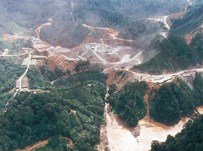 The fact is that the building of (especially large) dams had become increasingly controversial through the 1980s and 1990s, as Malaysia knows to its cost. Indeed, the original call for the World Commission on Dams came from dam-affected communities from all over the world. They gathered in Brazil in March 1997 to share their common experiences with regard to the loss of land and livelihoods as well as their efforts to fight against the vested interests which had promoted and benefited from the projects.
 And the Report is clear that it is almost always the most marginal members of society who are so affected. �The direct adverse impacts of dams have fallen disproportionately on rural dwellers, subsistence farmers, indigenous peoples, ethnic minorities, and women�, states the Report. It goes on: �Little or no meaningful participation of affected people in the planning and implementation of dam projects has taken place�.