
Mahathir's Future, Daim and the MCA: UMNO avoids crucial issues like the plague
by Maznah Mohamad
At its recent General Assembly, UMNO members may have been barking up the wrong tree. They were consumed by the ambition of a 2004 national election victory when their own intra-party election was in disarray. Dr Mahathir continued to talk down to the Malays, implicating that they are lazy, amnesiac, woolly and ungrateful, when it is their support UMNO is trying to regain.
No wonder. UMNO�s General Assembly is really an overrated theatrical performance, in its umpteenth run and was never meant to mirror the party�s state of being. Things have to be read between the lines. The real issues that demand to be uncovered lurk beneath the surface. In fact the most nagging issues � Mahathir�s future, Daim�s absence and the MCA-UMNO business deals were abandoned for silent resignation.
UMNO has changed from being a party that was once smug in its sense of mission to one which is directionless. It is true that UMNO has undergone a transformation. New dynamics are evolving that are making the question of survival � what, whose and how - an important one to reconsider.
Many Explosive Issues
The meeting should have been an explosive one given the outstanding issues � Daim�s rift with the Prime Minister and his exit as UMNO�s previously unassailable exchequer; the continued haunting of Anwar�s imprisonment and ill-health; the arbitrary and opaque measures used to pinpoint perpetrators of internal party corruption; the much rumoured divide between the Mahathir and the Abdullah Badawi camps, the complete abandonment of competitive rules for intra-party advancement, UMNO�s shaky business foundation and the escalation of rivalries, petty and substantial, all around.
Instead, true to expectation, all tensions were kept under wraps and mock conviviality was displayed among guffawing leaders on stage (a favourite and recurrent photo distraction in Malaysian newspapers).
Doublespeak
The first thing to read between the lines: Speeches were a classic case of words not matching deeds, or perfect examples of unabashed doublespeak.
In truth they were all Janus-faced. While Abdullah claimed that the movement must now be more concerned about �human rights, democracy, justice, transparency and strong judiciary� he was non-ambivalent about the ISA. When asked if the ISA should be repealed, the answer was an uncompromising �No�.
The head of UMNO Youth, Hishamuddin Hussein was less clear about what new directions he intended the movement to pursue. But as a whole the movement has not veered from its image as vanguard of Malay chauvinistic interests as in the passing of a resolution to reject outright all of Suqiu�s demands. Is that being realistic for winning a broad-based support when PAS has gone all out to address many of the concerns of the Suqiu?
As for Wanita UMNO, its chief, Rafidah Aziz, stressed the point till she was blue that there was no rivalry whatsoever between the movement and the upstarts of Puteri UMNO. This denial failed to reveal hints that the chief was flustered because Puteri UMNO had really been stealing Wanita�s thunder.
There were sophomoric quarrels over the veracity of membership figures (Wanita UMNO says Puteri UMNO will only get 20,000 members; Puteri UMNO says that it hopes to surprise the party ). There were multiple refrains uttered about working towards capturing the next election. But the speakers have kept Malaysian women in the dark as to what they intend to do to benefit them.
Personal Survival Overtakes Party Survival
Jollity, passion and tears aside it is hard to ignore the sense that what is paramount within UMNO is not so much about securing its future electoral win, than about the personal survival of its leader.
UMNO�s interest in winning future elections happen to be in conflict with the interest of a leader obsessed with exacting control over the party. In such a conflict, personal leadership survival will easily overwhelm the party�s first concern.
What is feared most by the leader in this situation is the emergence of intra-party challengers. The rhetoric spewed out during the proceedings was actually meant to distract the ordinary observer into believing that the party was making preparation to �re-popularise� itself for the next election. But the real answer to the party�s survival may never lie with an election four years away but with what is festering within it now.
The central leadership fear of displacement has caused it to use numerous pre-emptive tactics to stave off potential challengers. In the last general assembly (2000), the Supreme Council dictated that the post of president and vice-president be not contested. And just days before the recent meeting Abdullah Badawi suggested that the next party elections be postponed until after the 2004 national election. Some of these �pre-emptives� are even laughable ones, such as the call for all members to be obedient to the party president!
The Estranged Marriage of Politics and Business
But apart from what was badly said at the meeting, it was what was not said that is the more telling indicator of the party�s ill health. Why was the Daim issue totally avoided in the gathering?
The truth is that Dr Mahathir cannot afford to overemphasize the split. About a year ago, the popular and hard-hitting FreeMalaysia website refuted that there could ever be a split between the dynamic duo because, �The ties are so strong, in fact, that breaking them could risk destroying both men�A true conflict between the two could be nothing less than mutually assured destruction� Malaysia�s Butch and Sundance will go down, someday, but chances are they�ll go down together.�
The economic pie is getting smaller and the division of spoils is becoming harder to apportion. Overstretched public coffers and an angry citizenry have made it difficult to salvage all crony companies without inviting public backlash. Daim�s deft manoeuvering to prop up the economy may have enriched a select few but Mahathir suffers the flak of a disenchanted investor and business class, who are all also competing for government favours. But, as the website suggests, if the two are �thick as thieves� how can they bear to incriminate one another?
But this �split� may be the real mirror to the future of UMNO. Does it spell the imminent end to the marriage of politics (symbolized by Mahathir) and business (symbolized by Daim)?
It is most unlikely, because the survival of UMNO (even in its shell) must still depend on its well-placed agents to control corporations, generate patronage and bankroll elections. Can Daim be replaced by an equally adroit cash conjurer? The name of Tengku Razaleigh Hamzah is frequently noted through the rumour mill, but some factions within the party are bound to balk at this thought. On the other hand, if Daim is indispensable to UMNO�s survival will he be persuaded by others to realign himself and enter into new alliances?
Nanyang Siang Pau, MCA and UMNO
Although this fight is made out to be an intra-Chinese issue, there is an UMNO connection. The fight among UMNO, Hume and the MCA goes a long way back to 1989 when MCA was in deep financial trouble with its Multi-Purpose Holdings:
Does UMNO Still Have Influence Over Nanyang?
And if Hume and Nanyang were once linked to UMNO, why did Mahathir reveal that �Nanyang has been against us. It has been highlighting the extremists� views such as Suqiu�s during the Lunas by-election,�? (Malaysiakini, 22 June 2001).
Who, within UMNO, was involved with Nanyang? And why were the stories in the newspaper now unfavourable to Mahathir?
When Nanyang gave bad press to Mahathir, who could have allowed this to happen? Was there a �not-so-hidden� hand somewhere that was working towards Mahathir�s and his backers� downfall?
The Chinese angst over the MCA�s takeover of Nanyang might be a little misdirected, and UMNO�s silence is peculiarly strange. Nanyang Siang Pau was never an independent paper. In fact in 1991, it was MCA who fumed over the Hong Leong-UMNO deal when the takeover happened:
Another question to ask � is Mahathir �rewarding� the MCA by patching up old sores over the Multi-Purpose takeover? Whatever it is, there is a lot of quid pro quo horse-trading deals going on here among the political business elite of various ethnic groups.
In short, there is also a crony-war going on. We certainly do not want to get caught in the crossfire or be drawn into the mayhem as pawns.
Whose Future?
Given the mounting acrimony within UMNO it is indeed premature for the party to strategise for the next election. Leaders and their cronies console themselves that the reward for keeping the �marriage� intact, despite the strains, would be a future electoral victory.
And therefore, nobody will use formal meetings such as the General Assembly as the battleground to iron out differences, debate controversial issues, pose probing questions or use the rules of democracy to reprimand leaders and even oust them by the process of collective, transparent and open deliberation.
Meanwhile, things continue to boil under the surface and by now we are tempted to conclude that it is the leader rather than the party that is winning the battle for survival.
|
|||||||||||||||

 UMNO would have done better if it had turned inwards to scrutinize what was wrong with its own internal disorganization and odd style of leadership. Dr Mahathir�s negative name-calling is a queer way of winning trust from the Malays. Even their own propagandists in the NST (20 June, 2001) have run out of good spins and resolved to headlines such as, �UMNO General Assembly: Same Old Boring Rhetoric As UMNO Comes Under Siege�.
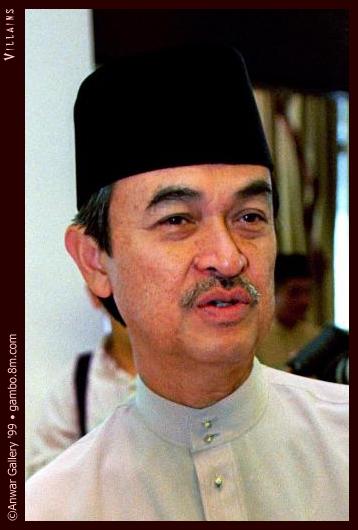 Abdullah Badawi�s speech was very distinct from Mahathir�s, in that the former tried to incorporate the rhetoric of democracy in persuading UMNO members to change, while the latter was blunt and dismissed any need for reforms. The UMNO Youth and Wanita Heads appeared amenable for a modicum of reforms to happen.
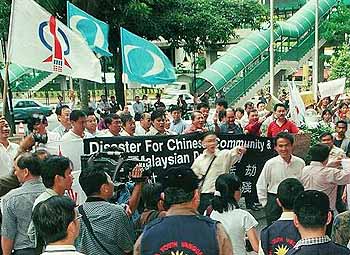 One other controversial issue, though seemingly separable from the interests of UMNO, is the fiasco over MCA�s takeover of Nanyang Siang Pau. The UMNO General Assembly has been almost oblivious to this controversy.