
MCA's Fractious Past
by Dr Francis Loh
In the mid-1960s, one of the founders of the Youth wing, Sim Mou Yew, also head of the Chinese Schools Teachers Association, led a group of radicals out of the party.
From 1971-73, yet another group led by Lim Keng Yaik, Alex Lee, Paul Leong, Tan Tiong Hong and T.C. Choong, branded also as the Young Turks for calling for reforms and democratisation of the party were outwitted by the old guard led by Tan Siew Sin, Lee Siok Yew, Kam Woon Wah and Lee San Choon, who controlled the party machinery and maintained close ties with UMNO. These Young Turks then left the party to join Gerakan.
One of them, Michael Chen, who remained behind in the MCA later challenged Lee San Choon for the presidency in 1979. Chen lost but took the matter to Court. Chen too left the party and joined Gerakan.
Between 1983-1985, after Lee had resigned as president, a protracted struggle between acting president Neo Yee Pan and FT chief Tan Koon Swan split the party right down the centre. Neo resorted to expulsions and suspensions of members and even entire branches. Tan filed legal suits and court injunctions. There were allegations of phantom members and phantom voters by both sides and an extraordinary general meeting was called in 1984 wherein Tan�s faction emerged victorious. But Tan did not last long as he was prosecuted and jailed over the Pan-El affair. In the wake of this crisis, Ling Liong Sik and Lee Kim Sai, who had allied with Tan, emerged as the new president and deputy president respectively in 1986.
In 1990 Lee mounted a challenge against Ling. A no holds barred contest was in the offing when it was averted in the eleventh hour. In 1996, Lee was eased out and replaced by Lim Ah Lek as MCA�s new deputy president.
This unending series of internal party conflicts, often resulting in expulsions or resignations suggest that there is a lack of democracy in the party. Through the years, the party president has been able to concentrate power. Like the UMNO president, the MCA president is also vested with the power to appoint other party leaders to top posts. This includes the secretary-general, treasurer-general, national organising secretary and his deputy, five other central committee members, the heads of the national-level bureau, and the chairpersons of the 13 state liaison committees. Increasingly, the president only consults the presidential council rather than the central committee or the general assembly even when making very important decisions, as in this case involving the RM230 million takeover of Nanyang Press Holdings Bhd.
|
|||||||||||||||

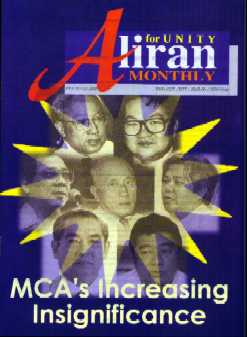 In the late 1950s, a group of Young Turks led by Dr Lim Chong Eu, Too Joon Hing, Yong Pung How, Tan Suan Kok and Ng Ek Teong allied themselves with H.S. Lee and challenged the party stalwarts comprising Ong Yoke Lin, Tan Siew Sin and the towkay leaders gathered around Tun Tan Cheng Lock, who was in his waning years. By 1959 the party was badly divided and the conflict was only overcome when Lim and his allies departed from the party (to form the United Democratic Party, and subsequently with others, the Parti Gerakan Rakyat Malaysia).