
The Challenge of Islam Within and Beyond Democracy It is time to take stock of this issue squarely
By Dr Maznah Mohamad
I believe that the juxtaposition of our anxiety over what new politics to create for Malaysia and our unfounded fears over what lies in store amidst a burgeoning global Islamic politics has forced us to scramble to look for an altered realignment that may in the end deliver us nearer to the political brink.
The DAP did not take long to make up its mind about not wanting to be associated with the �Islamists�. Ardent democrats and liberals writing in both mainstream broadsheets and alternative online papers also could not contain their chastisement of PAS� anti-U.S. demonstrators as �bigots� and �fanatics�.
I fear that what we are moulding out of a self-righteous name-calling is a political climate that will be split between a disparate secular force ready to eschew democracy on one divide versus a relentless but inexorable Islam on the other, with no good reason, therefore, to accept democracy.
My question is, how should we address the rise of a strong Islamic opposition to the present government? Is the solution to our need to preserve multiethnic cohesion to be found in the crafty manipulation of rhetoric by leaders as well as in the overt use of repression to flush out �Islamic radicalism�?
In the harried rush to differentiate �terrorists� from �Islamists� are we making the careless conclusion that Islam is necessarily averse to democracy, and vice-versa? Why is Islam suddenly presented as the disconcerting challenge to our aims of building a genuine democracy?
Perhaps, in the heat of the September 11 moment, many have forgotten that the most urgent task for us Malaysians now is to reconcile Islam with liberal democracy - and not to pin our hopes upon yet another strong superpower and its so-called moderate but authoritarian Islamic allies to do the �dirty� work of wishing away the rise of a �destabilising� Islam.
By now, after being exposed to the horrendous information about what damage an inconsistent and duplicitous American foreign policy can do, we should be aware that such a poor alliance can only lead to the further distortion and radicalization of the Islamic cause.
In between western hegemony and authoritarian national regimes there are many who want to see an enlightened, tolerant Islamic governance exist side-by-side and respectfully with a humane liberal democracy. If we did not bother to think of this possibility before, today�s unfolding global frictions and contradictions provide the best moment to do so.
I think we have to look at the rise of Islam more even-handedly and with greater probity. In this piece I would like to present an analysis that seeks to point to an unfortunate, but imminent split between two forces, Islam and the rest. My purpose here is not to advocate a partisan support for one side over the other but to make a reasoned plea that both sides come to an early understanding since by doing so we can help to prevent the possible rekindling of an open ethnic confrontation.
The debate over the Islamic state should now be seriously considered as an agenda to be negotiated upon rather than as a project to be overcome. Unfortunately, the DAP may have reduced its political role to redundancy by leaving the BA and UMNO may have to resort to unexceptional means to counter the rise of PAS. Whatever it is this does not augur well for the establishment and continuance of an inter-ethnic democracy.
PAS, KeADILan, and Reformasi
PAS� attempt at presenting the Islamic state challenge has irked many quarters. It has put the notion of a Malaysian nationhood project into a conundrum. The question is, can the country move forward with Islam at the apex while keeping intact the essential foundations of our society, i.e. its multi-ethnicity and multi-religiosity ?
Having partly drawn its strength from the support of a civil society keen to usher in a new era of more democratic and open politics, PAS quickly established itself as a credible and compelling alternative to UMNO.
When draconian measures were used against Keadilan leaders in April this year, the BN government showed that it was more perturbed by the growing challenge of a multi-ethnic coalition rather than that posed by an Islamic opposition.
However, it soon realised that thwarting the rise of this moderate alternative to UMNO only resulted in the further bolstering of PAS. UMNO�s loss of Malay support which commenced at the start of the reformasi movement had not only not been abated but is being made worse by each successive �pre-emptive� strike it makes to stave off the exodus of its old support base towards the opposition.
Two Approaches
When UMNO started to experience its loss of Malay support it was cornered into using only two approaches to prolong its legitimacy. The first was to frustrate any channel and platform that could provide for the consolidation of Malay dissent, and the second, was to redraw the bounds of its legitimacy by seeking the endorsement of a non-Malay consensus. Out of the latter, overlapping benefits were gained by its other partners representing other ethnic groups in the ruling coalition.
Yet, any augmentation of support by UMNO�s non-Malay partners would inevitably lead to the diminution of UMNO�s sway to maximally pursue exclusive gains for its Malay constituency. This was after all the extraordinary advantage that only UMNO had in the consociationalism; giving it a trump card to amass an almost unyielding Malay loyalty.
Now that the above calculation has been upset, UMNO has to decide whether it would be better to save the coalition and succumb to its own diminution or continue seeking whatever extraordinary means necessary to retain its dominance within the BN. So far, it has been more successful in the former.
Repressive And Responsive UMNO
At the same time the UMNO-led government did not have any qualms about quashing any Islamic movement which it considered �deviant� or �extremist� through violent and draconian measures (such as in the case of the Memali shootings and the banning of Darul Arqam).
UMNO was repeatedly successful at its electoral battles, even though it suffered from numerous bouts of intra-party crises due to the persistence of chronic factionalism. However, it was the Anwar crisis that palpably shifted Malay support away from UMNO. Large numbers of Malays could not countenance what they saw as the �immorality� of Mahathir�s and UMNO�s motives and actions behind Anwar�s imprisonment.
The loss in Malay support for UMNO, as evident in the 1999 national election results, was not only a matter of numbers but had distinctive and strategic significance � Islamic activists, the Malay middle class and urban youths switched sides.
Such a show of Malay disaffection, even if it was still insufficient to create an electoral sea change for Malaysia, was genuinely disconcerting for UMNO. It heralded the emasculation of UMNO within the ruling directorate. It implied that UMNO�s ability to have the upper hand in shaping national policies, particularly on Islamization, would begin to falter.
UMNO's 'Dimunition'
True that UMNO�s under-performance inevitably dented its stature in the National Front. However, there was no immediate, open challenge towards its presumed dominance within the coalition. This was due to the fact that Dr Mahathir, rather than his party was still revered - and feared - by the leaders of the other component parties.
Nevertheless, MCA was able to increase its bargaining power within this changed climate of a beleaguered UMNO in its midst. For example in May 2001, it was able to buy up stakes in a major Chinese language publisher, the Nanyang Press, after it was given the green light to do so by the prime minister.
Previously, such a takeover would not have been easily tolerated by UMNO as it would have preferred its own monopoly over the overall media industry. Thus, this was a big success for the MCA as it had managed to break the old �social contract� whereby UMNO was to maintain an upper hand over the more politically-strategic business deals. MCA, which never succeeded in getting a large Chinese consensus behind it, badly needed a vernacular mouthpiece for itself as it had not been too successful at acquiring a vehicle to spread its influence and control bad press.
In addition to this major coup, MCA�s long-standing plan to establish its own private university was also realized after official approval was given for it. Previously, ownership and control over institutions of higher education were stringently guarded to further the interests of the NEP. In other words, it was to be the exclusive preserve of UMNO.
The fact that the licence for a private university was given to the MCA was a major turnaround in the history and politics of Chinese education in the country. Remember the 1970s� proposal to set up a Chinese language university that was vehemently opposed by UMNO until it was politically and legally thwarted by the courts?
UMNO Relents Over A "Sacred Cow"
Further evidence pointing towards a diminution of UMNO�s stature within the National Front could be seen in its preparedness to relent over another �sacred cow�. This was over the issue of loosening the �quota system� for university admissions. Starting from the middle of this year open criticism of the education system was tolerated and perhaps encouraged by UMNO�s leadership to signal that it was relaxing its suppression of non-Malay expression of disaffection.
One can only surmise that having lost Malay support for the National Front, UMNO needed to win over this critical non-Malay consensus in redefining the new parameters for its legitimacy. At the same time there was also a need to address the issue of Malay students� involvement in opposition reformasi politics that was helping to erode UMNO�s credibility among youth.
Dr Mahathir used the occasion to revise the policy as a way of admonishing recalcitrant Malay students accused of being ungrateful to the government and UMNO. Needless to say this may have only helped to reduce the already shrinking Malay support for UMNO. On the other hand, UMNO�s non-Malay partners stood to gain from this policy reversal.
Islamic State
Besides retreating on many of its own economic and social policies of bumiputera protectionism, UMNO also tacitly endorsed a floodgate of questioning and debate over the issue of the centrality and �sacralization� of Islam in governance. This had to be done in an exceptional way because UMNO cannot afford to upset its own fine balancing of what is to be considered �correct� Islam and �incorrect� Islam. Thus the assignment of discrediting and rejecting the notion of the then yet-to-be formulated Islamic State was left to its non-Muslim coalition partners.
In this regard its partner parties particularly the MCA, MIC and Gerakan were given almost a carte-blanche opportunity during the 1999 election campaign, including during the 2001 Sarawak state election, to call for the rejection of the Islamic State among its potential constituents. This was quite successfully employed to turn non-Muslim voters away from supporting the DAP.
Nonetheless, such a campaign would have had a detrimental impact upon UMNO since the language used in the campaign (although meant for non-Muslims) was one of derision against Islam, especially because it evoked the impression that the Islamic State would be an inherently imperfect and unjust idea.
Consequently, this led to a defensive stance among Muslims not only to support the Islamic State as a noble, though still ambiguous idea, but to finally put on the table an explicitly spelt-out manifesto of what exactly the Islamic State should constitute.
If before, the idea of the Islamic State was an ambivalent strategy by PAS to distance itself from UMNO, now, it will be presented as a real, potent and explicit challenge to the dominant secular state. UMNO would have to address this new challenge.
Going by the numerous failures experienced by the BA, especially the DAP in trying to reconcile the Islamic state-Democracy issue we should not prolong any longer the sense of denial that we have harboured about the saliency of this challenge. This is not to say that democratic forces should buckle under the weight of the �Islamic State� pressure but to continue insistently to seek for this reconciliation.
Roll-back of Islamisation
Why is there an urgency to continue this reconciliation process? It must be realised that UMNO�s legitimacy among Malays has continued to slip because of its new dependence on non-Malay endorsement. This has forced a retreat of the NEP, and a rolling back of its Islamization policies. As these changes are being effected within a framework of economic downturn its credibility will be worn down even further.
This breakdown of both Malay support and a slowing economy will push the limits of UMNO�s ability to retain its dominance within the National Front. Hence, in order to contain that slide it becomes all the more likely that the BN government may resort to draconian measures to stem the rise of opposition Islam so as to retain non-Malay support.
However, all these measures will be counter-productive to gaining Malay support. In short, UMNO will end up on the short end of a zero-sum game. And the consequence will be the perceived �emasculation� of UMNO within the BN - which will further turn Malay support away from it towards an alternative Malay party.
As we are slowly but surely realising, the cumulative effect of the use of the �stick� against Malay dissidence and the serving of the �carrot� to entice non-Malay backing is only leading towards a sharp political bifurcation � between a strong Malay Islamic opposition on one side and a disparate largely non-Muslim-based coalition seeking recourse to greater authoritarianism as a counter-measure against Islamic radicalism, on the other.
This bleak scenario of an ethnic realignment may lead to the rekindling of serious conflicts which we would want to avoid at all costs. At the same time we do not want the government to enhance the use of its heavy-handed measures to contain this potential rift.
Amidst such a backdrop and to prevent the imminent destabilization of our multiethnic democracy, it is imperative that we attempt to build a model for governance based on the co-existence of an enlightened Islam within liberal-democracy.
Appreciating the Fundamentals of Islam
Let�s now look at the politics of Islamization in this country and why it is not possible to turn back Islam, if we are concerned about retaining democracy.
Furthermore, the Asian financial crisis opened up avenues for doubting the hitherto invincible capitalist model for development, especially when charges of corruption, excessive material accumulation and abuse of power within UMNO were counterpoised to the sway of higher moral ideals. This sets the stage perfectly for political Islam to play out the future of Malaysia�s politics in its favour.
It is pertinent to understand the history and basis of this Islamic challenge which is rooted in the rise of fundamentalist Islam. It can be traced to many factors and the universalization of its politics can be understood from several aspects.
First of all, its literalist adherence to the word of the Quran has meant strong resistance against intentions to comprehend the Quran as a source of teachings and practice that may be metaphorical, social or functional. Secondly the essence of Islam is in the pristine emulation of the life of the Prophet (pbuh) and his Companions, through what has been recorded as his sayings (the Hadith) and through what has been described as his deeds and behaviour (the Sunnah).
However, in complementing these, the dictates of a Muslim�s daily life as well as the precepts that govern rights and obligations are contained in a body of laws, called the Syariah. Islam is to be considered an all-encompassing faith, inclusive of a system of governance which is divinely ordained.
Therefore, the highest aspiration of a true or fundamentalist Muslim would be to aspire to live in an Islamic state under Islamic laws. The Quran is considered to be a complete and morals-entrenched Charter through which Muslims can fully live by and achieve their own high ideals, without resort to external models, such as those derived from the secular West. It is within such a context that Malays have become more and more drawn towards the appeal of Islam, not simply as a personal religion but as a foundation of governance based on faith.
If Muslim nationalist movements of the early twentieth century had sought to �reform� Islam by delinking Islam from politics, the modern movement of Islamic fundamentalism seeks to do just the opposite � to re-establish Islam, or faith as an indivisible part of governance.
The appeal of post-colonial Islamic fundamentalism is not that it is an atavistic movement seeking to return to the past but rather that it is an alternative social order battling to move forward.
It wants to challenge and eventually displace what is considered to be flawed secular institutions that are often unable to address basic and persistent human grievances (such as corruption, abuse of power by the authorities), shared not just among Muslims but also by the larger civil society. I believe that these are the premises upon which non-Muslims must be able to emphatize with before any meaningful dialogue can be struck, and then for reconciliation to proceed.
PAS' Growing Legitimacy
Finally, let me emphasize that by itself, the expression of political Islam as exemplified by PAS� role, would not have gained its swelling advocates if not for the vacuum created by the breakdown of UMNO�s legitimacy or if UMNO�s own Islamic pretensions had not created openings for the inflow of counter discourse and practice.
It was no coincidence that whenever UMNO undergoes its intra-party crises, PAS� electoral performance would excel. In 1989 when factionalism within UMNO reached a serious level, PAS in coalition with UMNO�s splinter party (Semangat 46) was able to make a clean sweep of the Kelantan state election in 1990.
It is to be expected that PAS must now pose its biggest challenge to UMNO. But can it attain the highest Islamic Ideal, the institution of Islamic laws and finally the setting-up of an Islamic state?
On its part, UMNO�s unenviable task is how to work at regaining its slipping dominance within the National Front, yet take up the Islamic challenge and preserve the multiethnic and secular fabric of Malaysian nationhood.
Given its beleaguered status would it ever be possible to do so, without the BN-government resorting to the use of more force and unconstitutional means to thwart this challenge? By all means we want to collectively prevent this from happening.
On the other hand, how should we, the ones who do not want to be led by either Western hegemony (and the failures of some of its secular institutions) or by authoritarian national regimes (and their expedient exploitation of both �Eastern� and �Western� symbolisms), face up to this emerging politics?
Questions, Not Conclusions
It is time to take stock of this issue squarely and weigh the realities properly rather than be caught in a whirl of denials about the challenge ahead. Those caught in between this relentless Islamic tide and an increasingly undemocratic government will be the ones who will suffer most. This middle force comprises both Muslims and non-Muslims who are all aspiring towards genuine democracy, but who may end up the biggest losers, if something creative and constructive is not started now.
Let me end by posing many difficult questions in our quest for starting this dialogue of reconciling Islam with liberal democracy
In conjecturing a future Malaysia there are many realities that most of us would prefer to ignore or deny, but doing so would be at our own peril. Sometimes, in order to provide hope for a �brave new world�, one might have to tread on dangerous terrains.
Now tell us what you think. E-mail us.
|
|||||||||||||||


 Perhaps we were mistaken to have assumed September 2 to be the springtime of a consensual multiethnic democracy. And perhaps those who suppose that September 11 will redraw the lines of religious and ethnic bifurcation all over again are right. In the course of two Septembers Malaysia�s old brand of inter-ethnic consensus may have become undone.
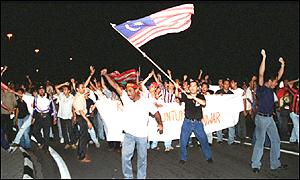 What is the source of our current dilemma? First of all, it is due to PAS� current ascendancy which is linked to UMNO�s falling political legitimacy, which took effect as soon as the Anwar crisis erupted. This event triggered the reformasi movement, which, while being an expression of widespread discontent among various contrasting groups fighting for good governance and reforms, also allowed for the re-strengthening of PAS.
 The second source of this dilemma has got to do with the disem-powerment of Parti KeADILan. A multiethnic party like KeADILan proved itself formidable as a moderate Islamic alternative to UMNO, especially with its success of mobilizing the middle-class, non-Muslims and youth. However, this was swiftly curtailed by the imprisonment of many of its more vocal, charismatic and able leaders.
 Another aspect to observe is how UMNO has handled the Islamization issue. During the pre-reformasi period UMNO was actually quite skilful in addressing the Islamic challenge. It essentially employed both a responsive and repressive approach to the challenge. For example, UMNO went to great lengths to prove that it was the guardian of a �correct� Islam � one that was accommodative to the economic agenda as well as to a secular administration.
 PAS has finally announced that it would be preparing a document that would clearly outline what an Islamic State would entail. The DAP�s withdrawal from the Alternative Front coalition had also pushed this process to its logical conclusion.
 In reality, the spiralling of Islamization (ironically promoted by UMNO itself to counter political Islam) is currently occurring to the detriment of UMNO�s stature and to the advantage of PAS�s potential though not fully realized relevancy.
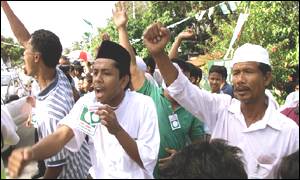 In 1999 PAS was able again to build itself up from where UMNO had floundered. Among large numbers of Malays, there was a moral and ethical vacuum created out of the Anwar affair which was easily filled by PAS. Given UMNO�s inability to rise to the challenge of good governance, transparency and human rights with unheeded calls for investigating allegations of government corruption and abuse, as well as its widespread violation of human rights through the use of laws on preventive detention (most recently against Islamic �militants�), UMNO will now have to prove if it can deliver anything at all which is exceptional to its constituency.