
Villagers in the Dark Kedah politician denies water and electricity to 200 villagers
by Kumpulan Kemajuan Masyarakat
The 31 households remaining there seem to be caught in a time warp. Children study under kerosene lamps and women fetch water in pails just like their parents and grandparents did 60 years ago.
The villagers are mostly poor ethnic Indian rubber tappers, factory or contract workers. Their dilapidated houses stand in stark contrast to the shiny new housing projects being developed just outside their village. The remnants of the only Malay family in the village moved out after the 75-year-old mother died from a snake bite in 1999, without ever having enjoyed access to electricity.
The village is an island of darkness and deprivation amidst the booming development in the parliamentary constituency of former finance minister Tun Daim Zainuddin. How this situation is allowed to persist until today is a bizarre story of feudal politics and connivance among the politically well connected.
Sg. Getah 2 does not have basic amenities because one K.S. Govindan PPN, JP, a Malaysian Indian Congress (MIC) branch chairman and former municipal councillor, is said to have refused to give permission to the relevant authorities to connect water, electricity and telephone lines to the villagers� homes.
He allegedly demands (but not in writing) that the villagers pay him a monthly land rent, including arrears of rent for 35 years, as well as agree to a set of tenancy conditions before he will allow the authorities to provide basic amenities to what he claims is his land.
These conditions include a change of name for the village to Ladang K.S. Govindan, no fencing around the houses, no rearing of animals, no cultivation and no repairs or renovation.
Govindan also claims that all the houses belong to him and the houses therefore cannot be sold or rented. From his demands, it would appear that Govindan is actually not very confident of his claim of ownership of the land and is attempting to armtwist the villagers into a ground tenancy arrangement that will strengthen his legal position.
From Villagers to 'Squatters' Overnight
The village lies on what was formerly the labour lines of Aberfoyle Plantation. The 200 residents of the village are mostly the children and grandchildren of former estate workers. Like many fragmented estates in Kedah, the ownership of the land has changed hands many times.
According to the villagers, some time in the 1960s the owners/employers then got into financial difficulties and verbally told the people that they would be giving them the houses in lieu of any compensation. The people continued staying on in the houses while more recent migrants had purchased or rented their houses from previous owners.
Govindan was one of the estate workers living in Kg. Sungei Getah 2 and still lives there. In 1989, he became one of the registered landowners of the land through an exparte originating summons that resulted in an order by the Alor Setar High Court on the grounds that the original land titles were lost.
What is pertinent to note is that Govindan owns only 3/20 of the Sg. Getah land, with the rest being held by Beh and Mohd. Ghouse both of whom have consented in writing to allow basic amenities to be connected to the villagers. However Govindan�s 3/20 portion of the land is exactly where the houses of the villagers are located.
In other words, Govindan took legal posession of his portion of the land knowing very well that people have already been living there for three generations. As soon as he registered his claim, he termed the villagers as �squatters� and insisted that they compensate him for living on his land for free all these years!
He justifies his claim of 35 years arrears in land rental on the basis that he is an aggrieved landowner who is unable to enjoy any revenue from his investment. So essentially what Govindan is doing is holding the people of Sg. Getah 2 to ransom; agree to his unreasonable demands or live in deprivation. His strategy is to indirectly evict the people through denying basic amenities and this strategy is working well as over 10 families have already moved out in the past five years.
The question that springs to mind is the stand of the government in this dispute between a senior Barisan National politician (and a Justice of the Peace and Municipal Councillor at that) and 200 poor villagers without access to water and electricity.
The previous State Assemblyman for Bukit Selambau, an UMNO politician managed to get kampung status for Sg. Getah 2 from the Rural Development Ministry as well as an allocation of RM244,000 for water and electricity supply to the village. Through his efforts, he also managed to get main water pipes laid to the village (but no water supply) much to Govindan�s extreme displeasure. Unfortunately he was dropped and Datuk V. Saravanan, the Kedah MIC Chairman and now state exco member, replaced him.
A Pre-Election Promise
Saravanan made a pre-election promise in 1995 that he would resolve the plight of the villagers as soon as he was elected. He and Govindan apparently go back a long way in MIC politics and Govindan, who is also a close associate of Dato Seri Samy Vellu, must have been pleased with the way things turned out.
Saravanan managed to �convince� his friend to meet the villagers and through his influence, the land rental arrears were reduced from RM1,680 per household (calculated at RM4 per month for 35 years) to an arbitrary sum of RM400 and this was agreed by the villagers. However, Govindan stated that the villagers had to pay the money beforehand after which he would impose a set of tenancy conditions that he has refused to divulge. By adopting this extremely unreasonable position, he stymied the entire process.
Obviously he had no intention of resolving the matter and was merely playing games. It is pertinent to note that he has not sent a single letter or legal notice to any of the villagers asking for land rent. Nor has he stated in writing his tenancy conditions.
Until today, both Saravanan and Govindan keep referring to this 1995 offer that they had made to the villagers and the ingratitude and arrogance of the villagers in not accepting this offer. Saravanan has never made a single reference to the tenancy conditions imposed by the landowner that remain the real stumbling block.
However he refers to the villagers as unreasonable squatters and accuses them of living on Govindan�s land for free. The questions of social and legal equity of the people who have lived there for 60 years do not bother Saravanan. His position is that Govindan�s rights as landowner are paramount and must be accepted by the villagers without any question while Govindan�s actions and demands are perfectly right under the law.
Since 1990, the villagers have sent more than 80 letters and memorandums to their elected representatives, the Kedah Menteri Besar, the relevant government agencies and national political leaders including the Prime Minister.
The villagers have gone to Wisma Darul Aman three times between 1998 and 1999 to try to meet Tan Sri Sanusi Junid, the then Kedah Menteri Besar; each time they have failed to meet him and have come away with promises of action. At every meeting with officials of the State government, they were told that the state is concerned about their predicament and will intervene to find a solution.
The efforts of the villagers have been successful to some extent. After the first meeting with the Menteri Besar�s officials in May 1998, the Public Works Department installed two water tanks in the village and supplied these tanks via water trucks. For the first time in 50 years, the villagers finally had access to clean drinking water!
In July 1999, the PWD activated a water standpipe in the village; on the evening before the villagers went to the Menteri Besar�s office for the second time in an attempt to meet him!
Following that meeting with the Director of the State Economic Planning Unit, Saravanan chaired a meeting held at the Sungei Petani Labour Office in August 1999. At that meeting, all the heads of department of the relevant agencies and Govindan were present. It was an extremely important meeting for the villagers as it was the first time that Govindan publicly stated his demands of land rental at RM4 for a total of 80 houses (based on his calculations of two houses per household!) and the tenancy conditions.
The villagers agreed to pay land rental of RM4 per household as he had requested and arrears for a maximum period of 6 years instead of the 35 years that he was asking for. They also agreed to abide by all reasonable tenancy conditions within the law.
At that meeting, Saravanan promised that the relevant government agencies would investigate the actual number of houses in Sg. Getah and the status of the land. The findings of this investigation were to be submitted to the State Legal Advisor together with Govindan�s demands and the State Legal Advisor was to study and table a report to the State Exco for a decision.
The villagers were satisfied with the outcome of this meeting and they also managed to secure a second water standpipe for the village.
Another Pre-election Promise...
After a frustrating three-month wait for a response and with the general election around the corner, the villagers decided to go to the Menteri Besar�s office for a third time in November 1999 to try to get a direct response from Tan Sri Sanusi Junid.
After waiting for more than five hours, they managed to meet the State Legal Advisor who told them that their situation was actually discussed at the State Exco twice and Govindan was directed to meet with the State Legal Advisor to draw up a tenancy agreement with the villagers. Unfortunately Govindan and his lawyers refused to meet him and more pertinently Saravanan informed him that the matter had been resolved.
On the eve of the 1999 election, Saravanan and his entourage came to the village (for the first visit since he was elected) and once again (in the presence of Govindan) he promised to resolve the matter within three months if he was re-elected. He asked the people to leave the matter entirely in his hands and not send letters to or contact any other parties. He also got the PWD to pave the dirt road leading to the village.
After much deliberation, the villagers agreed to his rather unusual request and waited for a response from him. They discovered to their chagrin that only Govindan�s house in the village received electricity supply after the elections.
Saravanan refused to respond to all their letters and refused to have a meeting with them. He also found a new issue to vilify the villagers; that they refused to pay for the water supplied by the two PWD standpipes. He never explained that the PWD did not instal water meters, nor send water bills nor put in place any mechanism to determine how much water each household consumed.
The villagers finally realized that they had been hoodwinked a second time and wrote to the Menteri Besar. To their surprise, the new Menteri Besar, Datuk Seri Syed Razak actually replied to their letter indicating that action would be taken. However, Saravanan intervened in the process again, misled the Menteri Besar�s Office and laid the blame squarely on the villagers.
The villagers decided to go to Wisma Darul Aman for a fourth time in December 2001 in an attempt to meet the Menteri Besar directly and to highlight the link between Saravanan and Govindan. Again they did not succeed but met with his senior officials who have agreed to intervene. They also discovered from the Menteri Besar�s officials that Govindan was actually planning to evict them to develop a housing project in the village!
Saravanan in the meantime is extremely agitated that the villagers have gone to the Menteri Besar�s office to complain against him and made veiled threats in the press that water supply to the standpipes would be disconnected.
Predictably, his public statements blame the villagers. And in an attempt to distance himself from the situation, he says that the State government cannot intervene unless �the squatters resolve their problem with the landowner�. True to form, he has not mentioned anything at all about his friend�s plans to develop the land nor does he think that it is his responsibility as the elected representative to ensure that the people affected by the development receive adequate compensation and alternative housing.
A Big Let-down
The villagers have now lost all faith in Saravanan and are insisting that the Menteri Besar handle their issue directly. Not only has Saravanan associated with Govindan in misleading the State government and the public, he has also consistently defended Govindan�s interests and his so-called rights as a landowner.
In the same press statement, Samy Vellu said that he knew Govindan and �will direct him to meet the villagers� saying �I know what to do with him if he refuses to do this�.
Now, more than three years later, they have realized that their humility has been mistaken as a sign of powerlessness. They have realized that their struggle for water and electricity has become a fight for their homes and their very right to live in Sungei Getah 2. Unfortunately, their elected representatives and the very people who claim to defend their interests are aligned against them in this fight. (See Sequel)
Now tell us what you think. E-mail us.
|
||||||||||||||||

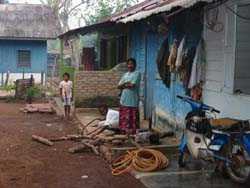 A village without access to piped water, electricity or even a public telephone in the Prime Minister�s home state, Kedah? Impossible? Take a look at Kampung Sungei Getah 2, located near Sg. Lalang, about 15 km from the booming town of Sungei Petani in Kedah. It has the dubious distinction of being probably the only settlement in Kedah without access to these basic amenities.
 It would appear that the MIC�s self-proclaimed role as �champion of the Indian community� is only for the well connected and influential and not for poor villagers without basic amenities. The villagers have heeded Samy Vellu�s advice in 1998 �to be humble as they are staying on the owner�s land�.