A Cult Of The Individual? The sorry tale of Dr Mahathir and Hulk Hogan by G Lim
In 1981, shortly after Deng Xiaoping came to power, the Chinese Communist Party (CCP) held its Sixth Plenum of the Eleventh National Party Congress Central Committee. Widely seen as a turning point in China's political culture, the Plenum grappled with the problematic legacy of Mao Zedong.
On the one hand, Mao had been officially idolised for years, imbued with an infallibility usually reserved for deities. On the other hand, it was impossible to deny that Mao was directly responsible for the Cultural Revolution, which had turned Chinese society on its head and caused widespread suffering and disillusionment.
In a carefully worded resolution, the party declared:
The cult of the individual acquired such monstrous size chiefly because Stalin himself, using all conceivable methods, supported the glorification of his own person. The cult of the individual has caused the employment of faulty principles in party work and in economic activity; our nation gave birth to many flatterers and specialists in false optimism and deceit.
The point of all this is that no leader, however great, should be idolised. Doing so is only a recipe for disaster. There are good leaders, and there are bad leaders, but there is no such thing as an infallible leader. Neither is there such a thing as an irreplaceable leader, which is just as well because all leaders are, eventually, replaced.
Both the Soviet Union under Stalin and China under Mao made the mistake of glorifying their leader to such a degree that, after their deaths, the countries were left bereft of direction and unable to come to terms with their own mistakes.
During their lifetimes, many misguided policies were allowed to pass, simply because no-one dared speak up. In China, this was the 'two whatevers policy': support whatever policy decisions Chairman Mao made and follow whatever instructions Chairman Mao gave.
This was the cult of the individual.
So, do we have a cult of the individual in Malaysia? The recent drama - or was it sandiwara? - at the UMNO general assembly raises worrying questions.
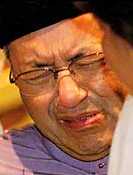
A tearful Mahathir announces his resignation from UMNO and BN post, though not from the premiership, mind you. Instantly, he is surrounded by UMNO top knobs, imploring him not to do so. Rafidah Aziz, her anguished face turned to the camera for extra effect, cries 'tarik balik, tarik balik'. 'No no,' says Dr M, 'I have made my decision.'
What a spectacle! Cabinet ministers abasing themselves publicly. Malaysia cannot do without Mahathir! We need your vision, your leadership, your far-sightedness!
What else can Mahathir do? Faced with such protests, he agrees to continue.
Professional wrestling, as everyone knows, is staged. Was the Mahathir resignation likewise just a performance designed to whip up not just support but pure adulation?
If it wasn't staged, then what kind of a leader does that make Mahathir, announcing his decision to retire in public without even consulting his closest cabinet colleagues?
Watch the scene again carefully. Sat behind Mahathir as he makes his announcement is xxxx. As Mahathir makes his announcement, her face registers not an iota of shock or surprise. Only when the other leaders, just off camera, start getting up does she get into role, and rush round Dr M herself.
A carefully timed resignation-retraction to whip up support is not new. Remember when trouble started brewing in the MCA, and Ling announced his resignation - again just from the party, not actually from his ministerial post.
Lo and behold, MCA officials from all over came out of the woodwork to plead with Ling to rescind his resignation, which he dutifully did. By-the-by, it also staved off the challenge from Lim Ah Lek for a year.
What was new about Mahathir's resignation was the way in which it was staged live on television to create the maximum public effect, so that we could all see the anguish of Rafidah and the trauma of Dollah.
Lest we didn't get the point, a role of BN politician later came out to emphasise the indispensability of the Prime Minister.
'The nation needs his leadership', said Chong Kah Kiat, Sabah Chief Minister.
'We need him for many more years to come.' Ling Leong Sik, MCA President.
'Malaysians love Mahathir and still need his leadership and far-sightedness.' Ting Chew Peh, MCA Secretary General.
The UMNO general assembly was an embarrassing farce, but indicative of a wider worrying trend towards presenting Mahathir as infallible and irreplaceable, a trend that Mahathir himself is doing his best to encourage.
Once when asked what kind of person could best be his successor, he replied 'Someone like me.'
Never one to mince his words, Ling Leong Sik also announced earlier this year that Dr M was 'the world's best leader'.
Apparently, Dr Mahathir's medical skills are also almost miraculous; Ibrahim Ali recently implied that Mahathir's visit to Fadzil Noor in hospital was the cause of his recovery. 'The PAS leader had been unconscious but shortly after Dr Mahathir visited him, he opened his eyes,' he said (Star, 22 June 2002).
A professor at USM has suggested teaching a course on 'Mahathir-nomics' (New Straits Times, 23 August 2001). Adam Smith, John Maynard Keynes and the other fathers of economics only deserve part of a course; Mahathir gets one all to himself.
Just in case the word of government officials is not enough, the government controlled press are also in on the act, running laudatory stories about their own boss:
Thumbs up for Dr M's leadership. After two decades in office, Datuk Seri Dr Mahathir Mohamad's tenure as Prime Minister has been one which has brought much progress to the country. (New Straits Times, 17 July 2001)
And let us not forget the self-congratulatory 'Thank you Prime Minister' festival held in Langkawi, or the planned 16 part television series idolising his early life.
A nation of flatterers and specialists in false optimism, indeed.
Now tell us what you think. E-mail us.
|
|||||||||||||||||||