
Is Any Opposition Better Than No Opposition?
by Village Idiot
I tended to sympathize with and support any and every political party that opposed the BN � subscribing to the notion that �any opposition is better than no opposition�. Recent events and the apparent direction of Malaysian politics have made me question the wisdom of taking such a stand.
Is Any Opposition Better Than No Opposition?
Executive dominance is a serious problem and we need a stronger opposition to serve as a check and balance. However, is it possible that some of the groups that we have been supporting are more exclusive and conservative than those in power?
We are concerned about the state of human rights, the dismal state of civil liberties and the lack of democratic space. Our hostility towards the executive is justified. However this should not blind us to the real threat of authoritarianism. It would be tragic if our antagonism towards the executive causes us to act in a manner that hastens the creation of a system, which is even more undemocratic than the present order!
More Questions Than Answers
Criticism of PAS normally focuses on a certain narrow band of issues played up by the mainstream media � the Hudud, PAS�s attitude towards the role of women, PAS�s fixation with the segregation of the sexes and PAS�s approach towards certain forms of entertainment.
Some of this criticism is valid. What is not often highlighted however is the manner in which PAS could possibly transform the political landscape and the effects that this would have on democracy, universal suffrage and equal citizenship.
PAS seeks to radically transform the country and its institutions � but is non-committal as to exactly what its model would look like. In order to get some sense of what is possibly in store, it is necessary to pose a series of specific questions regarding PAS�s vision of an Islamic state.
In PAS�s Islamic state:
Reformists supporting President Khatami control the majority of seats in the Majles. The President, Parliament and the majority of Iranians want to see reform taking place. Conservatives have been able to block such attempts because of their control of powerful institutions of state like the Council of Guardians.
In PAS�s Islamic State:
It is unfortunate that PAS has not made enough effort to grapple with the issue of democracy, universal suffrage, political participation and equal citizenship. Any party that aspires to take national power has to confront and address these issues in a coherent, rational and just manner.
Dogmatic And uncompromising
Sometimes PAS has the tendency to behave in a dogmatic and uncompromising manner. The way, in which the Syariah Criminal Enactment Bill was rushed through the Terengganu state assembly, was quiet alarming.
With this simple pronouncement, he dismissed the views of every single non-Muslim in the country! Nothing that they had to say based on the ethics or morality of their own spiritual traditions or based on �human logic� was of any consequence. They were basically irrelevant and have nothing to contribute!
This pronouncement also effectively dismissed the views of many Muslims who might not be regarded as having the necessary �qualifications� and �credentials� to argue authoritatively on what really constitutes �Hukum Allah�.
The fact that the opinions of so many Malaysians mattered so little is most worrying. The issue at stake was after all not some private exclusive religious matter but the creation of a parallel criminal justice system � that would one day affect everyone.
In denying the views of others, PAS it appears has no qualms about making the innovative (yet inherently undemocratic) argument that only views that originate from the same reference point, as theirs are legitimate. This attitude was exemplified by the statement made by Harun Taib the chairman of the Syariah Criminal Enactment Bill�s drafting committee (see Box).
To negate dissent solely on the basis that it originates from outside a particular frame of reference smacks of chauvinism. Given the multiethnic, multicultural and multi-religious character of this Nation, one has to be prepared to dialogue and consider the views of everyone. Especially if one wants to rule the country!
In the ultimate analysis, it is not just the question of negating the views of non-Muslims. If today it is okay to negate views that originate from outside Islam, one fine day it may also be convenient to negate views that originate outside a particular trend or viewpoint within Islam.
UMNO Vs PAS
While it would be naive to present the tussle between UMNO and PAS as the �battle� between progressive and conservative Islam, it cannot be denied that PAS�s version of political Islam is more conservative and rigid than UMNO�s.
While conservatives are to be found on both sides of the political divide, it would be myopic to regard UMNO and PAS as simply two sides of the same coin. One does not have to be thrilled with UMNO�s version of political Islam, but it is certainly one that is more acceptable and palatable than that espoused by PAS.
Engaging With Islamism
Being critical of PAS does not mean that one is anti-Islam. No one is denying the tremendous contribution that Islam has made and will continue to make in our history as a Nation. Neither does anyone deny that there are good and honest people in PAS.
There are significant differences, for example, between the Political Islam espoused by PAS and that espoused by Nahdlatul Ulama� (NU) in Indonesia or that espoused by An-Nahdah� (Renaissance) in Tunisia (The opposition party of Rached Ghannoushi, which has now been banned).
PAS is a political party and we have a right to be critical of it in the same way that we are critical of UMNO or DAP. PAS if it values and needs our support will respond to this criticism.
As Malaysians we have a stake in determining the direction in which this country progresses. It is a right that cannot be denied us. If policies of PAS need criticizing then it is our responsibility that these criticisms be voiced. Both the Nation as well as PAS will benefit from this feedback.
So What Now?
Rather, the purpose of this article is to argue that our obsession with the executive should not blind us to the other real danger that has emerged on the political landscape. Even if we chose to believe that �any opposition is better than no opposition�, we can no longer afford to do this in an unquestioning and uncritical manner.
Perhaps we need to be more selective and circumspect as to whom we choose to support and ally ourselves with. Perhaps we should also take care not to spontaneously extend our support to all groups simply on the basis that they too oppose the executive. Too much is at stake.
|
|||||||||||||||||||

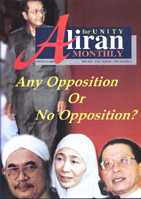 For many years, I believed that the biggest threat to the Nation was the unbridled dominance of the executive. I had no qualms in identifying the political elite in the Barisan Nasional (BN) as the greatest impediment to the building of a just, free and democratic Malaysia.
 PAS appears obsessed with the desire to implement the Hudud. It has pushed the enactment through both in Kelantan and Terengganu despite a fair amount of public criticism. PAS also appears to have scant regard for the notion of equal citizenship. Just recently acting PAS president Datuk Seri Hadi Awang stated that non-Muslims would have no policy- making role in an Islamic state (The Star, 27 August). On both these issues as well as a whole variety of other issues, it is clear that UMNO and PAS occupy different points on the spectrum of political Islam.
 Being critical of the policies espoused by PAS is to take issue with PAS�s version of political Islam. Political Islam has many variations and it would be wrong for us to think that PAS�s version is the only or the best approach.
 The purpose of this article is not to extol the virtues of UMNO or the Barisan Nasional or to downplay the issues of corruption, injustice and lack of democratic space that characterizes the present order. Neither is the purpose of this article to demonize PAS.