
Towards an Honourable MTUC by Ponniah
These two men had an agreement before the MTUC elections in March 2002: Shafie would not contest against Zainal, and Zainal, if he won, would pass the baton to Shafie when 2002 ended. Both went on to defend their respective positions as President and Deputy President. And then they waited till the last moment to make their �agreement� public. Honour Among Unionists Now, Shafie said, �Honour it� while Zainal said he was not obliged to do so. The Shafie-Zainal disagreement has raised many points in coffeeshop style talks. Will Zainal eventually leave his post as he piously declared in March 2002? Is the issue one of honour and obligation? Did the two men have any right to forge a private agreement before the MTUC delegates elected their leaders? What really is at stake and what should be done? By MTUC�s constitution, an office-bearer only leaves during his term of office if he is disqualified on constitutional grounds (such as ceasing to be a member or worker in the originating union), because of disciplinary action taken by the General Council, or by his resignation. Even a no-confidence motion against an office-bearer may have a moral effect but no force until the motion is followed by disciplinary proceedings. Hence, the Zainal-Shafie �agreement� lay outside MTUC rules which confer upon MTUC delegates the right to vote freely for a president who would hold office for three years. History of Pacts Back in 1984, MTUC President, PP Narayanan (�PP�), made a deal with Zainal: PP would hand over power one year later if Zainal did not challenge him. How was the deal done? The negotiations took place on the eve of the elections. PP had V. David (MTUC and Transport Workers Union [TWU] Secretary General) on his side. Their advisers negotiated with Zainal (MTUC Deputy President), and his ally, G. Rajasegaran (Raja) (MTUC Deputy Secretary-General). The next day, the MTUC General Council met while the conference was delayed. Then the Council presented the agreement to the delegates. About 20 delegates who disagreed with the proceedings threw their chairs and left the conference hall. The overwhelming majority of the delegates endorsed the agreement and made it their decision. When the time came, PP did not take advantage of constitutional provisions to continue in office. He vacated the presidency, and Zainal succeeded him. Zainal's Era Beginning in 1992, Zainal and Raja became running mates in a strong partnership. Raja himself had become Secretary-General. Zainal and Raja strenuously fought to establish a national union for electronic workers. At international forums, they put the Malaysian Government on the defensive for violating the International Labour Organisation Conventions. The Government finally pinned Zainal down along with his fallen mentor, V David, over their mismanagement of TWU. Zainal faced charges in the court. For his defence, he was assisted with funds from international trade unions channelled through the ICFTU. But, it is said, Zainal saw the writing on the wall and found a way out by moving closer to the Government at a time when the power struggle that resulted in Anwar Ibrahim�s sacking. Zainal then discarded his connections with certain opposition parties. Most people in MTUC understood Zainal�s predicament and even accepted his decision. Most leaders under similar circumstances would have failed to retain union support whether locally or internationally if they chose Zainal�s course of action. Yet Zainal deftly kept his position intact. Raja's Round Zainal�s shift and compromise with the Government�s shortcomings on labour issues led to his fallout with an erstwhile ally like Raja. Raja publicly criticised Zainal�s lack of transparency over the legal funds Zainal had received. Raja also took stands that conflicted with Zainal�s and embarrassed the latter�s position as a Senator. Their growing rift was apparent on the international scene. Previously Zainal concentrated on his rise within the ILO while Raja chose the ICFTU as his turf. By 2001, however, Zainal had unsuccessfully tried to seize the ICFTU profile from Raja. Raja�s trade union career began as a labour relations activist working with factory workers. Despite his current high position, he retains an activist image. That was and is his strength since his supporters, as well as some of Zainal�s backers, still see Raja as the true emblem of MTUC as a workers� organisation. Raja fearlessly stands up for unions. He is not tainted with political ambition and cannot be accused of using MTUC as a springboard. However, some are disgruntled with Raja for his handling of union leaders appointed to manage MTUC�s industrial relations cases. These are skilled union leaders who are paid on a case-by-case basis from fees collected from affected workers who turn to MTUC for help. It has been said that Raja had paid insufficient attention to the selection of these union workers, the criteria for their payment, and their work. It has been alleged that he had not ensured that they were strictly appointed on merit and that MTUC did not lose its service-oriented image. That was because those workers were mostly his supporters. Yet others claim that Raja �gets the work done� without any sign of personal gain. They regard Raja as the �insurance� MTUC needs to be an independent organisation, free from the control of either Government or political parties. His forthright and transparent stands on labour issues, regardless whether he faces employers or Government, have won Raja very broad worker support. Shafie's Salvoes Despite Zainal and Raja�s tense relationship, their professionalism did not disrupt MTUC�s work. The last MTUC election was a �proxy fight� in which Zainal and Raja put up separate slates. Zainal won because of his �win-win agreement� with Shafie. Some of the leading �proxies� lost because they did not have their own strong following. Most obvious of all, Zainal backed Malek Ariff from MAS Employees Union against Raja. But Raja defeated Malek by securing 317 votes (7 votes higher than Zainal�s in his win against Syed Syaril). As the end of 2002 approached, some Shafie supporters doubted that Zainal would vacate the presidency. While Shafie publicly expressed his confidence that Zainal would abide by their agreement, there was no response from Zainal himself. Soon Samuel Devadson (MTUC Selangor Division Secretary) fired the first salvo from the Zainal camp by asking Zainal to continue in office. To avoid being seen to be a minority, �new faces� from Zainal�s team urged him to remain. These included Abdul Razak bin Mohd. Hassan (President of Railwaymen�s Union of Malaysia and MTUC Vice-president) and the union leaders of Commercial Workers, Port Kelang and the Estate Staff Union. Then Zainal announced that he won�t step down. Shafie�s supporters have charged that a number of Zainal supporters or their patrons enjoyed personal gains such as being sent to the ILO Turin Institute in Italy for training without their selection being approved by MTUC based on relevance and the union point system. It has also been allged that Zainal won support by taking sides in internal union disputes because his side gets a more sympathetic reception from the Trade Union Department, such as during the recent bank union dispute. Shafie himself who, so to speak, opted for a free ticket to the Presidency in exchange for a ten-month wait, has not lost MTUC Secretary-General Raja�s backing. During his �waiting period�, Shafie was balanced in his support to both Zainal and Raja. Besides, Shafie led the MTUC Finance Committee well and proved his management skills. Shafie does not hide that he is a Government man. Not only has he posted a large support Mahathir banner continuously for months outside his union office, Shafie has openly shown that he gives priority to advice from the Minister of Labour. It was no surprise that the Minister of Labour offered to mediate in Shafie�s claim on the presidency. But Zainal shunned him and preempted the Minister�s intervention in matters regarding the MTUC leadership. Act Now, MTUC! MTUC�s present discord does not serve the interests of the organisation or its affiliates. The discord is bad for the standing of the parties in dispute, and MTUC�s credibility at home and among its fellow unions abroad. Indeed, even non-partisan union leaders are hard put to offer a clear and fair answer as to why they should accept anyone who dishonours an agreement. In their eyes, both parties had dishonoured agreements. Many of those leaders nominated Shafie to challenge Zainal in the election. They furiously took Shafie�s pact with Zainal as a betrayal. To them, however, Zainal�s conduct shows him to be an old politician who reneges on his promise for expediency. They were even disappointed with Raja who commanded their support but chose not to make an issue of the Zainal-Shafie pact. With Prime Minister Dr Mahathir Mohamad�s plan to retire in October 2003, there is a sense in this country that leaders should be ready to hand over the reins of power to their deputies. Yet MTUC leaders are busily justifying why they need not keep thei r promises. Do they expect to be judged to be anything other than indulgent individulas operating by unprincipled ways? Do they expect that an MTUC led by them will symbolizeworkers� strength, unity and solidarity? How should MTUC act presently? In principle, MTUC must protect its standing and tradition of public accountability by resolving its leadership issue honourably. The President and Deputy President having brought about this undesirable situation, should leave it to an MTUC Working Committee � comprising all principal officers except the President and the Deputy President � to submit a formula that fulfills two basic conditions: resolve the controversy justly, and institute a deterrent against any future recurrence. Then the MTUC General Council should act to disallow �private arrangements� whether between aspiring contestants or incumbent leaders. If MTUC�s leadership transition is not to be turned into a two-man show performed for personal gain, the General Council must henceforth institute disciplinary action against anyone involved in private power-grabbing �agreements�. Only then can MTUC safeguard the basic right of its affiliates and all delegates to a free, fair and transparent election of MTUC�s leaders. And Look to the Future MTUC must seize this chance to redirect its energies away from internal power struggles to more dedicated efforts to achieve the organisation�s primary goals of advancing the interests of workers and their unions. For example, MTUC must strengthen its union capacity-building, say by unionising 25 per cent of all. Then MTUC should push for labour law reform to eliminate the multiplicity of unions, bring about union mergers, and foster the creation of strong industrial and sectoral unions. MTUC must spearhead the drive for a nationwide minimum wage system as well as establish institutional mechanisms and standards for wage revisions that are based on the recognised principle of fairness. MTUC should likewise strive to reduce third-party involvement in union administration and the management of labour relations. For the future, MTUC must set its sights on developing an independent unionism that can negotiate with ability, and deliver with respect without depending on political patronage or non-members� support or funds. There is so much more that MTUC must do to entrench a framework of full collective bargaining rights for all public sector workers, legal protection for trade union leaders, and compliance with grievance procedure in work places. For the MTUC to pursue these noble aims in an era of globalisation, its leaders must themselves observe and practise good governance, transparency and accountability. Now tell us what you think. E-mail us. |
|||||||||||||||

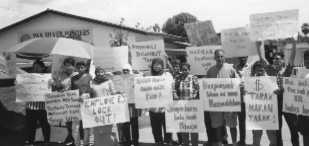 Who should be President of the Malaysian Trades Union Congress (MTUC)? The incumbent, Zainal Rampak? Or his deputy, Shafie Mammal?