Interview The Role Of The Opposition An individual can make a difference
by D J Muzaffar Tate
As I had never met the lady before, and knew her only by her reputation as an outspoken human rights activist and her role in the Women�s Candidacy Initiative, my first questions were focussed on her background and herself.
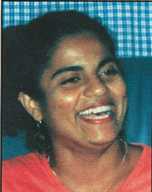
From her answers and her manner of answering, Toni at once came across as a very clear-thinking, focussed, and incisive personality, who knew who she was, what she stood for, and where she was going, without at the same time appearing overbearing or abrasive in any way.
Born in Ipoh of a middle-class Jawi Peranakan family (her father was a bank manager) , and educated at the Convent in Brewster Road (now Jalan Sultan Idris Shah), she had been sensitive to nuances of discrimination at an early age, because Indian Muslims are not always accepted on par by their Malay brethren.
Both her parents were very encouraging. Her father had aspirations that his three daughters would all soar and be successful profesional women and would brag to his friends about his daughters.
Toni also became intensely conscious of gender discrimination - inspired by her mother, the main caregiver, who urged her daughter on all occasions and at all times to stand up for her rights as a woman. Toni remembers from as far back as Standard 2 her mother coaching her on how to jawab (respond) when friends (or even teachers) made racial or class slurs, to not only do things right, but to do the right thing.
At 18, Toni went off to Australia to take a degree in Economics and Computer Studies at Flinders University, Adelaide, and immediately became involved in human rights issues which revolved around racism, poverty and gender discrimination. She stayed there for the next ten years.
During that period she got deeply involved with Community Aid Abroad (an Australian version of Oxfam) and got married to an Australian. Since her return to this country, she worked as the manager of the All Women�s Action Movement (AWAM) for about 3 � years and since leaving that organisation, has become a kind of roving consultant (she styles herself as a `free lance trainer�) on gender and human rights issues, especially with reference to issues affecting Muslim women.
In doing this she has been associated with a number of women�s organisations and human rights groups, in particular Women�s Candidacy Initiative, Sisters in Islam, Suaram and Amnesty International Malaysia. She chairs a regional network on building the capacities of grassroots groups, and has also done work for the ILO.
At the time of writing this article she had gone off to Patani in Southern Thailand to conduct a three-day course there on women�s rights amongst the local Muslim community women leaders, and by the time this edition of Aliran Monthly hits the streets she will be somewhere in Java to meet a group of women�s organisations there. A lady for all seasons.
Toni is equally as forthright about the state of Malaysian politics as she is about everything else. �As you know�, she says, �Malaysia is not a democracy, and we should do all we can to bring about political reform so that it becomes one.�
�This is the role of the Opposition parties, isn�t it?�, we ventured.
�Of course�, replied Toni, �but they are not playing the role. Instead, they are playing the political game according to the rules laid down by the Government, and they can�t possibly win. The playing ground is not merely uneven; it is vertically in favour of the BN.�
�So what can or what should the opposition parties do?�, we asked.
�Stick to their principles�, came the reply. �Stop seeking to score points by quibbling on minor matters for the sake of political advantage but make a stand on basic issues that are of real concern to the thinking public. Such as the issue of an Islamic state, for example.�
Toni went on to deplore the failure of Parti Keadilan Nasional to state its position on this in response both to PAS and the Government. �By not making a stand, the public are left wondering exactly where the Opposition stands on the Islamic State issue. Coming across as non-committal does not help the public understand the Opposition, and perhaps even is a disservice to the Opposition itself. The public does not vote on polling day, it is deciding who is worthy of their vote as we speak,� she noted.
She deplored the way in which the splendid principles and promises that had been displayed in the BA�s 1999 Manifesto appeared to have been side-lined and forgotten. She also felt that PAS had let the BA down by going back on its commitment not to raise contentious issues such as the Islamic State - a pledge made during the 1999 general election, with the result that the DAP had withdrawn from the opposition alliance.
In short, Toni argued that the Opposition parties must be prepared to put their declared commitment to the principles of reformasi, before their struggle for their own narrow political advantage. They must make their stand and argue with substance. If Parliament was a charade, then the Opposition parties should boycott Parliament.
�There is no point legitimising the charade by `playing along� with it when we know full well what Parliament can do and will not do,� she said. �So there must be some act of resistance on the part of the Opposition to send home the point that we have no confidence in the role of a Parliament that has been formed through elections that are neither free nor fair.
"The public must also have confidence that the Opposition have the capacity to hold its own, and not dance to the beat of someone else�s drum.�
Any act of resistance to send home that point would show the real substance of the Opposition, she pointed out, adding that there is a whole range of acts that can be used to show the kehampaan of the Opposition. A walkout by the entire opposition is one example, especially when issues that particularly stifle dissent are being discussed (for e.g. the amendments that were made to the Elections laws, etc).
"Let the world, and especially Malaysians, know the system is bung rather than go along with it, allowing the system to pretend that it is legitimate.�
She said that the Opposition cannot just wait for the acts of resistance to come from the people and then turn up when the `moment is right�. �They need to also set the agenda and send the message to the public that they understand opposition politics in this country to be more than electoral party politics.�
"If the Opposition is not playing its part, what can the ordinary citizen hope to do?", we somewhat naively asked.
This question really made Toni come into her own. "People always underrate the role of the individual", she said, "but individuals can make a difference. People should not just keep quiet. They should continue to voice their opinions in the Press, attend peaceful demonstrations to express their views, badger their local State or Parliamentary representatives.
"In the same way, the role of those who decline to join any political party but seek election as Independents should not be overlooked. It is, of course, commonplace for both the BN and Opposition parties to scoff at Independent candidates who stand for election. `What can they do for you?' � the electorate is asked. `They have no political clout � they can�t bring development to your constituency.'"
Toni clarified that she wanted to put across the point that merely participating in electoral politics is not enough. �Challenging the foundations of electoral politics - what it means to be involved in politics - is even more critical for the long-haul, transformative change in the political landscape of the country. We did not want to be arm-chair critics of the system, and decided to run the way we did to contribute something towards a different way of thinking about politics.
"To encourage and support diversity in candidates, issue-based candidacies, etc is to show maturity and to really want something different and not pander to BN-style, party-or-nothing politics.
"Indeed, there are many voters in this country who are not satisfied with freshly tarred roads and brand new public toilets to their constituency." Toni would like to think that the public are looking for someone who will speak up for rights and interests (as it should be) but there are many voters in this country who do unfortunately see longkang politics as the �substance� of politics.
"And who can blame them when that is exactly how it has been projected to them,� she lamented. �What worries me is that there are some in the opposition who feel the need to play the game because they believe that that is what the electorate understands. By going along, the opposition not only fights a losing battle because the BN will always have more resources to pour into this kind of politics, but it also skirts the issue that these issues are issues for the local councils, which again highlights the need for proper local council elections.�
She felt the opposition has an obligation to denounce freshly tarred roads and public toilets from becoming political battlefields rather than be dragged into the losing game.
Toni Kasim stood as an independent for the parliamentary seat of Selayang in the 1999 general election in a straight fight with the incumbent BN candidate. She lost, as was only to be expected, but all the same she garnered 43% of the votes cast.
The whole episode was remarkable in a couple of ways. In the first place, the Women�s Candidacy Initiative who put her up as a candidate succeeded in persuading the Opposition parties to let her stand. Secondly, she managed to capture over two fifths of the vote despite the might and built-in advantages of the BN party organization. "There was that wave of change at the time and perhaps many were chagrined by the behaviour of the BN at the time and wanted a change. Nonetheless, that we asserted our right to run was empowering, even as many people, in BN and BA alike, were sceptical about our reasons and capacity to run."
In the end, she felt vindicated. �We were over the moon about what we had achieved!�
Toni Kasim had made her point about what an individual in the Opposition can do.
Now e-mail us and tell us what you think.
|
|||||||||||||||||