The Language Of The Hegemon Some jottings on the Iraq-US crisis
by Wong Soak Koon
This is the language of the hegemon (in this case, America, which sees itself as indisputable Leader of the world). This kind of language usage is therefore unitary: it brooks no argument and allows no other perspective. The use of the word �rogue states�, for example, begs the questions: Who decides on who the �rogues� are? Similarly, who decides on the �heroes�? In the nightmarish, surreal landscape of geopolitics and realpolitics, a �hero� (or, an ally) today can tomorrow be a �rogue� and find his portrait hung among those to be neutralised, deposed, even destroyed. Was not Saddam himself at one time in the gallery of the accepted, even the courted?
Geopolitics and realpolitics cannot encourage such flashbacks or it can be simply argued that a �hero� has metamorphosed into a �rogue�. But the fact remains that the power to christian someone a �rogue� rests with the hegemonic power and it will do so readily when its geopolitical purposes require such a naming. In any case, binary thinking (i.e. black and white thinking) about �heroes� and �rogues� is always prevalent in imperialistic and neo-imperialistic times. It ties in with demonisation of the adversary (i.e. thinking of the enemy as monstrous and somehow non-human). By contrast the hegemonic power sees itself as heroic defender of the Good and the Right defined according to its purposes.
The adjective �pre-emptive� in �pre-emptive action� also causes me great anxiety. It connotes action before a fact is established. Does this mean that, based on covert intelligence in that mysterious shadowland which surrounds democratic practices, practised by that Kafkaesque cohort of CIA agents and whoever of that ilk, the hegemonic power can arrest, detain, even kill? And this can be done not only nationally but transnationally since some national states are themselves willing to collude with the United States for their own political mileage? Who establishes the �facts�? Is there an international body strong enough to do so fairly and fearlessly? More than ever in this season of war and violence we need such an authority since all kinds of documents can be forged.
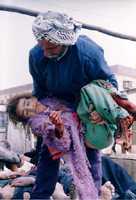
What is even more brutal is the use of the phrase �collateral damage� to sanitise the on-ground horror of thousands, even millions of human beings killed and maimed. The trauma and human costs cannot be quantified: so much for �collateral damage�. Wars can now be conducted via high technology so America may not see as many body-bags as it did in the Vietnam war, but wars still mean human sacrifice and intense human suffering on all sides even if all we see on the TV screen, as we sit down to dinner, are the co-ordinates and the targets as bombs rain down as if we are watching a computer game. �Games�, geopolitical and ideological, are being played but they will spill warm human blood and gore! We must not allow ourselves to be immunised into confusing actuality with cyberspace.
An intense public-relations war is being waged in America to garner patriotism and fan war fervour, and language is a key weapon. And yet, as scholars of public discourse and the dissemination of propaganda will tell us, language has a strange way of subverting the hegemonic power�s hopes. How? Because language is fascinatingly fluid, mobile and transformative and in the uncontrollable realm of everyday usage, some people (not necesarily the highly educated) can and will question, debate and even disagree with propaganda daily fed to them.
It was the cynic-romantic, George Orwell, who sadly concluded that the innate decency of people is seldon brought into the corridors of power. I beg to differ. I prefer to err on the side of the hopelessly romantic and say that people can collectively affect the course of world events and so prevent or at least delay violence. Massive outpourings of anti-war feelings cannot be dicounted. And even if war is inevitable, many people globally have shown that America�s rhetorical battle to win hearts and minds has not been won.
Now e-mail us and tell us what you think.
| ||||||||||||||||||