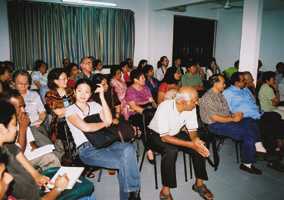
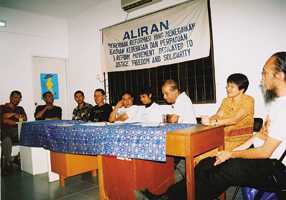
Asian Activists Converge On Penang ARENA delegates dialogue with Penang NGO activists
by Francis Loh
Most of those present were Fellows of the Asian Regional Exchange for New Alternatives (ARENA), a regional network of Asian scholars � academics, intellectuals, activists, journalists, writers and artists � whose aims are to contribute to processes of meaningful and people-oriented social and political change.
Towards this end, ARENA Fellows explore alternative paradigms and development strategies which promote equity among social classes, castes, ethnic groups and gender so as to prevent the marginalization of communities. Also high on ARENA�s agenda is the promotion of peace initiatives and democratic participation. At this point, ARENA must count as one of the most significant regional network of NGOs in Asia.
They had gathered in Penang for their Triennial Congress, a time to exchange ideas, reflect on past experiences, review past achievements and failings, and plan for the following three years� programmes. They were also keen to learn more about Malaysia and Malaysian NGOs.
Hence present that evening were representatives from ten Penang-based NGOs. These were the Women�s Centre for Change (WCC), Jamaah Islah Malaysia (JIM), Consumers Association of Penang (CAP), Sahabat Alam Malaysia (SAM), Third World Network (TWN), Citizens Health Initiative (CHI), SOS! Penang, Kumpulan Kemajuan Masyarakat (KKM), Suaram and Aliran. Such a gathering of Penang NGOs would have been a significant event by itself. To have them dialogue with 50-odd ARENA Fellows from throughout Asia was unprecedented, almost a wish come true!
Aliran�s Prema Devaraj, who moderated the event, welcomed all and then invited the Penang NGO representatives to share insights of each group�s experiences and work. Each was only allowed ten minutes.
Ramakrishnan, Aliran�s president, led off. Although involved in human rights and alternative development activities, in fact, he clarified, Aliran�s focus is on social and political education with a view to promoting justice, freedom and unity within a multi-ethnic society. He highlighted the importance of Aliran Monthly as a medium for all groups to exchange these alternative ideas.
Loh Cheng Kooi next talked of WCC�s re-orientation from providing a shelter for abused women, to conducting outreach work in order to change sexist prejudices and attitudes, to advocacy for change in laws and policies that discriminate against women.
Rashid Hasnon, JIM�s co-ordinator in Penang, talked of JIM�s traditional concern in organising religious-cum-educational programmes for its members and their children. More recently, however, JIM has been drawn into more overtly political activities especially after the detention of its leader under the ISA and America�s aggression in Iraq.
Meenakshi Raman spoke on behalf of both CAP and SAM while T Rajamoorthy briefed the meeting about TWN. It was informative for all present, including the Malaysians, to learn of the related histories of this trio of NGOs. As environmental degradation resulting from rapid economic growth increasingly threatened sustainable development, SAM was established as a separate unit from CAP to better focus on the environmental issue, Meena explained.
Likewise, TWN was specifically set-up to address development problems of a global nature which could not be solved by any one country, for instance the pro-Western capitalist bias in the Uruguay Round of Talks and now the World Trade Organisation as well. The audience was duly impressed with the achievements of these three organizations, among Malaysia�s most well-known and respected NGOs.
Chan Chee Khoon then discussed CHI�s advocacy of a comprehensive, yet affordable, health care system with adequate government funding. The looming corporatisation of the health services, a global phenomenon, was also discussed.
The history of Suaram, the human rights organization originally set-up in Kuala Lumpur, but which had since spread its wings to Penang, was told by Choo Chon Kai, its new co-ordinator in Penang. The presence of Chon Kai, the youngest of the speakers, indicated that the youths, or at least some youths, were still interested in issues of human rights and alternative development.
Ganesh Rasagam then talked about KKM�s work among the rural estate communities especially those threatened with eviction from their estate homes either without compensation or compensation that was ridiculously inadequate despite decades of labouring in the estates.
Finally, Ong Boon Keong of SOS! Penang talked of the housing woes of the poor urban dwellers in Georgetown triggered by the repeal of the Rent Control Act. Beginning from January 1, 2000, many were forced to pay huge increases in their housing rentals or were threatened with eviction. Ong discussed how the people appealed and protested to the authorities to no avail. Instead, some were arrested.
It was an informative introduction to the Penang NGOs. Questions then followed which helped to clarify especially for those Fellows from poorer Asian countries like Bangladesh, Sri Lanka, the Philippines and Indonesia - who were impressed with Malaysia�s very visible physical development - that in fact, while communities were still being marginalized amidst the apparent development achievements. Fellows from Japan, Korea, Thailand, India and Taiwan, on the other hand, could empathise with the struggles of the Malaysian NGOs for more participatory democracy, gender equality and for greater social equity.
The Dialogue did not end that night - for representatives of these and other Penang NGOs also participated in the ARENA Congress meetings the following days. Another dinner was hosted by the Third World Network while Khoo Salma of the Penang Heritage Trust led the delegates through an innercity �heritage walk� one afternoon.
From discussions with these ARENA Fellows, it was evident that they appreciated this opportunity to dialogue with the Penang NGOs and to engage with an alternative view of developments in Malaysia. The Penang NGOs, no doubt, benefited from this encounter with ARENA too.
Now e-mail us and tell us what you think.
| |||||||||||||||||