Vol 23 Issue 3, 2003 Public Intellectuals And The Poverty Of Imagination An autonomous public space for intellectuals is sorely lacking by Fathi Aris Omar
Please support our work by buying a copy of our print publication, Aliran Monthly, from your nearest news-stand. Better still take out a subscription now.
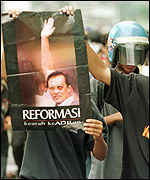
It�s even rarer to hear of �independent cultural activists� or �independent artistes�. The term �independent media� appears to be more popular and has succeeded to some extent in presenting the �pros and cons� of some important debates, at least occasionally. Although there is a term �public intellectuals� it is not yet popular in our daily discourse. Generally speaking, public intellectuals refer to a group of better-educated people who are keen to voice out their opinions publicly, even though those ideas might be critical of the powers that be. For this reason, public intellectuals strive to create an autonomous space which is free from the political interference of the State, or of the opposition parties, for that matter. Unfortunately, most of Malaysia�s ustaz, academics, journalists, artistes, literary figures, social and cultural activists, that is those who might be regarded as our public intellectuals, are too overwhelmed by partisan politics, in particular the politics of the ruling party. It does not appear that there exists an autonomous public space where they can write, express, and create their art free of political interference. Instead, the space in which they operate, indeed, the space wherein they eke out a living, is often dominated and controlled by the government. Consequently, much of Malaysia�s expressions and representations of the religious experience, art, culture, literature, the media and academic studies end up trying to please the powers that be. With the exception of a few, there is no open contestation of the government�s vision, its policies and agenda. Because of the political pressure that has for so long maintained such a tradition, there is a �poverty of imagination� among these would-be public intellectuals. Reformasi and a New Opposition One consequence of this poverty of imagination is that a number of cultural activists who are critical of the government eventually end up joining or working for the opposition parties. In fact some have begun to create poetry or perform theatre that is beholden to those in power in Kelantan or in charge of the Markaz Tarbiyyah PAS! The example of a small group of cultural activists � amongst them is Dinsman � is instructive. Critical of the BN government, these intellectuals have not struggled to try to create that autonomous public space free from partisan politics. This would have been a major contribution towards the consolidation of our democracy. Rather they have merely shifted their allegiance from the BN government to the Opposition, which has emerged as a new political patron for some of these cultural activists. Following Reformasi 1998 the Opposition became more popular and better received. This was evident in the number of activities it conducted, its economic activities and its large numbers of supporters. In turn it received more financial contributions, developed a support system and even had access to more physical space (halls and stages) for functions, including cultural activities. Another factor which facilitated the shift of political support or ideas from the government to the Opposition was because of the new issues � social justice, rule of law, basic rights and democracy � which were incorporated into the Opposition�s agenda. No doubt, the political crisis of 1998 surrounding the Anwar Ibrahim sacking, trial and detention has opened up the space for more widespread participation in politics involving all levels of Malaysian society and different types of organisations and structures. In this regard, the Opposition had become somewhat like the Barisan Nasional itself, which is also rather all-encompassing and broad-based! That said, it should be noted that this new political development differed from the issues, agenda, and lifestyle traditionally associated with PAS. Prior to this era of Reformasi, the Opposition did not have the power to attract cultural activists and artistes to their cause. Involvement with PAS, if any, usually meant adopting a �new life� steeped in Islamic ways and in repentance. Hence they would not be encouraged to practise the arts and other cultural activities. Instead, they would be encouraged to adopt the mode of thinking and lifestyles of the Opposition political activists or their ustaz. Much of this changed as a result of Reformasi which encouraged the people to be more open and porous; society was in a state of flux. For example, Hishamuddin Rais and his young friends � imbued with a �secular� lifestyle � were able to develop and present a theatre of Tok Ampoo. The long-haired, enthusiastic and young Reformasi activists often would stand up to read poems and at times appear in brief �agit-prop theatre�. From One Patron to Another Some of this openness, however, has disappeared recently. In part this is because of the development of too close and closed relationships with PAS. Although the cultural activists like Dinsman declare that they are not interested in becoming politicians, the close relationship that they have developed with PAS, in my humble opinion, amounts to another form of hegemony. Put simply, they have not been able to extricate themselves from a system of dependency. Instead of creating an autonomous space in the middle, they have jumped from the right (BN) to the left (Opposition). Before Reformasi, some members of this group of cultural activists were closely associated with and active under the BN government�s umbrella of cultural activities. The best example of this would be their involvement with the pro-BN Persatuan Penulis Nasional (Pena) Then, they appeared happy with their access to a plot of land and an old house that was located in the vicinity of the National Palace to such an extent that all issues and matters were debated only within the walls of the house and its fences. They were not especially concerned with debating in the public, particularly if their views ran contrary to the government�s. Even when they expressed their opposition to the use of the English language in the teaching of Mathematics and Science recently, this opposition was contained to where they were holed up. I am not comfortable with the perpetuation of such a situation. Being dependent on the Opposition or the BN government results in closing up that little autonomous public space. The hegemony of the powers-that-be over our public intellectuals therefore persists. Cause for Concern Although as individuals, each of these cultural activists might be awarded some space by the government, in the end that awarded space remains inadequate if we want to create a more democratic Malaysia. For there are big national issues that need to be addressed by this group of public intellectuals. And in order to do so, they must create the necessary autonomous space. Even amongst the journalists-literary figures who were fighting for the independence of the country, for instance A Samad Ismail or A Samad Said, there was little attempt to claim for themselves and public intellectuals some independent space. Following independence, instead, many began to become dependent on the government while others became a part of the establishment class. Some of them were also co-opted, such as in the case of the National Union of Journalists (NUJ), to the extent that the NUJ found it difficult to criticise the government when press freedom was curtailed via the enactment of restrictive laws. More recently, the NUJ was also unable to be critical when independent publications such as Eksklusif or Detik were closed. Meanwhile the few critical voices were silenced and marginalised. This was not unlike how to promote and protect the spirit of Soekarnoism in Indonesia in the 1960s, the Manikebu (Manifesto Kebudayaan) group was silenced by the pro-Soekarno group in Lekra (Lembaga Kesenian Rakyat). The reverse subsequently occurred during Soeharto�s time. In fact, such reversals often occur in other countries too. When the Opposition comes to power, the cultural activists associated with the Opposition will then be pulled into establishment positions. When they do so, alas, they behave the same way as the very group of people they displaced. Hence the shift in support among this particular group of public intellectuals from the BN to the Opposition is cause for concern. The ugly pattern would be likely to recur since they do not seem concerned to create that autonomous public space. There would be groups who are close to the Opposition today who would take the cue from Pena or the NUJ when their interests are threatened by their patrons. As a result, many important issues would again be neglected and many people would be victimised by this kind of reversals. Creating the Autonomous Public Space The influence of BN politics is strong, as it is able to shape the thinking, behaviour and what is called �tradition�. Everyone � particularly the Opposition and its activists � is familiar with the BN�s brand of politics. Increasingly, Malaysians are also imbued with this brand of politics which emphasises the need for development and for continued political stability under the BN�s leadership, even if it resorts to undemocratic means. In fact, we often hear that if politician A gains control of the country�s leadership or a certain ministry, then his/her people would accrue benefits from this political ascent. In the meantime, his/her political foe would have to be marginalized drastically; there�s no question of meritocracy, professionalism or democratic values. What emerges is cronyism or the benefits of political patronage. Our public intellectuals who are beholden to their patrons also hope to benefit via promotions in universities and media organisation or within the cultural establishment. Previously, we only associated this trend of cronyism with the BN government. Depending on the rise or fall of particular BN leaders, there would also occur the displacement and appointment of particular intellectuals to new posts. However, the problem extends beyond the BN. For when PAS took over in Terengganu after 1999, this phenomenon also surfaced there. There is a tendency among some of us to think that this negative tradition has become �common� and that we should be resigned to it. For people who think like this, politics in our country is essentially about power and caters to the interests of certain groups, not about democracy and the interests of the people. This is the nagging worry when a group of public intellectuals become immersed in the sphere of partisan politics and are no longer independent and critical. Now e-mail us and tell us what you think. | |||||||||||||||||