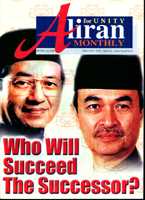
Who Will Succeed
The Successor?
Reflections on the Mahathir-Abdullah transition
by Khoo Boo Teik
|
|
Will history repeat itself as tragedy or farce?
|
Consider the nervous outcomes of the past two UMNO general assemblies.
June 2002: Dr Mahathir Mohamad announced his intention to retire and sent UMNO into an apparent fit, for who would succeed Mahathir? Over the past year, that question has been largely answered: Abdullah Ahmad Badawi, Mahathir�s fourth Deputy Prime Minister.
June 2003: Mahathir reaffirmed his plan to retire in October. UMNO was left in suspense when the PM-to-be refused to name his DPM-to-be although Abdullah had half-promised to do so by the end of 2002.
Thus persists, in a limbo-like state, UMNO�s melodrama of establishing the successor�s successor in the post-Mahathir period.
History won�t tell us exactly how UMNO�s melodrama will end but it will help us understand UMNO�s experience of leadership succession, including the �disappearances� of three Mahathir deputies � Musa Hitam, Ghafar Baba and Anwar Ibrahim.
Tunku to Razak
At the beginning of that tortuous experience was a critical transfer of power in the aftermath of May 13, 1969. �May 13� demolished the parameters of Alliance rule, and Tunku Abdul Rahman�s era was over. Yet his eventual successor, Tun Abdul Razak, and select members of the Malay elite maintained Tunku�s formal leadership of party, coalition and government and set the precedent for constitutional and orderly leadership transition.
Razak had a short tenure as Prime Minister. Upon his death in 1976, his deputy, Hussein Onn, took over power. The Razak-Hussein transition made clear that the PM enjoyed the prerogative of appointing his successor. It also established that seniority in UMNO counted, and UMNO�s Deputy President would become DPM and in due course take over from his predecessor. Operating by the principle of the leader�s prerogative, Hussein chose Mahathir to be his deputy.
Yet Mahathir�s appointment in a way violated the principle of seniority in UMNO. Of the three Vice-Presidents, Ghafar Baba had received the highest number of votes, Razaleigh was second, while Mahathir, readmitted into UMNO in 1972, had been elected with the lowest vote. In response, Ghafar resigned from the Cabinet in protest while Razaleigh bided his time.
Hussein to Mahathir
Then in mid-1981, Hussein announced his intention to retire, essentially paving the way for Mahathir to succeed him. No one disputed Mahathir�s claim on UMNO�s presidency, and in July Mahathir became the fourth prime minister in what seemed to be a transition marked by neither crisis nor contention.
But the resulting vacancy for UMNO�s deputy presidency, and it was understood, deputy premiership, led to the first battle between Vice-Presidents Razaleigh and Musa Hitam. Superficially, Razaleigh�s claim was stronger than Musa�s, Razaleigh being the more senior, but Musa had decided not to let the post go uncontested.
Technically, Mahathir was unable to exercise the leader�s prerogative to appoint his deputy since the formal transition from Hussein to Mahathir would only take place only after the June 1981 general assembly. Ideologically, the circumstances supported a current of argument that the party should decide who should become Mahathir�s deputy.
That UMNO�s 1981 election was at liberty to select Mahathir�s deputy effectively opened the way for the party at large to be directly involved in determining leadership succession. The 1981 Razaleigh-Musa battle, therefore, set a precedent following which political succession was no longer the party�s mere endorsement of the president�s prerogative.
Henceforth, political succession depended on UMNO�s triennial election that became increasingly bitter because of a growing party factionalism. The 1981 Razaleigh-Musa contest was followed by the 1984 Musa-Razaleigh fight. Both contests took a heavy toll on UMNO�s stability.
But in February 1986, Musa suddenly resigned as DPM and UMNO Deputy President, because of supposedly irreconcilable differences with Mahathir. Some quarters in UMNO urged Musa to reconsider. Musa withdrew his resignation as UMNO�s deputy president. He argued that while he had been appointed DPM by Mahathir, he had been twice elected deputy president by the party.
Headed For A Split
Faced with this party crisis, and looking ahead to UMNO�s 1987 party election Mahathir picked Ghafar Baba to replace Musa, incidentally making it four times that Razaleigh had been bypassed for deputy premier! That, and Musa�s falling out with Mahathir prepared the all-out Team A-Team B struggle from 1987 onwards.
Now the leaders could only fight for survival, but the party would decide the succession. Mahathir defeated Razaleigh by 761 votes to 718. Musa lost to Ghafar by 699 to 739 (in a contest that included 41 spoilt votes). In defeat, Razaleigh and Rais Yatim, resigned their Cabinet positions. In victory, Mahathir purged the remaining Team B ministers and deputy ministers from his Cabinet, not caring that one minister, Abdullah Badawi, came in second among the three Vice-Presidents. In the end, UMNO was split, deregistered in 1988, and reconstituted without Razaleigh�s faction.
With these outcomes, Mahathir appeared to have recovered the leader�s prerogative to determine succession. He seemed to have left the party at large the dubious privilege of �mandating� what the leader had decided.
But UMNO�s factionalism did not end there. The exclusion of the Razaleigh camp and the weakness of the Musa faction allowed new figures to flourish and new centres of power to arise. And since Mahathir had had quintuple coronary by-pass operations in 1990, seemingly the surest transit to UMNO�s summit was once again offered by the deputy�s post!
Factional Visions
But Ghafar�s incumbency did not inspire awe. Anwar Ibrahim moved to challenge Ghafar in 1993 with such a masterly exploitation of UMNO�s new rules for elections that no Anwar-Ghafar fight actually took place. Anwar led the Wawasan Team, an alliance of a �new generation� of leaders, namely, Muhammad Muhammad Taib, Muhyiddin Yassin and Najib Tun Razak.
While Anwar made Ghafar�s position untenable, the Wawasan Team swept Abdullah Badawi and Sanusi Junid from the Vice-President�s posts. In hindsight, the Wawasan Team�s 1993 campaign uncannily duplicated Team B�s 1987 initiative � except that the President was unopposed, and the upstarts were successful. The outcome was evidence of the ability of the party at large once again to impose its succession preference upon the leadership.
Once again, Mahathir sought to impose the leader�s will. In UMNO�s 1996 election, Mahathir could not be challenged because of a change in party rules. Neither could Anwar but crucially Mahathir shifted the burden of the succession question away from himself � to Anwar!
Time, however, was on Anwar�s side as he set out to spread his influence over UMNO. By 1998, it was assumed that the Anwar camp commanded the loyalty of a plurality of the delegates to the 1999 General Assembly when the next party election would be held.
Up to mid-1997, a smooth transition from Mahathir to Anwar was not an implausible scenario. However, the July 1997 East Asian financial crisis wrecked that scenario. As the crisis deepened, Mahathir would simply not leave office under a cloud. Morever the domestic management of the economic crisis ruptured relations between �No. 1� and �No. 2�.
On the afternoon of September 2, Mahathir sacked Anwar. In the evening of September 3, UMNO�s Supreme Council met, and in the early hours of September 4 expelled its deputy president. Each of these two decisions had a special significance. The PM�s decision relied on his control of the state to crush a deputy feared to have obtained control of the party at large. The Mahathir-dominated Supreme Council�s decision pre-empted any Anwar comeback in UMNO via a Musa-style separation between being DPM and being UMNO Deputy President.
From then till 2000, when Abdullah Badawi was elected Deputy President without contest, the party at large had lost its ability to determine succession if its preference was opposed to the intent of the leadership.
Lessons
 There are at least two clear lessons from UMNO�s tormented history of leadership transition that led in 1998 to the sordid Anwar affair.
First, there has always been a tussle between incumbent leaders trying to force their will upon the party, and rival leaders hoping to rise via a decision of the party at large. Those who accept the leader�s prerogative to decide his successor insist on the need for stability. Those who oppose it speak of democratic practice.
Thus we have had the strange spectacle of smooth transitions at the level of the prime minister while we witnessed fiercer and fiercer fights for the deputy president�s position in UMNO.
Second, so long as UMNO doesn�t support liberalism and fairer competition in the political system, it has no hope of institutionalizing stable mechanisms of leadership change within the party.
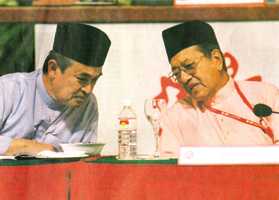
These lessons are worth pondering on the eve of the Mahathir-Abdullah transition.
Just last month, the pretenders to the post of UMNO Deputy President � in alphabetical order: Muhammad Muhammad Taib, Muhyiddin Yassin and Najib Tun Razak � had to maintain a semblance of elite unity by promising to abide by Abdullah�s choice of DPM. Yet everyone suspects the behind-the-scenes jockeying for power is intense.
And Abdullah, UMNO�s �Deputy President without contest�, is hard put to offer a deputy for anointment ahead of UMNO�s next party election. That Abdullah was once �Team B� while Muhammad, Muhyiddin and Najib were once �Wawasan Team� must make one wonder, if the going gets rough, whether history will repeat itself as tragedy or farce.
Now e-mail us and tell us what you think.

