
Reforming PAS? by Dr Ahmad Fauzi Abdul Hamid
Please support our work by buying a copy of our print publication, Aliran Monthly, from your nearest news-stand. Better still take out a subscription now.
Ceramahs or Party Politicking? It was only in the mid-1980s that PAS accommodated dakwah as part of its strategy in winning influence among the Malay-Muslims. By then, the leadership had been taken over by the so-called Young Turks, many of whom had themselves been active in other dakwah movements early in their Islamist careers. While dakwah became an important activity of PAS’ Youth Wing, it never established itself as PAS’ core activity. The party politicking and electioneering activities of PAS overwhelmed any dakwah tendencies of converts to PAS from other movements. Whenever there were calls from within to reform the party’s orientation, the diehards in PAS would accuse the new PAS members identified with such calls of lacking loyalty to entrenched PAS’ ideas. An example was the witch-hunt and eventual banishment of former Islamic Representative Council (IRC) members during the 1987 PAS General Assembly. If calls for reform came from outside PAS but still within the Islamist camp, they would similarly be outrightly rejected. This became clearer as PAS gained confidence by wresting political power in Kelantan in 1990. Offers of assistance to PAS’ Kelantan state government in 1991-92 from Darul Arqam and Jamaah Islah Malaysia (JIM), in order to widen the appeal of Islamic programmes in Kelantan beyond the scope of party ceramahs, were bluntly rejected and dubbed attempts to hijack the state from PAS. In short, PAS was, and arguably still is, convinced that only its path was right, and only its method was correct in the fight to realise Islam as the solution. This narrow mindset was made worse by PAS’ continual electoral victories in Kelantan and capture of Terengganu in 1999. After all, are these not signs of the veracity of PAS’ struggle? I remember attending, as a postgraduate student, a session between PAS’ General Guide-cum-Kelantan Chief Minister, Hj. Nik Aziz Nik Mat, and Islamists among Malaysian students in Birmingham, England, in December 1995. In contrast with dakwah movements’ gradualist approach, Hj. Nik Aziz plainly rejected the notion that an Islamic state could come about step-by-step, starting from the individual, then progressing to the family, the society and finally the state. He surmised that such a theory was concocted by the enemies of Islam to obstruct the Islamic struggle. Ruling out the conception of the diversity of movements and methods, he insisted if there had to be diversity after all, one movement needed to be installed as the parent movement, by which he meant none other than PAS. Islamists Divided The above-mentioned narrow-mindedness persisted through the 1990s, dispelling many fellow Islamists who were nevertheless happy that more people were apparently beginning to accept the entry of Islamists in competitive elections. The ‘moderate’ brand of Islamists ventured into the politics of the ruling establishment, and a significant number of them - under the formal or informal patronage of Anwar Ibrahim, who himself had joined the ruling United Malays’ National Organisation (UMNO) in 1982 after heading ABIM for eight years - held positions of influence in the ruling party, government and civil service. The leading Islamists were divided into those convinced of PAS’ hard-and-fast approach of confrontational opposition politics, and those seeking to reform the system from within. But for the bulk of rank and file Islamists, hopes were high that one day, somehow, the two streams would merge. By the mid-1990s, conventional politics, whether oppositional or pro-establishment, seemed to be justified as the method most likely to bear fruit for Islamists. This sentiment became stronger following the state’s suppression of Darul Arqam and the cowing of Jamaat Tabligh. For, if even movements with no clear design on political power were suppressed, would it not be wiser for Islamists to explicitly proclaim their political intentions and offer a viable Islamist alternative to the populace and the ruling elite? Anwar and Reformasi  Then came the Anwar Ibrahim saga. With Anwar sacked from UMNO and the government, and later arrested, tried, convicted and incarcerated under questionable circumstances, Islamists within the establishment suddenly found themselves in a quandary. A handful stayed on, but most preferred to leave establishment politics rather than face ostracism. UMNO ideologues did not lament their departure. In their view, these Anwar loyalists had never been pure UMNO members anyway. Some former comrades of Anwar joined PAS, but most rallied behind Anwar’s Reformasi campaign. Human rights became the clarion call of Reformasi. By 2001, many Islamists, while feeling they were instrumental in the formative periods of Reformasi, were disappointed to discover themselves sidelined in contests for the leadership of KeADILan – the new party championing Reformasi.
On the other side of the coin, in spite of its frailties, since the Anwar saga erupted, PAS has persistently been at the centre-stage of anti-state political mobilisation. PAS leaders such as Fadzil Noor (died June 2002) were quick to capitalise on their long term friendship with Anwar in portraying that PAS was indeed with Reformasi, and was with Anwar all along. PAS projected itself as an indispensable component of Reformasi, and by means of being the largest opposition party, emerged as its leader and pace-setter, at least as far as the masses were concerned. Voting PAS was depicted as voting for social and political reform. After all, in constituencies where PAS candidates were left as solitary opposition candidates in one-to-one contests against the BN (Barisan Nasional), what avenue was there left to express one’s reformist sentiments apart from voting PAS? PAS Benefits As the biggest election contender among Reformasi elements, PAS was catapulted into leading the assorted Reformasi groups by default. Reformasi groups, out of practicality and convenience, had to accept PAS’ leadership despite sharing with it only one long term aim: the restoration of justice, as embodied in the treatment meted to Anwar Ibrahim. Their short-term goal was simply the exoneration of Anwar. PAS was the greatest beneficiary of rather than the main contributor to Reformasi. The leap in the number of votes and seats of PAS in the 1999 elections was due to the euphoric support for political and social reform rather than serving as an endorsement of PAS’ policies. PAS’ spokesmen became ever more convinced that Malaysia was on the way to becoming an Islamic state by means of states within the Malaysian federation falling one-by-one in domino-like fashion to PAS in consecutive elections. For them, PAS’ methods had been verified, while those of other movements, by being ineffectual, were clearly false.
To be fair, there exist liberal voices even among keADILan’s leading figures. For example, Syeikh Azmi Ahmad, keADILan Vice-President and former mufti of Penang, recently issued a statement that in an Islamic state, the people’s welfare and justice rather than the implementation of hudud, was the priority. I would say that this practical view is accepted by many dakwah enthusiasts who share the same reform-minded outlook of their social activist counterparts. The difference is that, while the former’s aspirations are spelt out in Islamic idiom, the latter’s aims assume a secular-humanist outlook. But what utility do these accommodationist stances possess when their supporters are forced by circumstances to vote PAS, and PAS then wilfully interprets votes cast for its candidates as endorsing its juridical interpretation of Islam? The wedge between PAS and non-PAS Islamists could only be driven further apart by a possible domination of PAS’ upper echelons by leaders of the east coast states, where there is less need for and understanding of accommodationist politics due to the preponderance of Malay-Muslims. As we approach the 11th General Election, non-PAS Islamists are faced with the difficult choice of either siding with PAS, whether directly or indirectly, or standing aloof altogether from conventional politics. PAS claims to have had a marvellous rise in membership in recent years, thus claiming success of the first option, not to mention those who align themselves with PAS’ politics via membership of keADILan and Parti Rakyat Malaysia (PRM). But some Islamists have opted for the second option. Former members of Darul Arqam, for example, being under constant surveillance from the authorities since their movement’s proscription in 1994, have focused upon building urban Islamic communities of their own. This can be seen from the string of business enterprises that have sprung up, under the aegis of Rufaqa’ Corporation Sdn. Bhd., in Bandar Country Homes, Rawang, Selangor and to a lesser extent, Bandar Baru PERDA, Bukit Mertajam, Penang. Still confident that their struggle will eventually be vindicated, most harbour hopes, however illogical they might seem to be, that the forthcoming Election will be abandoned amidst political turmoil, and that their leader of choice, Ghafar Baba, be handpicked as Dr. Mahathir’s successor as Prime Minister. PAS- Lacking In Substance? PAS serves as a poor embodiment of contemporary political Islam in Malaysia. It is rich in idealistic rhetoric, but often lacking in substance, except in the case of electioneering. While appearing inflammatory in public, it finds it difficult to deliver goods. Omar Khalid, a former PAS activist in Terengganu and an ex-detainee under the Internal Security Act (ISA) in 1987, has detailed in his booklet Parti Islam: Antara Realiti dan Fantasi, how Kelantan’s Chief Minister, Hj. Nik Aziz, confessed to him that PAS was indeed unable to fulfil some of its promises to the people. All too often PAS leaders have simply reacted to the agenda of the ruling party and the government, rather than proposing a masterplan of its own. Without planning whatsoever, inconsistencies abound. The newly elected Terengganu state government in 1999 toyed with the idea of imposing kharaj (land tax) on non-Muslims when the Kelantan state government had never implemented it since 1990. Unsure of itself, PAS’ leadership at national level has been fiercely attacked by grassroots members in private party assemblies. It is a well-known criticism of PAS that its rank and file members lack continuous Islamic education (tarbiyyah) from their leadership. In order to succeed at the highest level of Malaysian politics, PAS needs to improve its profile as a party of dakwah and welfare – one that wins the hearts and minds of people rather than just their short-term votes. Even with the present-day incoherence, PAS has gained a significant measure of support from reform-minded Malays of my generation. I have no doubt that they will continue to do so, if only for the want of a more credible electoral alternative. But to transform such support from an anti-BN and anti-UMNO one to an unwaveringly pro-PAS vote, an internal Reformasi within PAS is called for.
Now e-mail us and tell us what you think. | |||||||||||||||||||

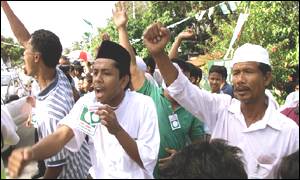
 PAS serves as a poor embodiment of contemporary political Islam in Malaysia. It is rich in idealistic rhetoric, but often lacking in substance, except in the case of electioneering.
