
|
|||||||||||||||
|
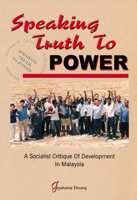
Speaking Truth To Power Some opinions about this new book Aliran Monthly 2003:9 Please support our work by buying a copy of our print publication, Aliran Monthly, from your nearest news-stand. Better still take out a subscription now. We also welcome donations.
Herald 24 Aug 2003 �In his newly published book, Speaking Truth to Power, chest physician and activist Dr Jeyakumar Devaraj, share�s his groups� experience of working with the marginalised � estate workers, the peneroka bandars, factory workers, the orang Asli, vegetable farming communities�. His book takes readers through not only problems faced by the marginalised communities but also ways they have come together to change their world. He clearly outlines their struggles and their persistence. He documents, investigates problems, be they land issues or medical (reflective of his medical training) in a way that lay persons can follow. Readers will be challenged by the action taken by communities and the process by which these actions are arrived at. He takes the reader from the micro scene � the estate, the peneroka bandar, kampungs � to an analysis of these circimstances.� K Arumugam KL Book Launch 13 Sept 2003 �Kumar has documented the exploitation of people. The words used by Kumar in the book may take different forms like �poverty�, �marginalisation�, �elections�, �estate owner�, �menteri besar�, �police�,�judge� and maybe even you and me. �Kumar dissects the power structures and nakedly confronts the oppression. The problem is not a material one; it is social in nature, and political in practice. It is the result of the barbaric priorities of a system founded on economic competition.
Dr Mohd Nasir Hashim Foreword to book Dec 2002 �In all these different communities and strata, Kumar has documented the hardship that the ordinary people of Malaysia have to endure � hardships brought on by a form of development that worships power and profits, a form of development that completely ignores the contributions and sacrifices that ordinary workers and farmers have made to the development of this country, a capitalist system that leads to impoverishment of communities and the destruction of the environment. Woven into the narrative of the case studies are concrete examples of what ordinary people can achieve if given the right analysis and some democratic space. These examples show that once people are given the space to verbalise their woes, analyse their experience and translate this into community action, they become a powerful force that their oppressors cannot brush off lightly. Kumar�s book demonstrates to us that the call to struggle for a better society is not a conjured dream or an abstract idea in the minds of romantics. It is a reality that is taking place right now in our midst wherever activists with the correct ideology align themselves with marginalised communities and strata, enabling these communities to demand a process of dialogue with the forces oppressing them.� Dr Khoo Boo Teik Introduction to book Jan 2003 �Kumar�s insistence on uncovering the roots of economic deprivation and his refusal to rationalise away the causes of social injustice supply the radical edge to his writings. Above all, it is Kumar�s willingness to do something about the injustices he encounters, and to do so here and now, that is the hallmark of his blend of personal conviction, intellectual crticism and activist intervention.�  Dr Subramaniam Pillay
Penang Book Launch 18 Oct 2003 �Kumar�s book simply states what the problems are in each community and what needs to be done. The chapter on beri-beri among immigrant workers is a story which is especially poignant. It is shameful that in this day and age that beri-beri (thiamine deficiency) can exist in our society. Socialism should neither be seen as a dirty word nor should the Soviet bloc be used as the only face of socialism. Socialism is about social justice.� Dr Jeyakumar Devaraj Penang Book Launch 18 Oct 2003 �This book is a documentation of what a group of us in Alaigal found. We are just ordinary people but we have come through a process of listening to the people and learning from each other�s experiences. We have learnt now not to be afraid of being arrested, something which is understandably frightening to many people. Through a combination of working together with the people, activism and people power, change can occur."
Now e-mail us and tell us what you think in fewer than 250 words. Your comments might be published in the Letters section of our print magazine, Aliran Monthly. Alternatively, post your comments to the message board. | |||||||||||||||

 We are just ordinary people but we have come through a process of listening to the people and learning from each other�s experiences.
