WSF - Festival of the oppressed
Aliran Monthly 2004:1
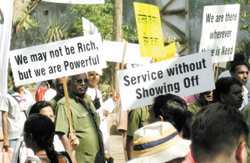
|
|
Photo by Nadarajah, Asian Communication Network
|
The official theme of the World Social Forum (WSF) was of course �another world is possible� but that expresses an aspiration rather than a reality. Perhaps Alex Callinicos� phrase above is more a accurate depiction of what really happened in Mumbai from January 16-22.
This notwithstanding, it was an occasion which has no parallel in my recent experiences. A hundred thousand participants, over 200 speakers, 12 conferences, panels and roundtables, 300 seminars and workshops everyday, films street plays performed simultaneously in 13 different locations. And, to top it all, there was also the �Mumbai Resistance� organized by some 30-odd organizations held opposite the WSF grounds if you cared to go!
Soaking in the panorama
Yes, all shades of �the oppressed� came out in numbers and it was particularly heartening to see dalits (the unscheduled lower castes or �untouchables�) parading daily in the Goregaon Nesco exhibition grounds (where the WSF was held) in protest of their plight. If there is one failure of Indian democracy it is its inability to remove the scourge of caste-ism from its society. This was amply demonstrated by the daily appearance - the chanting and dancing - of dalits at the WSF amidst the crescendo of drums, which indeed �celebrated� their oppression.
But I�m ahead of my story. I arrived in Mumbai late in the evening from Kuala Lumpur along with a bunch of other WSF-ers, and must admit that I found on arrival at this famed city both refreshing and a culture shock. India�s financial, industrial, commercial and entertainment hub and de facto capital of 13 million is truly a city of contrasts. I was whisked uncomplicatedly by my hotel pickup to my not-so-stylish hotel in the Andheri area and was thankful for the lack of touts wanting to get a piece of the unsuspecting tourist. The transport system is wonderfully efficient in Mumbai with a backbone of a dependable railway system and the 24-hour availability of taxis and three-wheeled auto rickshaws. Despite the Mumbai traffic, it was remarkable that one never really got stuck in interminable traffic jams like those of Bangkok or Jakarta.
 ...by the time I had to leave and had experienced three days of WSF, I was already fully convinced � despite a touch of diarrhea! � that another world was actually present, vibrant and alive in Mumbai 2004.

|
Getting to the Nesco grounds was a breeze in an auto rickshaw or taxi. I recommend the first method because for a quarter of the taxi price you will get a veritable rollercoaster ride on the streets of Mumbai! And along the route you can soak in the panorama of Mumbai life laid bare before your eyes; bustling commercial life, four-star and five-star hotels not so far from masses of humanity, some living in dilapidated mudflats amidst the dust, grime, pollution and noise � it was truly absorbing.
Well organised
But back to the WSF story. First, one must say it was remarkably well organized. Friends and colleagues promised that it would be totally chaotic, but in truth it wasn�t that bad for an occasion that boasted the hosting of well over 1,000-odd events in one venue! Security was excellent and there were no �incidents� on the grounds that I could remember. One was electronically screened before entering the grounds; there were large maps at strategic points to show the venues of events, lots of water dispensing kiosks, adequate and clean toilets, assistance booths and food courts. What else could one ask for?
Yes, a programme � which unfortunately did not come until the midpoint of the second day. That was the only major �glitch�. The smarter ones amongst us would have downloaded some of the interesting events from the Internet, I suppose, but some guidance on the first day to the major events would have been useful. Well, the programme did come eventually, but it wasn�t much help either because you invariably had to make difficult choices and, like me, may have ended up missing most of the many events you wanted to attend for one reason or another.
Another world is here
Most people had to event-hop to get a smattering of the best and the brightest of the WSF. And then you also have to visit the exhibitions, see the performances, the films, and get some sustenance in between. In short, you ended up doing very little of what you�d really intended and became quite fatigued midway through the day, content to sit down somewhere or wishing you were back in your hotel!
But here is a smattering of the events, panels, seminars and workshops of the WSF:
- On opening night, Junoon, the Pakistani sufi rock band was in it its element but I missed Gilberto Gil of Brazil as dinner beckoned (the programme was at least one hour behind time).
- Ahmed Ben Bella, Arundhati Roy, Jeremy Corbyn did their thing as speakers but we at the back of the Maiden open space were struggling to listen amidst the cacophony of drums and dancing.
- The next day saw the big venues (main halls, 1-5) hosting panels on food sovereignty and natural resources, women and globalization and war militarism and peace, WTO, NAFTA and FTAA, people�s world water forum, movements on sexuality issues, human rights, nuclear war, socialism, deepening democracy, etc. Among the �alternative� intellectuals who spoke were Maude Barlow (Canada), Sunila Abhyasekaraya (Sri Lanka), Nyugen Binh (Vietnam), Chandra Muzaffar (Malaysia), Walden Bello (Philippines), and Vandana Shiva (India).
- The second day saw discussion on issues such as the world court of women against war, media, culture and knowledge, the US occupation of Iraq and Afghanistan, wars against women, women against wars, political parties and social movements, children�s rights, debt, corporate accountability, and engagement with Gandhi. Speakers included the likes of Winnie Mandela, Ramsey Clark, Mary Robinson, Mustafa Bargouti, Ashish Nandy, Richard Falk, and Irene Khan.
- Seminars and workshops focused on topics such as the effects of agent orange in Vietnam, child poverty, cultural resistance to globalization, domestic violence, fundamentalism, left, right and centre, globalization and indigenous peoples, humanity above nationality, progressive Islam and liberation theology, challenges before media, democratisation in Burma, eco-villages, trafficking of women and children, the other worlds: countering hegemonic order.
- A world dignity forum was held on the third day, along with panels on racism and caste-ism, globalization and social security, tribals and violence, political bodies and emancipatory struggles, war trade and finance, sustainable workplaces, transformative education, Africa-Latin America solidarity, how to start and organise an NGO in Brazil, a world tribunal on Iraq, to name a few.
Basically, whatever contemporary political, social, economic problem or issue of the day one could think of was represented by activist groups and discussed and debated in Mumbai. Admittedly, 80 percent of the participants were Indian and not all the discussions were necessarily illuminating nor were any solutions ever found to the many problems that still afflict the world. However, by the time I had to leave and had experienced three days of WSF, I was already fully convinced � despite a touch of diarrhea! � that another world was actually present, vibrant and alive in Mumbai 2004.
Johan
Now e-mail us and tell us what you think. Your comments might be published in the Letters section of our print magazine, Aliran Monthly.
Alternatively, post your comments to the message board.
|

