
|
|||||||||||||||
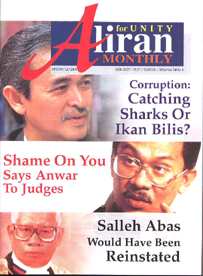
| War on corruption: Hunting the sharks
or ikan bilis
Still unsure about his political support base,
Abdullah is unlikely to introduce radical reforms
by Anil Netto
Nonetheless, Abdullah Badawi�s drive against corruption has already opened up several cans of worms. Topics such as the bulk issue of taxi permits, the postponement of a controversial railway double-tracking project, the Maika scandal and the failure of a Mahathir confidante to control the Bakun Dam project have hit the headlines. There seems to be some willingness to acknowledge that corruption is a serious problem that must be tackled. Abdullah also made waves when it was announced that Malaysia will ratify the United Nations Anti-Corruption Convention and set up a RM17 million Anti-Corruption Academy (what, another ACA?). There are several possible reasons why Abdullah has seized on a war on corruption as one of the thrusts of his new administration. First, corruption represents a major leakage of funds in the country and will only aggravate the already significant budget deficit. Abdullah has said that he wants to try and balance the budget. But the real question is whether he will confine himself to �ikan bilis� - or make heads roll as he follows the money trail to the well-lined pockets of the �monster sharks�. Second, the competition for foreign direct investment is getting stiffer. Malaysia no longer has the advantage of cheap labour now that countries like China and Vietnam have opened up to foreign investors. Thus, Abdullah probably figures, the only way we can market ourselves is to clean up our act and highlight Malaysia as a country that practises transparency in business dealings and reduces the incidental costs and leakages (bribes and kickbacks) to a minimum. Acting against corruption, would help inspire confidence among investors. Senior American corporate leaders have responded positively to Abdullah�s efforts: �We see strong leadership, a pro-business focus, and a Prime Minister committed to efficient and transparent governance to support sustained economic growth and development,� said Michael Gadbaw, the chairman of the US-Malaysia Business Council. Critics, however, point out that Abdullah�s measures don�t go far enough and so far, no �big fish� have been caught.
Moral failure Abdullah also cannot ignore the groundswell of disgust at the cronyism and nepotism that were the hallmark of the previous administration. Apart from the anger over the ouster of former deputy premier Anwar Ibrahim, there was overwhelming anger at corruption, cronyism and nepotism. Some of the biggest protests in 1998 centred on cash-rich Petroliam Nasional Bhd (Petronas), wholly owned by the Malaysian government, which announced what analysts felt amounted to a bailout of Mahathir�s son, Mirzan. At that time, Mirzan�s main public listed company, shipping concern Konsortium Perkapalan Bhd (KPB), was submerged with debts estimated at around RM1.7 billion. Its share price had fallen to RM3.78 by February 1998, a fraction of its pre-financial crisis level of over RM17. The Petronas-controlled national shipping carrier Malaysian International Shipping Corporation Berhad (MISC) stepped in to acquire debt-laden KPB�s shipping assets with cash. Numerous other scandals tarnished the image of the ruling coalition. The reformasi anger on the streets over corruption and abuse of power was palpable and cost the ruling coalition dearly. The opposition made sharp inroads in the general election in 1999. To this day, Malay voters are said to be deeply divided. That is why it is bewildering to see Mahathir now appointed as advisor to Petronas. Opposition parties like PAS have criticised the Barisan Nasional�s perceived moral failure to bolster support for an Islamic state. Abdullah, whose own Islamic credentials have been much touted in the media, realises that he will have to clean up the administration�s act if he is to counter effectively the PAS argument. Abdullah appears to be willing to tackle straightforward bribery and abuse of power, judging by the ACA swinging into action over the 6000-taxi permit fiasco. Such irregularities are easy to start with. But Abdullah has also postponed the double tracking project . How significant are these episodes? (see tables) Public attitudes must change if a war on corruption is to have any meaning. At present, many Malaysians think that current levels of corruption are acceptable and �oh, there are so many other countries where corruption is worse, like Indonesia and the Philippines.� But why aren�t we comparing ourselves with countries with much better records in wiping out corruption? No level of corruption should be considered acceptable � there should be a zero-tolerance policy towards corruption in all sectors. Measuring success How should success in Abdullah�s anti-corruption drive be measured? We should be careful here or we could easily fall for BN and mainstream media propaganda about how much the government is doing to wipe out graft. Success should be measured based on the following benchmarks: First, the Anti-Corruption Agency must be made truly independent and staffed by people of unquestionable integrity. It should report to Parliament rather than the Prime Minister and it must go after the big fish without any foot-dragging. For a start, the ACA must immediately resolve the Perwaja Steel scandal and take another look at the Maika debacle (see accompanying article) and allegations involving politicians such as Rafidah Aziz and Samy Vellu. Second, Abdullah must tackle corruption in the civil service and in the government. He must focus on major areas that lack transparency. For example, there must be absolute transparency in weapons purchases, that involve billions of ringgit. He must eliminate any possibility of middle-men raking in huge �commissions� whether in arms purchases or recruitment of migrant labour. Third, the big guns like Petronas (the national �cash cow�) and the Employees Provident Fund must be made more accountable. Petronas controls billions of ringgit of oil resources belonging to the Malaysian people - a lot of it has already been squandered on unproductive projects - and it must be held transparently accountable to Parliament. Fourth, Abdullah must eliminate money politics and disentangle politics from business. That�s easier said than done, of course, but no war against corruption would be complete without this. He must terminate the �politics of development� where promises of development are used to buy support from voters. This is a form of electoral bribery. Fifth, top government leaders and high-ranking civil servants must periodically be required to declare publicly their assets. Leadership by example all the way down. If lower-ranking personnel know their bosses are clean and will not tolerate corruption, they will be less inclined to indulge in unethical practices themselves. Sixth, corruption and bribery in the private sector must be wiped out. The institutions responsible for improving corporate governance such as Bank Negara and the Securities Commission must be made truly independent and effective. Seventh, whistleblowers must be protected at all costs and not penalised like they have been in the past. Indeed, Abdullah can encourage whistle-blowing by allowing greater freedom of the press to report corruption and abuse of power in high places and by abolishing the Official Secrets Act and the Internal Security Act. Finally, the judiciary and the Attorney General�s office must be made more independent to ensure that the corrupt are brought to justice. Will Abdullah have the political will to carry out these tasks? Or will he be satisfied with rhetoric ahead of a general election to win votes? It is difficult to reform a system that is so steeped in money politics and in which business and politics enjoy a cosy relationship. Abdullah may be sincere in trying to change the system from within, but will the system itself end up changing Abdullah? Systemic corruption or conflict of interest is now deeply ingrained. It will be tough to get rid of it without the political will. The new premier is still unsure about his political support base. He is thus unlikely to introduce radical reforms to rock the boat. This is why many Malaysians remain sceptical about the prospects of success in the war on corruption under the present government. The 6,000-taxi permit fiasco Recently, an allegation was made that the Entrepreneur Development Ministry had issued 6,000 taxi permits to one company. Malaysia Taxi/Limousine and Hire Car Drivers and Operators Association president Yusoff Lahir lodged a police report on this matter. Attorney General Gani Patail on 9 December 2003 ordered the Anti Corruption Agency to carry out further investigations into irregularities that it found in the issuing of the taxi permits. He said, however, that he found no truth in the allegations that 6,000 such permits were issued to one company. �The number differs very much,� said Gani. �Be that as it may, certain other irregularities were disclosed in the course of the said investigation.� The following day, ACA officers recorded a statement from Entrepreneur Development Minister Nazri Abdul Aziz about �procedural irregularities� over the issuance of 1,200 taxi permits to seven companies. Earlier, Nazri was involved in a verbal spat over ACA director of investigations Nordin Ismail�s threat that the agency would issue warrants of arrest to witnesses, including ministers, who refused to present themselves for questioning. In hisinfamous remarks, Nazri lashed out at Nordin: �He has displayed a despicable attitude... He cannot be trusted to facilitate a fair and just investigation. He wants to exert his power and show that we are subject to him and are liable to arrest at his command. �I want to remind him for the last time that he is a government servant and, in this structure, ministers are his superiors.� This kind of arrogance is typical of some ministers who think they are masters of the people rather than servants entrusted with a responsibility who can be sacked if they under-perform or commit criminal breach of trust. Of course, Nazri has a point about the ACA�s foot-dragging. Such foot-dragging has become almost legendary especially in ACA cases involving �big fish�. Apart from the delay in probing the taxi permit fiasco, there have been delays involving the Rural Development Ministry: it has been two years since the ACA started investigating a misappropriation of RM6 million. And all of us are familiar with how the ACA sat for years on high profile cases such as the allegations involving Rafidah Aziz and the special shares awarded to her son-in-law. Let�s not even talk about the ACA foot-dragging � it�s more like paralysis � in the debacle surrounding Perwaja Steel, a project close to Mahathir�s heart. Apart from the number of permits actually awarded, the real issue is why taxi permits can�t be given to responsible, hardworking individuals who want to work as taxi drivers? Why can't permits be awarded to individual drivers or cooperatives made up of, say, retired teachers rather than well-connected companies acting as middle-men? Step into any taxi in the capital and ask the driver what he thinks of his taxi companies and chances are you will get a mouthful about how much he has to pay the companies for the use of the car, and how he has to work long hours just to cover the costs of rental and petrol before making a little something extra as income. How can we expect courtesy and professionalism from taxi-drivers who are so afflicted and burdened? � A. Netto The Double Tracking Project Controversy The government�s decision to postpone the RM14.5 billion railway double-tracking project, one of the biggest infrastructure projects in Asia, has been viewed positively. The electrified double-track rail line across the length of the peninsula was supposed to be part of a planned 5,600-kilometre trans-Asia link. A letter of intent had been issued to state-backed Indian Railway Construction Co and China Railway Engineering Corp as part of an oil palm barter deal. But only days before he retired on 31 October 2003, Mahathir raised eyebrows by awarding the project to politically well-connected Syed Mokhtar Al-Bukhary�s Malaysia Mining Corporation and partner Gamuda. Controversy raged until 17 December 2003, when Abdullah said that the project would be postponed in favour of more urgent development schemes. This episode raised fresh concerns about the persistent lack of accountability and transparency in Malaysia. It also highlighted how tightly politics and business are intertwined. It is premature to say whether Abdullah is really trying to disentangle business from politics. It may be that he has one eye on the coming general election, widely expected to be held in first quarter of 2004. His interest in grassroots development projects could be merely a tactical move to win back support for BN ahead of the polls. Or it could be that the reaction from China and India was not positive, to say the least. To minimise the damage, Abdullah may have simply decided to postpone the project indefinitely. This does not mean that such a major rail infrastructure project is not beneficial to Malaysia. But what is lacking is competitive bidding, transparency, and open tenders. There is no reason why rail transport cannot give air and road transport a run for their money. Just look at the congested highways, the long queues at toll plazas, the numerous express bus companies, and the emergence of domestic budget airlines like Air Asia. Surely there is scope for a much-improved rail service. Trains are just as good as buses in terms of energy consumption per passenger kilometre; trains are also well ahead of cars and aircraft. For transporting goods, rail is superior to road and air in terms of energy efficiency. If we are serious about conserving our fuel resources, promoting sustainable transport, and reducing air pollution due to aircraft and vehicle emissions, we must not neglect our railways. We cannot expect capital intensive public transport like railways to turn in a quick profit. Fares have to be reasonable to attract passengers. Public transport by its very nature is a service to the public and many governments provide subsidies to railways. With an excellent railway system, travellers will flock to the trains. But the planning and the cost-benefit studies of major upgrading work must be meticulously professional and the award of projects transparent. There is no room for cronyism. What is needed is a strategic national blueprint for sustainable transport, not piecemeal, ad hoc projects that will only benefit well-connected crony companies. Syed Mokhtar suffered a second blow when Abdullah�s administration moved to terminate an agreement between the Minister of Finance and GIIG Capital (also linked to Syed) related to the sale of a 60 percent stake in Sarawak Hidro, the Bakun project�s owner and promoter. Thankfully, that is likely to spell the end of the road a proposed energy-intensive, polluting aluminium smelting plant - a project also linked to Syed Mokhtar - which was supposed to consume the surplus electricity produced by Bakun. But Abdullah said that the Bakun dam project itself would continue as money had already been spent on construction. That doesn�t make sense. If he is against huge unproductive projects and more concerned about grassroots development, he should call off Bakun altogether (instead of merely scaling down the size of the dam) and look at more sustainable means of energy production. � A. Netto Now e-mail us and tell us what you think. Your comments might be published in the Letters section of our print magazine, Aliran Monthly. Alternatively, post your comments to the message board. | |||||||||||||||

 The new premier is still unsure about his political support base. He is thus unlikely to introduce radical reforms to rock the boat.
