
|
|||||||||||||||
| Trade unions and politics (Part 1)
Though they are not political parties, trade unions are political organisations
by K George
Please support our work by buying a copy of our print publication, Aliran Monthly, from your nearest news-stand. Better still take out a subscription now. We also welcome donations.
All over the world trade unions are known as organisations of the working people including agricultural workers and fisher folk. In Malaysia, employers are also allowed to form trade unions under the Trade Unions Act. However, this article confines itself to workers� organizations. Over two centuries ago, industrialisation came into existence in many parts of the world. An industry consists of capital, management and labour. All three are equally important. Capital alone is incapable of producing without labour. Management is only required if there are workers. In spite of vast technological development, the hand of labour is vital. Of course, the numbers required have fallen. Uprooted from their villages, the workers had no choice but to depend entirely on their meagre wages. Employers had the prerogative to �hire and fire�. Exploitation of workers was rampant. Alone they were totally helpless. Neccessity was the mother of invention. They realized that if they were united they would be able to face their employer. That is how unions came into being. It was then known as combination. Many governments declared combinations illegal. Many workers lost their jobs. They were beaten up, tortured; jailed. But the struggle went on. Today trade unions have been recognized and accepted as legal entities by democratic governments. Their wings have spread to almost all parts of the world. Nationally, they have federations and confederations. They also maintain a relationship with international secretariats and international confederations like the International Confederation of Free Trade Unions (ICFTU). Over and above, there is the International Labour Organisation (ILO), which is one of the wings of the United Nations. Political connections Workers organisations in many countries are directly allied through confederations to political parties, which are committed to social justice, democracy, freedom, peace and the emancipiation of the working people. To name a few, national organisations in Australia, New Zealand, England, India, Philippines, and most of the European countries have been allied to their respective labour parties. In the United States, The AFL-CIO, a very powerful organization, is linked to the Democratic Party, which is more sympathetic to the working people�s aspirations. There are also countries like Malaysia, where trade unions maintain their independence. Nonetheless, most of them are fully aware that without involvement in politics, the aspirations of the workers can never be satisfactorily realized. Goals of trade unions
These are achieved through collective bargaining or labour laws. It is the responsibility of the government to ensure the establishment of machinery for collective bargaining. Not all employers are interested in collective bargaining. Several other claims are negotiated between the union and the employer: bonuses, overtime payments, working hours, shift duty allowances, gratuities, uniforms, transport allowances, and housing/vehicle loans. Then, there are other aspirations: unemployment benefits, old age pensions, low cost housing, and free education. These are the responsibility of the government Workers� organisations all over the world are committed to struggle for democracy, equality, freedom and peace. Let me reiterate that labour is an equal partner with capital and management, that they are the primary contributors to the economic growth of a nation. Hence, it is entitled to an equitable distribution of the nation�s wealth - which in effect means that its demand for social justice is justified. To realise the workers� aspirations, political involvement is inevitable. In the process, they have to reject capitalism, which in my opinion, is an evil system. If it becomes the dominant economics force in the world, the workers will be the worst victims and world peace will remain an unattainable dream. The ultimate goal of trade unionism is, therefore, to pursue the establishment of an egalitarian society. The MTUC and its political involvement The Malaysian Trades Union Congress (MTUC) is a multireligious, multiracial and multicultural mass organization. More than 300 trade unions are affiliated to this workers-only national centre in Malaysia. The MTUC is a founder member of the ICFTU. These organizations, as their names indicate, are solely committed to struggle for the working people�s aspirations. Intermittently, the MTUC holds workshops and symposiums to review its achievements and failures and to adopt the Workers� Charter. The last symposium, held in May 1989, was entitled �Labour�s Struggle towards the year 2000�. That gathering of 105 top leaders from its national president to the chiefs of divisions discussed all issues relevant to the workers and arrived at specific conclusions. Let me briefly highlight political decisions and declaration. First and foremost, the symposium endorsed the long-standing contention: �A trade union is a political organisation but not a political party.� In Malaysia, the Barisan Nasional (BN) (and before that, its predecessor, the Alliance) has been in power since Merdeka in 1957. It is a coalition of several parties, dominated by UMNO Baru. Some of the other partners are also racial parties, devoid of any definite ideology. Under the circumstance, it is not desirable for the MTUC to ally with any of the existing political parties. Nevertheless, its involvement in politics is inevitable for the realization of the MTUC�s goals, some of which are:
The MTUC�s struggle should, therefore, be geared to the attainment of an egalitarian society, in which there will be freedom and equality, human and trade union rights; where there will be no poverty and starvation and no exploitation of human being by human being. To realise these goals and declaration, the symposium decided on a number of steps to be taken. Foremost of them is that at the time of general elections, the MTUC will prepare a manifesto based on its charter and submit it to the main political parties for their consideration and reaction. Any party that responses positively to the manifesto will be asked to enter into a Social Contract with the MTUC. After reaching the agreement, MTUC will render unreserved support and assistance including active campaigning for the party concerned,. In the event more than one party accepts the manifesto, the general council will decide on the choice of the party based on its track record. The other steps proposed by the symposium include the setting up of a powerful Political Bureau, to be targeted to develop a philosophy of political trade unionism and for the creation of a just and equitable society based on democratic principles. Political education would be carried out at all levels of the national centre to ensure that workers become aware of the importance of political involvement. The symposium also made a firm decision that the MTUC would not surrender its political independence. (Part two of this article will explain how the above decision has been implemented and the setbacks suffered by the trade union movement in the Mahathir era as well as the after effects of the MTUC president becoming a senator.) Implementation It must be underlined that the labour charter prepared by the symposium was adopted by the General Council and later by the Biennial Delegates Conference of the MTUC held n December 1990 unanimously. Considering the importance of the Political Bureau, the MTUC president Zainal Rampak himself was appointed as the Bureau Chairman along with several heavy weights from the organization. Zainal has been deeply involved in politics, having been a member of the Labour Party, Gerakan, Pekemas, the DAP, Semangat 46 and finally UMNO Baru. He personally told me he was urged by Anwar Ibrahim to join UMNO Baru. The MTUC had since its formation in 1949 mintained a friendly and working relationship with the Tunku, Tun Razak and Tun Hussein Onn. Tunku was the guest of honour along with several Ministers at the opening ceremony of the MTUC building in Petaling Jaya. Tun Razak, declared open the MTUC�s Silver Jubilee Celebration and also made a RM25,000 donation for its Building Fund. Then came Tun Hussien Onn. PP Narayanan, the most prominent union leader in Malaysia, had access to him. Yet Malaysian trade unions suffered several setbacks. The machinery for collective bargaining in the public sector, the National Whitely Council, was replaced by a Joint Council (without any collective bargaining rights) in 1979. The function of this council is still limited to giving views. Referring to the new situation, a prominent CUEPACS leader told a meeting that we are involved in collective begging. Collective bargaining is a fundamental right and primary function of trade unions, without which a trade union is reduced to the status of a club. Article 125 of the constitution was amended to enable the government to terminate the service of an employee in the public interest and the employee concerned is denied the right to seek reinstatement - which in effect means the public employees have lost their right to natural justice. The cabinet committee handled by then DPM Mahathir recommended a rejection of the report on the terms and conditions of public employees submitted by the Ibrahim Ali Commission, which was appointed by the Government when Razak was the Prime Minister. Then came numerous abnoxious amendments to the Trade Unions Act in 1980. All these setbacks to the trade unions may be attributed to Mahathir�s overwhelming influence on the then prime minister, Hussien Onn. Trade Unions and politics (Part 2) Now e-mail us and tell us what you think. | |||||||||||||||

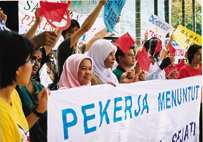
 Referring to the new situation, a prominent CUEPACS leader told a meeting that we are involved in collective begging.
