
|
|||||||||||||||
|
Workers make their voices heard May Day rally event a rousing success as police adopt low-key approach
Please support our work by buying a copy of our print publication, Aliran Monthly, from your nearest news-stand. Better still take out a subscription now. We also welcome donations.
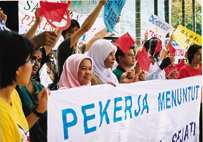
Saturday, 1 May 2004 It started drizzling a little at 10.30 am and that got some of us a little worried as we sat at a teh-tarik stall nearby contemplating the skies. But it was not enough to dampen the spirits of those who were trickling in for the alternative national May Day gathering for workers, held for the first time in Penang. That morning, we wondered if the police would try to set up road blocks to deter out-of-town workers from turning up at the Esplanade in full force. Though the organisers had informed the police that the event was taking place, we were not sure what to expect. By 11 pm, the first of the 30-odd buses from Perak, Kuala Lumpur, and Selangor started rumbling in. Excited grassroots workers and residents from marginalized communities poured out of the vehicles, relieved that they had made it without any hassle. As more buses arrived, the crowd at the Esplanade swelled to more than a thousand � organisers claimed up to 1,300 turned up � making this one of the best-attended May Day gatherings organised by grassroots network, Jaringan Rakyat Tertindas (JERIT) (Oppressed People�s Network) in recent times. This year�s theme was �Workers Demand Genuine Democracy� � meaning democracy at all levels including at the local level. Representatives of grassroots communities took centre-stage during the programme, while activists played a supporting role. The police maintained a discreet presence � a handful of uniformed police and some plainclothes personnel taking notes and photographs, and that was it. No riot police, no light strike force, no roadblocks, no confrontation with organisers � all this contributed to the lack of tension or �suspense� in the air. Young and old, Malays, Chinese, Indians and others, farmers, factory workers, plantation workers, evicted urban pioneers, youths, activists and other concerned Malaysians, they were all there with one purpose � to assert their rights as workers, as socially conscious citizens in a democratic society. Many had stories to tell: a shared experience of gradual empowerment, heightened awareness, prompting them to stake their claim and come out in the open in solidarity with other workers. Some sang songs of empowerment, others acted out skits depicting how workers broke free from the chains of exploitation and oppression, still others recalled the inspiring history of the worker�s movement and how May Day began in the United States. Tracing the Origins
It was said of the incident: �The workers asked only for bread and a shortening of the long hours of toil. The agitators gave them visions. The police gave them clubs.� The eight accused were charged with conspiracy: under conspiracy laws, labour unions were deemed to be illegal. The prosecution wanted to make examples of these activists to �save our institutions, our society.� All were found guilty. Four were hanged, one committed suicide in jail, and the remaining three were freed years later as a result of public disquiet over the flawed trial. A chill descended on the workers� movement and the next labour day was only observed in 1890. Parades, gathering and simultaneous demonstrations took place not only in US cities but also in major European industrial zones and in Cuba. Workers demanded guaranteed eight-hour workdays, and sought to raise awareness of the struggle for workers� rights all over the world. Since then, May Day has grown into an annual gathering, a day to take stock and re-energise workers to continue the struggle to promote their rights. This radical history of May Day has been largely ignored by the mainstream media, not only in Malaysia but even in the United States. But not today, when those present made their voices heard loud and clear. Different Voices An activist read out this year�s May Day Declaration, endorsed by 73 civil society groups, as the crowd pumped their fists and chanted their demands. Among the major demands were the introduction of a minimum wage, the repeal of oppressive laws and reforms to facilitate the formation of more independent unions. The declaration also called for fair treatment of migrant workers and the reintroduction of local government elections. A Chinese farmer from Perak lamented the loss of land that had affected the livelihood of farmers who had toiled the land for generations. �We do not have any paper qualifications,� he said, in a poignant moment as the crowd hung on to his every word. �But we know how to work the land and earn a livelihood from it. Now where do we go?� The Aliran Singers took to the stage, performing two songs: the anti-war protest song �Blowing in the Wind� and "Lagu Hari Pekerja" sung to the tune of �The Carnival is Over�, a song that the The Seekers made famous in 1965. Inilah Hari Pekerja Kita mesti bersatu Untuk rakyat dan negara Kita berganding bahu Kuasa di tangan pekerja Kita saling membantu Membina dunia baru Yang adil dan bersatu Chorus: Kita tidak boleh undur Kita tidak ragu Berjuang untuk keadilan Ke hadapan kita maju Loh Cheng Kooi of the Women�s Centre for Change addressed the crowd next, urging those present to uphold democracy in the family. �Husbands should participate more in helping their partners,� she said. �They need to lend a hand in household chores and in raising the family before fighting for workers rights.� She informed the crowd that the women�s groups had been lobbying for a draft Sexual Harassment bill, which they had submitted, to be adopted as law. Aliran exco member Sarajun Hoda Abdul Hassan spoke on behalf of the NGO movement. He highlighted several areas to improve workers� rights and called for stepped up efforts to wipe out corruption. He also recommended that bodies like the Ant-Corruption Agency and Suhakam should be freed from Executive influence. Calling for the backlog in Industrial Court cases to be cleared and for a reform of labour-related laws, he pressed the government to ratify all international declarations pertaining to labour. Representatives from Kumpulan Kemajuan Masyarakat (KKM), Sahabat Alam Malaysia and students� groups also spoke. The event ended with creative depictions of the workers' struggle by theatre groups linked to youth groups such as Food Not Bombs and Reactive. A youth group from Perak (Gabungan Pekerja Kilang dan Kesatuan) brought the event to a close with a rousing rendition of dikir barat, which extolled the workers� power to bring about change. Despite a slow start, they soon had the crowd on their feet as everyone joined in the singing and clapping with much gusto. Volunteers then served lunch packets to the multitude. Suaram's Choo Chon Kai told me that Ong Boon Keong (better known as Organic Ong), who had cooked and prepared the food for the huge crowd the previous day, had collapsed out of sheer exhaustion! By morning's end, the crowd appeared distinctly rejuvenated, fuelled by the sheer enthusiasm, spirit and energy on display. Credit to the police for allowing the people to show that peaceful assemblies are not a bad thing at all. On the contrary, gatherings like this provide a positive democratic outlet for legitimate dissent and allow the people�s voices to be heard. Hidup Pekerja! Hidup Perjuangan Pekerja! Now e-mail us and tell us what you think. Your comments might be published in the Letters section of our print magazine, Aliran Monthly. Alternatively, post your comments to the message board. | |||||||||||||||

 We do not have any paper qualifications...but we know how to work the land and earn a livelihood from it. Now where do we go?
